

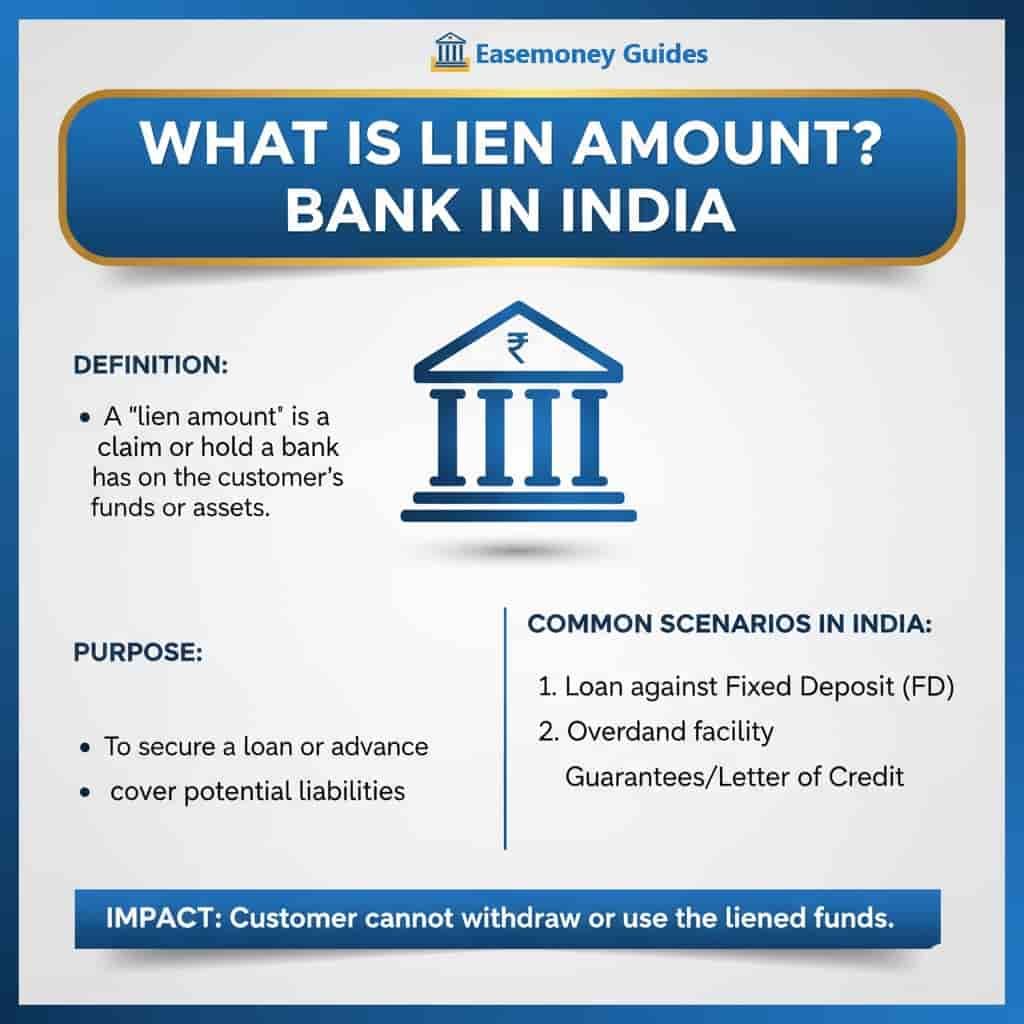
A lien marked amount means the bank has temporarily blocked part of your money for a specific reason.
You can still see the balance in your account, but that particular amount cannot be used for withdrawal, UPI, ATM cash, transfers, or purchases until the bank removes the hold.
The blocked money still belongs to you — it is not permanently deducted. Once the issue is solved, the lien amount is automatically released back into your usable balance.
📌 Real-Life Example of a Lien
Lien Amount: ₹2,000
Available Balance: ₹23,000
💡 Human Tip: Most lien amounts are caused by overdue EMIs, IPO applications, failed ECS payments, minimum balance charges, or temporary fraud/security checks. In many cases, the hold gets removed automatically after settlement.
⚠️ Important: If the lien remains even after clearing dues for several days, contact your bank immediately and ask for the exact lien reason code or hold status.
📌 Banking Complaint Help:
📖 Read below: Bank-wise lien balance overview, and common reasons behind hold amounts.
Bank-Wise Lien Balance Overview
Here’s a quick look at how major Indian banks handle lien balances and their typical removal times:
| Bank | Where It Shows | Removal Time |
|---|---|---|
| SBI | YONO app or NetBanking | 24h – 7 days |
| HDFC Bank | Statement in the mobile app | 24h – 5 days |
| ICICI Bank | iMobile and Customer Care | 1 – 7 days |
| Axis Bank | Axis Insta help portal | 2 – 5 days |
| Kotak Mahindra Bank | Kotak netbanking and help centre to resolve | 2 – 7 days typically |
| Bank of Baroda | NetBanking / Branch | 3 – 10 days |
Tip: Always first check and confirm your “Available Balance” — not just your “Total Balance” — before making any payments.
Common Reasons for a Lien Amount in Bank Accounts
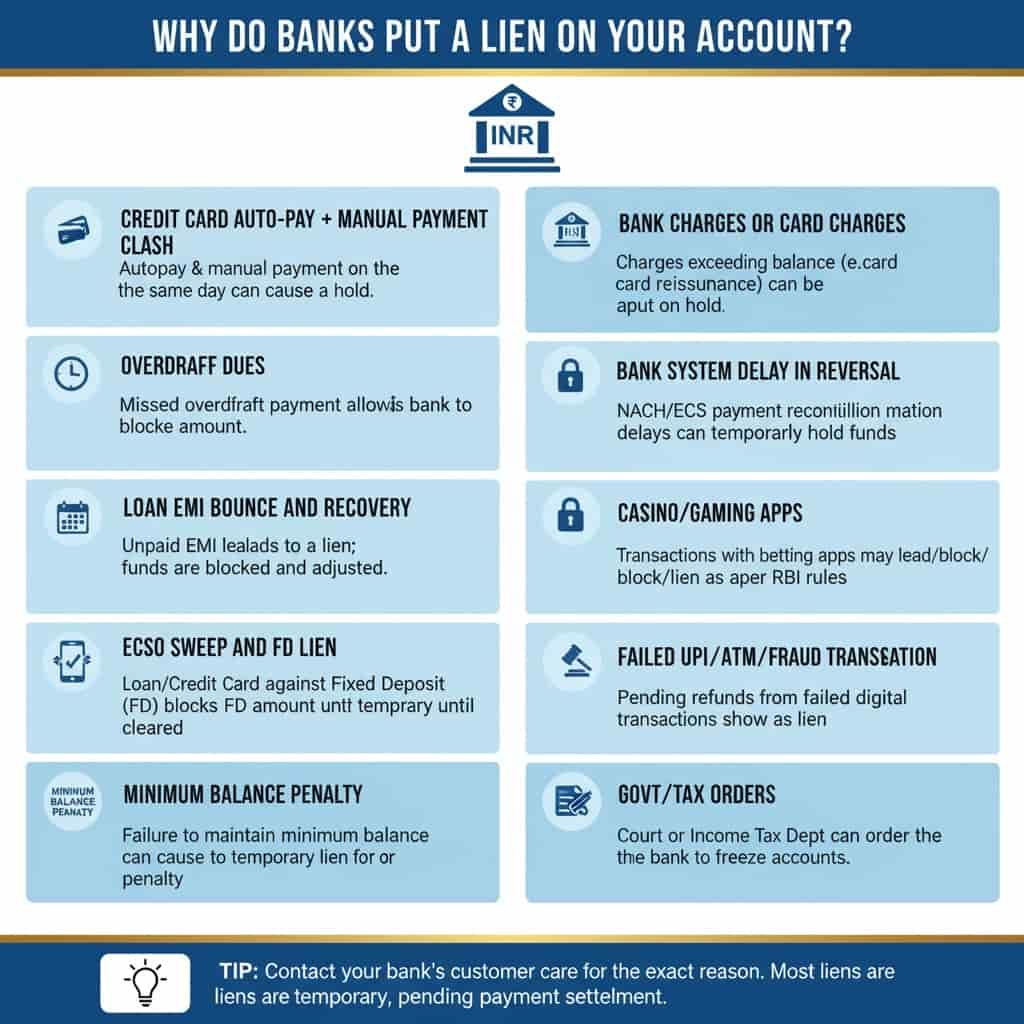
1. Credit card Auto-Pay + Manual Payment Clash
- If you pay manually on the due date.
- Autopay still triggers on the due date = it clashes, and the bank finds that your autopay has not been settled. So, put your savings amount into a lien.
2. Overdraft Dues
- If you linked your savings account to an overdraft facility and missed the payment, the bank can automatically block that due amount.
3. Loan EMI Bounce and Recovery
- If EMI is not paid on time, your bank may mark a lien on your account.
- Your funds are blocked and later adjusted for dues.
4. ECS Bounce or Auto Debit Failure
- If you an any active Auto-debit facility on your account, but when the due date it fails for any reason, such as insufficient balance, the bank may temporarily block the amount to ensure the next debit succeeds.
5. Auto Sweep and FD lien
- If you take a loan or a credit card against your FD, the FD amount is counted as a lien.
- Cannot break it until the loan is cleared.
6. Minimum Balance Penalty and charges
- Some banks place a temporary lien if the required monthly balance is not maintained.
- After money is deposited, the bank deducts the penalty amount automatically.
- The lien usually gets removed after recovery is completed.
7. Bank Charges or card charges
- If your account balance is lower than pending service charges, the bank may place the amount under lien or hold.
- Charges can include debit card reissue, cheque book request, passbook replacement, or physical statement fees.
- Once money is added to the account, the bank recovers the charges automatically.
8. Bank System Delay in Reversal
- Sometimes NACH or ECS auto-payments take time to update in the banking system.
- Even if you already paid manually, the amount may remain under lien for 2–3 working days during reconciliation.
- In most cases, the lien is removed automatically after settlement.
9. Casino/gaming apps
- If you linked your account with any type of betting apps, the RBI have very strict guidelines for that.
- If you transact there, the bank may block/lien that amount, sometimes freeze your account.
10. CyberCrime and Fraud prevention
- Rare, but if your bank finds any suspicious transactions, the bank can freeze your account and put a lien mark.
11. Failed UPI/ATM/POST transaction
- In most cases, when you swipe your card or do just QR scan via UPI, if payment fails but your money is blocked.
- It may show as a lien until the refund happens.
12. Govt/Tax orders
- In rare cases, the income tax department or court may order the bank to freeze your account and place a lien on the balance.
- This usually happens during legal investigations or disputes.
- The lien is removed only after official clearance or legal settlement.
Tip: The exact lien reason can differ, so contact your bank for confirmation. In most cases, the amount is temporarily on hold due to pending charges or transaction settlement and gets released automatically after processing.
Do You Need to Pay the Lien Amount?
A lien does not always mean you have to pay money. It depends on the type of lien placed on your account. Here are the common lien situations:
1. Temporary and system-related lien
- Auto-pay + manual payment failure.
- Slow settlement delay
- Someone put money in your account due to the wrong account number (in this case, you will see that amount, but you cannot use it)
- Cyber fraud
- Suspicious complaint under review.
Here, you don’t have to pay anything. The bank will release or refund your lien after settlement and will have completely processed the investigation.
2. Due/obligation related
- Missed EMI or loan Dues
- Pending credit card bill after the due date
- Minimum balance penalty
- Bank charges on product – debit card, cheque bounce, withdrawal fee, and failure of NACH.
Here, this situation counts as a bank funds recovery lien; the bank has already blocked the money to adjust dues. If you don’t pay, the bank will use the lien amount to recover.
How to Remove a Lien Amount from any bank
- Check the reason – Open NetBanking/mobile app, check SMS/email alerts, or contact customer care to know why the lien was applied.
- If it is a system hold – For failed payments, auto-pay delays, or settlement issues, wait 2–5 working days. You can also raise a complaint ticket for faster review.
- Clear pending dues – If the lien is due to EMI, credit card bill, minimum balance penalty, or bank charges, first clear the pending amount.
- Check legal notices – For GST, court, cybercrime, or income tax holds, clear the issue with the authority and submit proof to the bank.
- Contact the bank – Call customer care, email support, or visit the branch if the lien still remains.
- Wait for confirmation – After verification, the bank removes the lien and the amount becomes usable again.
Read: Steps To remove Lien Amount from Bank Account
When Will the Lien Amount Be Credited Back?
Usually, a lien amount is settled within 1–7 working days after the issue is resolved. In legal or fraud-related cases, it may take longer.
| Reason | Expected Time |
|---|---|
| System error or slow payment settlement | 48 hours to 5 working days |
| Loan EMI or credit card payment | Up to 3 working days after payment |
| Negative balance or unpaid bank charges | Around 48 hours after deposit adjustment |
| Legal, cyber fraud, GST, or court-related hold | Up to 15 days or sometimes longer |
FD-Based Lien (Fixed Deposit Lien)
A lien does not just work only on your savings account, but it can also be set on fixed deposits. This usually happens in two cases:
- Loan or overdraft against FD: If you take a loan on your FD amount, the FD itself is marked with a lien as security. You will continue earning interest on that, but you cannot prematurely withdraw or break the FD until the loan is repaid.
- Credit card issued against FD: If you have a secured credit card based on your FD. In such cases, a portion (say 75-85%) of your FD is marked under lien. If you default on your card bill, the bank can recover the dues directly from that lien.
Example:
- FD amount: ₹1,00,000
- Credit card issued: ₹80,000 limit
- Lien marked: ₹80,000 on FD
You still own the FD, but you cannot close or withdraw the lien amount until your dues are settled.
What happens if the lien balance is not paid?
- For Loan/EMI/Cards – You Bank will use your lien amount to adjust the outstanding. Your credit score drops, + late fees + recovery notices for the remaining balance.
- Temporary lien – it will adjust as per the bank’s timeframe; you don’t need to do anything, no credit score impact.
- Penalty and charges – for just a minimum balance penalty, banks usually don’t go legal, but for big loans, they take legal action only. If you try for a loan in future, if your account is linked with PAN, you may find difficulties.
Frequently Asked Questions
Can a lien amount affect my UPI payments?
Yes, your blocked amount will not work on UPI and any other payment mode.
How Lien Works When the Account Has a Zero Balance?
Even if your account has a ₹0 balance, a lien still exists in the bank system. Suppose you have ₹1,400 due for loan EMI It’s like a note in the system: “Once money is deposited, collect ₹1,400.”
Lien vs Hold – Are They the Same?
In most day-to-day banking situations, “lien” and “hold” mean the same thing: money that is temporarily blocked by the bank. The simple difference is that a lien is a legal term, and hold is used as an operational result.
Can a lien be placed even if I didn’t take out any loans or credit cards?
Yes. Around 40–50% lien cases come from charges, failed autopay, or system holds. Tip: Don’t assume loan issues—always ask customer care for the exact lien reason code.
Why does my balance show money, but every transaction fails?
Because banks show the total balance, not the usable balance. A lien reduces “available balance.” Many users miss this and think the app is faulty. Always check the “withdrawable” or “available” amount.
Does the lien automatically disappear if I ignore it?
Sometimes yes, mostly no. System-related liens clear in 2–5 days. Recovery or charge-related liens stay active until adjusted. Ignoring them delays access and may trigger auto-debit later.
Can banks recover lien money without my consent?
Yes, legally. Under banker’s general lien rights, banks can auto-adjust dues once funds arrive. That’s why lien amounts sometimes reduce silently without debit alerts.
Will a lien affect my credit score directly?
The lien itself doesn’t hit CIBIL. But if it exists due to missed EMI or card dues, those underlying delays are reported. Tip: clear dues first, then request lien removal proof.
How long should I wait before escalating a lien issue?
If the lien doesn’t clear in 5 working days after payment or clarification, escalate. First customer care, then nodal officer, then RBI CMS. Waiting silently is the biggest customer mistake.
What’s the safest way to prevent lien issues in future?
Maintain minimum balance, avoid manual + autopay overlap, track EMIs, and review account charges quarterly. One small missed fee often creates unnecessary lien confusion later.
Hope you liked the content. Explore smart options below 👇
🔥 Recommended