

A cheque number is a unique serial number printed on every cheque leaf in your cheque book. It helps banks identify, verify, and track one specific cheque transaction.
If you are new to cheque banking, first understand how a cheque works in India .
📌 Key Understanding About Cheque Number
✅ Quick Insight: A cheque number can be used only once. Even if the amount or payee changes, the banking system still tracks the cheque mainly through this unique number.
⚠️ Important: The cheque number itself does not expire, but the cheque leaf usually becomes invalid after 3 months from the written date.
📖 Read below: Where to find cheque number, cheque number vs MICR, and how banks track cheque transactions in India.
How to Find the Cheque Number Easily
Finding the cheque number on your leaf or in your book is simple once you know what to ignore.
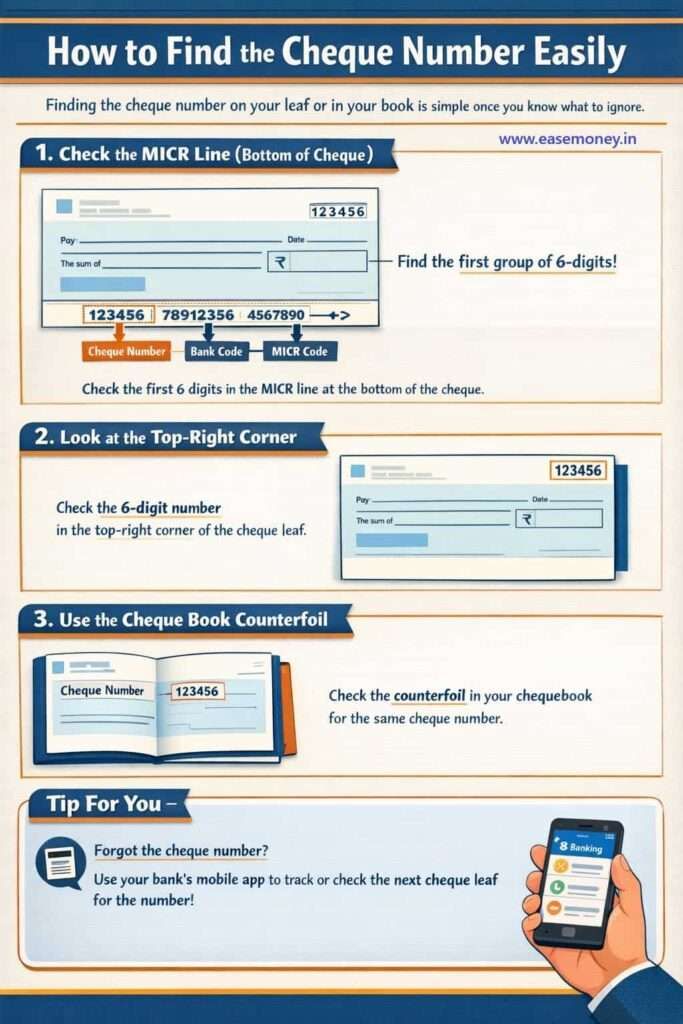
Step 1: Check the MICR line (bottom of cheque)
- Look at the bottom white strip of your cheque leaf. You will see a line of digits printed in a unique magnetic ink font.
- The first group of 6 digits enclosed in double quotes is your unique cheque number. It appears right before the 9-digit MICR code.
Step 2: Look at the Cheque Book Counterfoil
- If you have already issued or torn out the cheque leaf, look at the counterfoil (the record-slip page) at the beginning or side of your cheque book.
- Most Indian banks print a tracking table here containing pre-printed serial numbers that match your cheque leaves perfectly.
Step 3: Track Issued Cheques via Mobile Banking
- If you do not have your physical cheque book nearby, log into your bank’s official mobile application or net banking portal.
- Navigate to the “Cheque Status” or “Account Statement” section to view the specific 6-digit cheque number associated with any cleared, pending, or stopped transaction.
💡 Tip: If you forget the cheque number after submitting the cheque, you can check it later in your mobile banking app or use the next cheque leaf number in your cheque book to estimate it.
Decoding the Bottom Line of a Cheque
The bottom row contains separate identifiers critical for automated sorting and truncation systems:
- First 6 Digits: The Cheque Number.
- Next 9 Digits: The MICR Code, which identifies the specific city, bank, and branch layout.
- Following Digits: The account number or transaction code required by the clearing house.
Cheque Number vs MICR Code
Many people think the cheque number and MICR code are the same, but both are different.
- The cheque number is a unique 6-digit number used to identify one cheque leaf. It helps banks track cheque payments, stop cheque requests, and cheque records.
- The MICR code is a 9-digit bank branch code printed at the bottom of the cheque. Banks use it for cheque sorting and clearing.
| Feature | Cheque Number | MICR Code |
|---|---|---|
| Length | 6 digits | 9 digits |
| Purpose | Identifies cheque leaf | Identifies bank branch |
| Position | Bottom left | Next to cheque number |
| Changes? | Changes on every cheque | Same for same branch |
History and Evolution of Cheque Numbers in India
Cheques existed in India even before independence, but cheque numbering was not always central at first.
- Before the 1950s: All the cheques went through Manual ledgers, and there was minimal reliance on numbers.
- 1960s–1970s: Growing use of serial numbers
- 1980s: Public sector expansion made numbering important
- Late 1990s: MICR clearing increased dependency, this push the all cheque number system in real.
- Early 2000s: Core banking systems made cheque numbers mandatory, this is the final stage when cheque numbers became too important for track or identity.
- 2010 onwards: CTS made cheque numbers digitally critical
From this point, a cheque without a valid number effectively became unusable.
When a cheque number is required in daily life
A cheque number is really important when money via cheque needs to be traced, stopped, proven, and disputed. This is everyday work and required at these stages for you and your bank.
- To track cheque payments
- For cheque return/bounce reference
- For bank records and dispute resolution
- If you lose a cheque or change your mind, your bank will require the cheque number to stop payment only that leaf.
- Banking forms, such as sometimes it require Refund processing.
- When you fill out the deposit slip at the branch, it must be required.
- Needed while filling a request or generating complaints.
How Banks Track Cheque Transactions in India
- Cheque Scanning – When a cheque is deposited, the bank scans the cheque image and reads details like cheque number, MICR code, amount, and signature.
- Digital Transfer – Under CTS (Cheque Truncation System), the physical cheque usually does not move between banks. Only the digital image and data are sent for clearing.
- Verification Process – The paying bank checks signature, account balance, cheque status, and other security details before approving payment.
- Positive Pay Security – For cheques above ₹50,000, many banks ask customers to pre-submit cheque details through mobile banking to reduce fraud and fake cheque risks.
What Are the Other Numbers Printed on a Cheque?
A cheque leaf contains multiple banking numbers besides the cheque number. Each one has a different purpose in cheque processing and banking verification.
1. Cheque Number
- Usually 6–7 digits
- Unique for every cheque leaf
- Printed at the top-right corner and bottom line
2. Account Number
- Linked to your bank account
- Shows where money will be debited from
- Usually printed near the signature area
3. MICR Code
- 9-digit magnetic code
- Identifies bank and branch
- Printed at the bottom of the cheque
4. IFSC Code
- Used for NEFT, RTGS, and IMPS transfers
- Printed near the bank branch address
5. CIF Number
- Customer identification number
- Mostly available on cheque book cover or first page
- Not printed on every cheque leaf
Frequently Asked Questions
How to confirm a cheque number?
The safest way for you is to match the top-right number with the counterfoil or MICR line. If all three align, that cheque number is correct and uniquely tied to your account.
What does “VOID” mean on a cheque?
“Void” means the cheque’s payment permission is cancelled, not its identity. The cheque number, account details, and MICR remain valid for verification and KYC purposes.
Is a cheque number always 6 digits in India?
Mostly yes, but not always. Indian banks commonly use 6 digits, while some newer cheque books use 7-digit numbers. RBI mandates uniqueness, not a fixed length.
Can two cheques have the same cheque number?
Yes across different banks, but never within the same bank system for the same account. Internally, each cheque number is mapped uniquely and cannot repeat.
What happens if I write the wrong cheque number on a deposit slip?
The bank may fail to trace your cheque, delay processing, or ask for clarification. Wrong cheque numbers don’t move money, but they definitely slow resolution.
Does a cancelled cheque still have a cheque number?
Always. Cancellation only blocks payment. The cheque number still exists and is often the reason cancelled cheques are accepted as proof of account ownership.
Can I stop payment without knowing the cheque number?
You can, but it’s risky. Without the exact cheque number, banks may block a wider range, or ask for written confirmation to avoid accidental misuse.
How to Get the HDFC or SBI cheque number?
State Bank of India and HDFC cheque numbers are usually 6 digits, printed clearly on the bottom of the cheque and in the MICR line with white background, it almost same as other banks do.
Hope you liked the content. Explore smart options below 👇
🔥 Recommended