In 2026, finding a credit card with truly uncapped rewards on insurance payments is almost not possible. Earlier it was easy, but now banks changed rules to control high-value spending.
Unlike before, major banks like HDFC, ICICI, Axis, even Amex, have added strict monthly caps or limits on reward earning. So even if you pay large premium, rewards stop after certain amount.
- But still, some cards stand out in practical use.
- They may not be fully unlimited, but they give higher caps, milestone benefits, or smart reward structure depending on how you make payment.
So real situation is this — no card is truly uncapped now, but few cards still give better value if used in right way.
Top Credit Cards for Insurance Payments For You
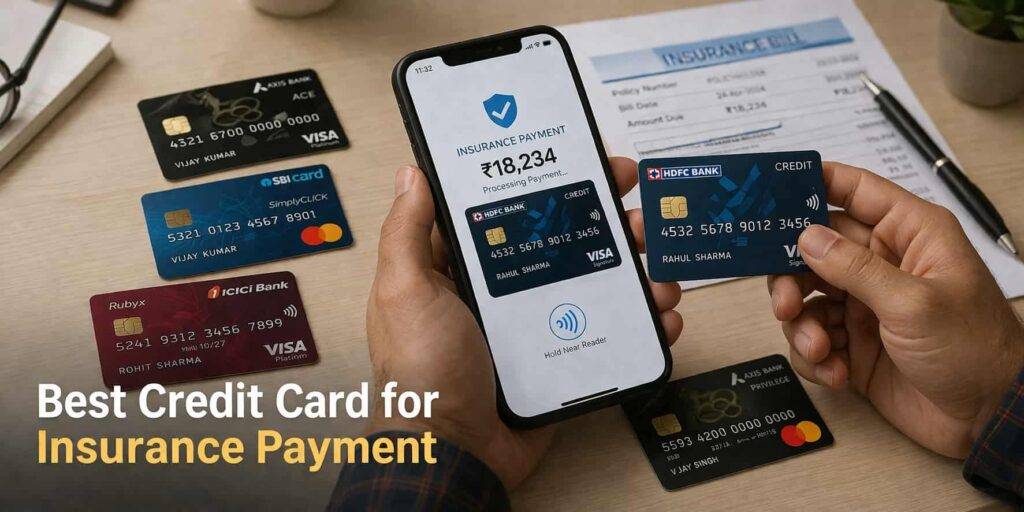
Paying insurance premium with credit card in 2026 can be useful, but depends how you use it. It gives rewards, some cashback, and also some extra time for payment through billing cycle.
But issue comes with convenience fee, not insurance itself. Many platforms like Amazon Pay, Paytm, Phonepe or insurer portal charge around 1% to 2% fee, and GST also applies on that fee.
For example, if premium is around ₹1,00,000:
- Fee (1%) → ₹1,000
- GST on fee (18%) → ₹180
- Total payment → ₹1,01,180
Now if your card gives only 1% reward (~₹1,000), you still lose ₹180.
Insight: As per financialservices.gov.in September 22, 2025 (extending into 2026), life and health insurance premiums are GST-free, but GST still applies on convenience fee charged by payment platforms if use a credit card, which is where actual extra cost comes.
So correct card selection matters — rewards should be higher than total fee. Below we find few top recommended cards that may save rewards and cashback for you.
1. HDFC Bank Infinia (Metal Edition)
If you are looking for number 1 card for high-value insurance payments, then HDFC Infinia (Metal Edition) is still top choice in 2026. Many cards reduced rewards, but this one still giving strong value.
Why It Works Better Than Others
- Reward rate: 5 RP per ₹150 (~3.33% value when used for flights/hotels)
- Monthly cap: 10,000 points
- Full benefit till around ₹3,00,000 spend per month
- Milestone advantage: Insurance spend counts in ₹10 lakh yearly target → ₹12,500 fee waiver possible
- No redemption charges: You can use points on SmartBuy without extra fee
Unlike most cards where rewards stop early, here limit is still high enough for big premium users.
Fee Reality (Where Most People Go Wrong)
Even with this card, payment method matters a lot.
- Best option → HDFC BillPay (safe, proper reward credit)
- Third-party apps → may charge 1%–2% fee + 18% GST
Example on ₹1 lakh premium:
- Total fee → ~₹1,200
- Reward earned → ~₹3,330
- Net benefit → ~₹2,100
So yes, still profitable, but only if you track fees properly.
Pro Tip for Large Premium Users
If your premium is high like ₹5 lakh:
- Pay ₹2.5 lakh at month end
- Pay ₹2.5 lakh next month start
This way you avoid monthly cap issue and still earn full rewards across two cycles. Many users miss this trick.
Ground Reality (Important)
This card is not openly available. It is invite-only, usually given to high-income users or strong HDFC relationship holders. You can’t just apply normally.
If You Don’t Have Infinia (Practical Option)
(a.) HDFC Regalia Gold – “Mini Infinia”
- Reward: Still, You will get 4 RP per ₹150 (~1.3%)
- Key point: Insurance spend counts fully toward milestone rewards
- Example → ₹1.5 lakh spend can give ₹1,500 voucher
- Eligibility: Easier, around ₹1 lakh monthly salary or existing HDFC user
Tip for You: Nowdays, best card alone is not enough — how you split payment and where you pay makes real difference.
2. Tata Neu Infinity HDFC Bank Credit Card (RuPay)
This card comes at position #2 mainly because it gives very high 5% value back, but only till a limit. Unlike Infinia, here earning stops early, so big spend users don’t get full benefit.
Why It is #2 (The 5% Trap)
- Reward rate: 5% (NeuCoins) looks very high
- Monthly cap: Max 2,000 NeuCoins/month
- Actual limit: Full 5% only till ₹40,000 spend
- If you spend ₹1 lakh → still only 2,000 coins (~2%)
So yes, percentage is high, but earning stops quickly, that’s why it stays below Infinia.
How to Save & Maximize Rewards
- Use only Tata Neu App
- Go → Pay Bills → Insurance
- Direct insurer website gives only ~1.5%
- Avoid UPI payments
- Even though RuPay supports UPI, rewards drop (around 500 coins cap)
- Always select credit card option
- Split payment smartly
- Example: ₹80,000 premium
- Pay ₹40K this month + ₹40K next month
- You can earn 4,000 coins instead of 2,000
- Use coins properly
- 1 NeuCoin = ₹1
- Best use on BigBasket, Tata 1mg, Croma (real saving)
Important Check
- Your insurer must be listed inside Tata Neu bill section
- If not listed, you won’t get 5% benefit
This card is best for medium spend users, but for high premium, cap becomes biggest limitation.
3. PhonePe SBI Select Black Credit Card
This card comes at position #3 because it gives the highest reward rate (10%), but only for small payments. After that, cap and fees reduce real benefit.
Why It is #3
- Reward rate: 10% (10 points per ₹100) on PhonePe
- Monthly cap: Max 2,000 points
- Spend limit: Full benefit only till ₹20,000/month
- Fee issue: PhonePe charges around 1%–2.3% + GST
So actual return becomes around 7%–8%, still good, but only for smaller premiums.
How It Helps Compared to Others
- Better for small payments
- ₹20K premium → ~₹2,000 reward
- Tata Neu gives only ₹1,000
- Flexible redemption
- 1 point = ₹1 (direct statement credit)
- Unlike NeuCoins, no brand restriction
- Extra benefits
- 5% rewards on many online brands
- 4 domestic lounge visits + Priority Pass
Real Profit Comparison
- ₹20,000 → ~₹1,600 profit (after fee)
- ₹40,000 → ~₹1,200 (cap hit)
- ₹1,00,000 → ~₹600 (fees reduce value)
So this card works best for low premium users, but for high payments, cap and fees reduce benefit quickly.
4. Amazon Pay ICICI Bank Credit Card
This card sits at #4 position because it is simple and reliable. It doesn’t give high % like others, but it works every time without confusion or limits.
Why It Stays at #4
If we talk straight math:
- SBI PhonePe → high return (~7–8% after fee)
- Tata Neu → decent (~3–4%)
- Amazon ICICI → around 0.8% net
- With the Amazon Pay ICICI card, even if you pay directly on the insurer’s website (outside the Amazon app), you still get 1% unlimited cashback. It’s the ultimate “fallback” card.
So yes, for small payments, you are earning less here. That part is clear.
But Here’s Where It Actually Wins
- No cap problem = Other cards stop giving rewards after ₹20K–₹40K. But here, even ₹5 lakh payment → you still get cashback on full amount.
- No confusion system = No biller add, no app restriction, no tracking limit. Pay and get cashback, simple.
- Real cashback, not points = 2% via Amazon Pay, 1% direct website. Comes as balance, usable directly
- No cost card = Lifetime free, so even if you use once a year, no issue
Real Example
If you pay ₹1 lakh:
- Fee → ~₹1,180
- Cashback → ₹2,000
- Final → ~₹800 profit
Not huge, but safe and consistent.
When This Card Makes Sense
- If premium is above ₹1 lakh
- If other cards hitting cap
- If you don’t want to track rules
5. HSBC Premier Credit Card For Insurance Payments
This card is still one of the strong options for insurance in 2026. Not flashy like 10% cards, but gives solid and stable 3% return, and cap is also better than most cards.
Insurance Reward Structure
- Reward rate: 3% value-back (3 points per ₹100)
- Monthly cap: Rewards valid on ₹1 lakh combined spend
- Includes insurance, utilities, tax, education
- Point value: 1 point = ₹1 (for Apple or travel partners)
Why It Works Well for Insurance
- Good net return = Platform fee is around 1.18%, but card gives 3% → Net profit comes around 1.8%
- Higher usable limit = Tata Neu stops at ₹40K, but here you get full reward till ₹1 lakh spend. So better for medium to high premium users
- No expiry issue = Points don’t expire, so you can collect over time and use later for big redemption
Fees & Eligibility (Reality Check)
- Joining fee: ₹12,000 + GST
- Annual fee: ₹20,000 + GST
- Waived if you maintain Premier status
Eligibility:
- ₹50 lakh TRB (₹40 lakh for older accounts)
- OR ₹3 lakh monthly salary
- OR ₹1.15 crore home loan relationship
So overall, this card is not for everyone. But if you already fall in Premier category, then for insurance payments, it gives clean, stable return without overthinking caps.
- Tip: Use this for up to ₹1 lakh premium monthly to get full value.
- Insight: This card is not about high %, it is about balance — decent reward + higher usable limit + no expiry pressure.
LIC Co-Branded Credit Cards – Best for LIC Premiums
If your premium is LIC insurance only, then these co-branded cards make more sense. Reason simple — they still give uncapped rewards for LIC payments, which is rare now.
Top LIC Cards
- IDFC FIRST LIC Select Credit Card (Best Value)
- 10X points on every ₹125 spent
- Effective return ~2% (1 point = ₹0.25)
- Lifetime free
- No cap on LIC rewards (if paid via LIC website)
- Extra: Domestic + railway lounge, roadside assistance
- LIC Axis Bank Signature Credit Card (Travel Focus)
- 2 points per ₹100 (~2% value)
- Lifetime free
- No cap on LIC premiums
- Extra: 8 domestic lounge visits/year + fuel benefits
- IDFC FIRST LIC Classic Credit Card (Basic Option)
- 6X points (~1.2% value)
- Lifetime free
- Extra: 4 railway lounge visits/quarter + basic cover
Important Rules (Don’t Miss)
- Pay via LIC website only = Third-party apps like PhonePe, GPay, Amazon Pay usually give only base ~1%
- Point validity = Axis LIC → ~12 months and IDFC LIC → up to 3 years
- Check convenience fee = It usually 0.5%–1.5%, so make sure reward is higher than this
So if your main spend is LIC, these cards are very straightforward — no cap tension, just pay and earn.
Insight tip: These cards are niche, but for LIC users they give more stable value than most premium cards today.
Why Insurance Payments via Popular Credit Cards Don’t Give Rewards
Most credit cards have reduced or removed rewards on insurance. Earlier it was easy, but now banks changed rules because this category is not profitable for them.
Main Reasons Behind This
- Low earning for banks (MDR issue) = Banks earn around 0.5% or less from insurance payments. But if they give you 2–3% cashback, they go in loss.
- System misuse (real problem)
- Some users buy big policies, earn rewards, then cancel in 15-day free-look period
- Agents sometimes use their own cards to pay for many clients just to collect points
- MCC 6300 block = Insurance payments come under this code. Many banks like Axis, ICICI directly give zero rewards on this category
- Platform fees reduce value = Apps like PhonePe, Amazon Pay charge 1%–2.3% + GST. So even if reward comes, profit becomes very low or zero
Where You Still Get Value
Even if direct rewards are zero, insurance spend still helps in:
- Milestone benefits = Example: Spend ₹4 lakh → fee waiver or voucher
- Cards like Amex Platinum Travel, HDFC Regalia Gold use this system
So situation now is simple — banks stopped daily rewards, but still using insurance spend for long-term benefits.
Tip: Don’t expect cashback, use insurance spend to hit milestones.
FAQs
Which is the best credit card for insurance payment in India?
In 2026, HDFC Infinia is top for high premiums, giving ~3.3% return till ₹3 lakh/month. For normal users, Tata Neu or Amazon ICICI works better depending on spend size.
Can I pay insurance premium without charges using credit card?
Mostly no. Platforms charge around 0.5%–2% fee + GST. Only some bank bill pay options reduce charges, but completely zero fee cases are very rare now.
Which card gives highest cashback on insurance payments?
PhonePe SBI Select Black gives up to 10%, but only till ₹20,000 monthly. After cap, real return drops. So high % looks good, but limit reduces total earning.
Which credit card is best for health insurance premium?
For health insurance, Tata Neu Infinity gives 5% till ₹40K, but if premium is high, Amazon ICICI or HSBC Premier works better due to higher usable limit.
Is SBI credit card good for insurance payments?
Yes, but only specific cards like SBI PhonePe Select Black OR SBI Cashback Card. Normal SBI cards mostly give low or zero rewards due to MCC 6300 restriction on insurance category.
Why some credit cards give zero rewards on insurance?
Banks earn very low commission (~0.5%) from insurance. Giving 2–3% cashback causes loss, so many banks blocked rewards or added caps from 2024–2026 updates.
Hope you liked the content. Explore smart options below 👇