💳 Credit Card Late Payment Calculator
📊 Charges Estimate
📉 Credit Score Impact
⚠ Calculator Assumptions
Minimum Due: Usually 2–10% of statement balance.
Interest: Estimated ~3.5% per month.
Grace Period: Banks usually allow ~3 days.
Credit Reporting: 30+ days delay may affect CIBIL score.
You open your credit card SMS and see ₹900 charge. You think bank added mistake. But actually payment date passed, and now late fee + interest both started.
How to Use This Late Payment Charges Calculator
Using this tool is very simple — hardly one minute. You don’t need any banking knowledge. Just enter your bill details, and it shows what the bank will likely charge you.
1 Step – Select your credit card bank
First, choose your issuing bank from the dropdown. Different banks have different penalty slabs, so this matters. If you select the wrong bank, the estimate can differ a little.
2 Step – Enter your total bill amount (₹)
Put the full outstanding shown on your statement, not what you plan to pay. For example, if your statement shows ₹18,420, simply enter ₹18,420 — not ₹2,000 or the minimum due.
3 Step – Add how many days you paid late
Count actual calendar days after the due date. Even a 1–2 day delay can trigger charges, but within a few days, banks sometimes allow reversal. Still, interest calculation may start.
4 Step -Select Minimum Due Paid or Not
- This is very important.
- If you paid MAD → usually no late fee, but interest runs.
- If you did not pay MAD → late fee + GST + interest + possible CIBIL impact.
5 Step – See the instant result without tapping the button
- The calculator will estimate:
- late payment fee
- GST on the fee
- interest cost
- possible credit score risk
This tool follows the latest bank slab structure, so you can understand the real extra cost early and act before the bill becomes a bigger burden.
Quick Example: Let’s suppose: Your Card Bill = ₹15,000, and you paid 7 days late. Minimum due not paid. You may see roughly: late fee around ₹900 + GST + about ₹500 interest. So a small delay can quietly add ₹1,400+ extra in just one billing cycle.
What Happens After You Miss a Credit Card Due Date?
Missing one due date doesn’t damage everything immediately. It usually happens step-by-step. You can still control it early, but if you ignore it, the problem grows quietly.
Phase 1: The First 3 Days (Grace Period)
If you realise quickly, you can still fix it. As per RBI rules, Banks usually don’t report to CIBIL immediately. If you pay within about 3 days after the due date, banks normally shouldn’t treat you as a defaulter.
You can avoid the flat late fee, but interest may still start from the transaction date. Like: you forgot the 10th and paid on 12th — mostly safe. But don’t rely on this regularly, as it can trigger your profile.
Phase 2: Immediate Charges start (Days 4–30)
Now the system fully activates.
- Late fee added (up to ~₹1,300 depending on bill)
- Interest starts at around 3.5% per month on the whole balance
- 18% GST applies on fee and interest
Unlike a loan EMI, credit card interest is daily running. You can pay ₹1,000, but the remaining amount keeps growing quietly.
Phase 3: Impact on Credit (After 30 Days)
If you still don’t clear at least the minimum due:
- Bank reports “30 days past due” to CIBIL
- Score may fall 50–100 points
- The card may get temporarily blocked
This is where future loan problems start. Even personal loan approvals can become difficult.
Phase 4: Serious Default (90+ Days)
If ignored for months:
- Account becomes default/NPA
- Recovery calls begin
- Card permanently cancelled
- Records can stay in the report up to 7 years
So you can miss a date once, but you shouldn’t ignore it. Early payment = small damage, but long delay = long memory in credit history.
What are Credit Card Late Payment Charges?
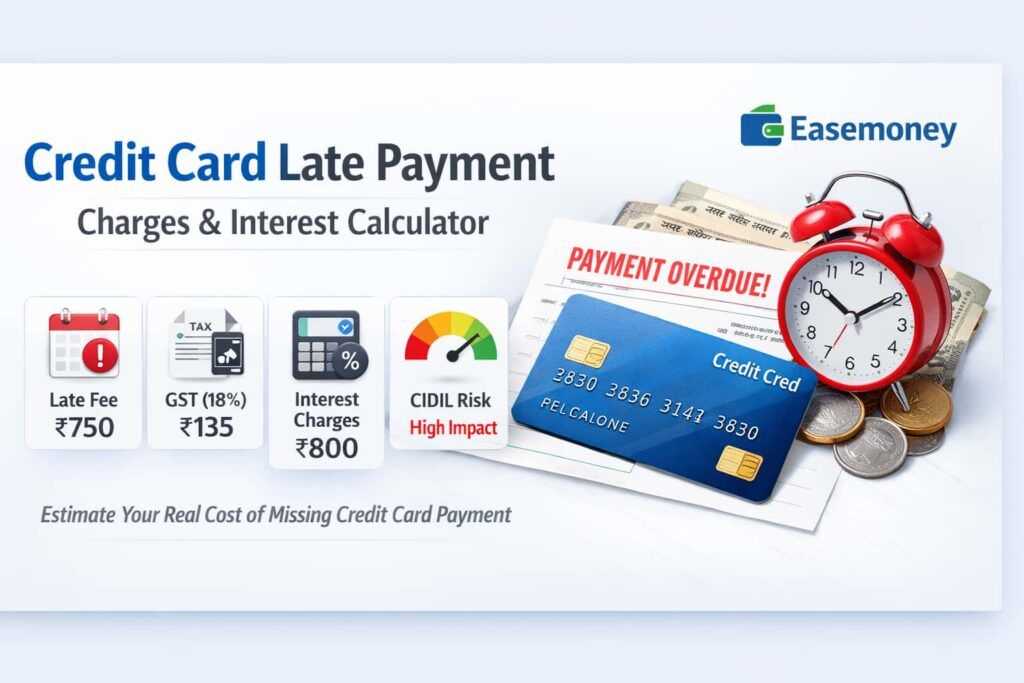
Late payment charges are the penalty fees banks add when you miss your credit card due date and do not pay at least the Minimum Amount Due (MAD).
In simple words — the bank gave you a billing date and you didn’t pay the minimum by that date, so the system automatically fines you.
This is not a random charge. In India, banks follow RBI card rules, so fees are slab-based and depend on your Total Amount Due (TAD) — the bigger the bill, the bigger the penalty.
And remember: the late fee is only the first part. After that, GST and interest also start.
Typical Late Payment Fee Slabs (Most Banks – 2026)
| Total Outstanding Bill | Late Payment Charge |
|---|---|
| Up to ₹100 | Nil |
| ₹101 – ₹500 | ₹100 |
| ₹501 – ₹1,000 | ₹400 – ₹500 |
| ₹1,001 – ₹5,000 | ₹500 – ₹600 |
| ₹5,001 – ₹10,000 | ₹750 |
| ₹10,001 – ₹25,000 | ₹900 – ₹950 |
| ₹25,001 – ₹50,000 | ₹1,100 |
| Above ₹50,000 | ₹1,300 |
After this, 18% GST is added, and monthly interest (around 3.4%–3.8%) begins separately.
Top 10 Banks Late Payment Charges (2026 Approx.)
| Bank | Lowest Slab | Highest Slab | Special Note |
|---|---|---|---|
| HDFC Bank | ₹100 | ₹1,300 | Nil up to ₹100 due |
| SBI Card | ₹400 | ₹1,300 | Nil up to ₹500 small dues |
| ICICI Bank | ₹100 | ₹1,300 | Standard slab structure |
| Axis Bank | ₹100 | ₹1,200 | Slightly higher for big dues |
| Kotak Mahindra Bank | ₹100 | ₹1,300 | Similar to ICICI slabs |
| IDFC FIRST Bank | ₹100 (min) | ₹1,250 | % based with cap |
| IndusInd Bank | ₹100 | ₹1,300 | Mid-range slabs |
| Standard Chartered | ₹100 | ₹1,200 | Lower cap on high bills |
| American Express | ₹500 (min) | ₹1,000 | 30% of minimum due |
| RBL Bank | Small % | ₹1,300 | Percentage based capped fee |
After Late Payment Fee — How Credit Card Interest Actually Works
Many people think the late fee is the main problem. Truth: the late fee is small, but the interest is the real damage. The moment you don’t pay the full bill, the bank removes your interest-free period. Now the bank treats your swipe like a personal loan and goes back to the original purchase date.
Normally, you get around 20–50 days free credit. But if you miss a payment → that benefit disappears.
What Changes Immediately
- Grace period cancelled
- Interest applied from the purchase date (not the due date)
- Interest runs daily (not monthly)
- New purchases also start accruing interest instantly
Typical card interest rates: Monthly: ~3.4%–3.75%, It goes around Yearly: ~42%–45%.
Real Example (₹20,000 Full Limit Used)
- Card limit: Your total limit is ₹20,000
- You spent: ₹20,000 on Jan 1
- Statement: Jan 15
- Due date: Feb 4
- Interest rate: 3.5% monthly
Stage 1 — Before Due Date (Safe Period)
- Jan 1 → Feb 4
- If you paid full ₹20,000 → Interest = ₹0
- Everything normal.
Stage 2 — You Missed a Payment
- Feb 5 onwards, Now the bank says: “You borrowed ₹20,000 from Jan 1.”
- So interest starts counting from Jan 1, not Feb 5.
- Late fee also added ≈ ₹900 (after buffer days).
Stage 3 — Next Statement (About 45 Days Later)
Interest is calculated daily:
- Interest ≈ ₹1,035
- Late Fee = ₹900
- GST (18%) ≈ ₹348
| Component | Amount |
|---|---|
| Original Spend | ₹20,000 |
| Late Fee | ₹900 |
| Interest | ₹1,035 |
| GST | ₹348 |
| New Total | ₹22,284 |
In just ~45 days, your bill increased by ₹2,284 without buying anything new.
The Dangerous Trap (Most People Don’t Know)
Suppose on Feb 16 you buy tea for ₹200. You might think: small purchase. But because the previous bill is unpaid:
- No grace period now
- Interest starts the same day
Even a ₹200 swipe begins interest immediately.
Simple Understanding
- Pay full → no interest And No late fee.
- Pay minimum → interest continues but no late fee.
- Miss payment → interest goes back to the day you spent
So a maxed card can grow 10–12% in one cycle. That’s why credit cards feel cheap first… but expensive later if ignored.
Can Banks Reverse or Waive Late Payment Charges?
Yes — banks can remove the late payment fee, and this happens more often than people think. But it is not automatic. The bank treats it as a goodwill gesture. If you have a decent payment history, you can usually get it reversed just by asking properly.
1. When Banks Usually Agree
You have a very good chance if:
- First mistake – you never missed a bill earlier
- Small delay – 1–3 days late only
- Technical issue – UPI failed, app down, payment stuck
- Salary delay OR emergency – medical or genuine problem
Example: If you forgot once after 12 months of regular payments, banks like HDFC, SBI, ICICI commonly reverse it.
2. How You Should Request (Important)
- Pay immediately first = First, at least pay the minimum due before calling. The bank helps only after payment.
- Call customer care = Tell them politely it was accidental and request a “late fee reversal”.
- Speak clearly but calmly = Don’t argue. Just say:“I always pay on time, this was one-time mistake. Kindly reverse the late charges.”
- Escalate if needed = If the first agent refuses, you can request a supervisor or send an email from your registered email ID.
3. What Banks Usually Reverse (and What Not)
| Charge | Chance of Reversal |
|---|---|
| Late fee | Very common |
| GST on fee | Often credited back |
| Interest charges | Rare |
| CIBIL late mark (30+ days) | Almost impossible |
If the delay crosses about 30 days, the bank must report it to the credit bureau. After that, even the bank cannot easily remove it.
Expert Tip: Set auto-debit at least for your Minimum Amount Due. You can forget a date, but the system won’t. This single setting prevents 90% of late fees in real life.
How Many Points Will Your CIBIL Score Drop After a Late Payment?
The damage depends on how late you are. A 2–3 day delay is usually manageable, but once the bank reports it (30+ days), the score drop becomes serious.
Typical Score Drop
- 30 days late: about 50–100 points fall
- 60 days late: about 80–150 points fall
- 90+ days late: account treated as default/NPA → 100+ points drop and long-term impact
Important thing — the higher your score, the bigger the shock. Someone at 780 often loses more points than a person at 650.
Why It Shows Faster Now (New Reporting System)
Earlier, banks reported once a month. Now it is much quicker:
- From 2025 → updates roughly every 15 days
- Moving toward 2026 → reporting becoming weekly
So if you delay payment, it appears on your report much faster than before. You don’t get months of buffer anymore.
How Long Does the Damage Stays
- Late mark stays in report: As per RBI, up to 7 years
- Score recovery: usually 6–12 months of regular on-time payments
The record doesn’t vanish quickly, but your score can improve if your behaviour improves.
Practical Tip
If you realise you forgot the bill, and you are still under 30 days, pay full immediately.
You may still pay a fee, but you can stop the “30 DPD” tag. Once that tag appears, repairing your credit becomes much harder.
- Read:
FAQs
What happens if I am 3 days late on my credit card payment?
Usually nothing serious if you pay quickly. Under RBI buffer, banks may not report to CIBIL yet. You might still see interest charges, but many banks reverse late fee on request.
How much is the penalty for late credit card payment?
Most banks charge around ₹500–₹1,300 depending on bill size. Example: ₹15,000 outstanding normally attracts about ₹900 late fee plus 18% GST. Interest also starts separately around 3.5% monthly.
Will a 2 day late payment affect my credit score?
Normally no if cleared fast. CIBIL reporting usually starts after about 30 days overdue. But repeat delays signal risk internally, so bank may reduce limit or reject future increase offers.
What happens if I use 90% of my credit card limit?
Your utilisation becomes very high. Even if you pay on time, score can drop 20–60 points. Banks feel you depend on credit. Try keeping usage below about 30% regularly.
Is it safe to keep auto-debit for minimum due?
Yes, it’s a safety net. Even if you forget the date, minimum gets paid and credit history stays protected. Later you can manually pay the remaining amount without late fee damage.
Does paying minimum due stop interest?
No. Minimum due only avoids the penalty and CIBIL late mark. Interest keeps running daily on remaining balance. A ₹10,000 balance can still add ₹300–₹400 interest next statement.
Why credit card interest starts from purchase date after late payment?
When full bill is not paid, the bank cancels the interest-free period. Then all old swipes are treated like borrowed money from the day you spent, so interest counts from purchase date, not due date.
Hope you liked the content. Explore smart options below 👇
🔥 Recommended