

A Fixed Deposit (FD) is a simple savings option where you deposit a fixed amount for a fixed period and earn a guaranteed interest rate.
The biggest advantage is certainty. Once your FD is opened, the interest rate stays locked for the entire tenure, even if market rates move up or down later.
Before investing, you can compare the latest Fixed Deposit Rates in India or estimate your maturity value using our FD Calculator.
📌 Simple FD Example
- Deposit Amount: ₹50,000
- Tenure: 2 Years
- Interest Rate: 6.50% p.a.
- Maturity Value: Around ₹56,800
- Interest Earned: Around ₹6,800
💡 Saving Tip: If you do not need regular income, choose a Cumulative FD. The interest gets added back to your deposit and earns further interest through compounding.
📌 Interesting Fact: Fixed Deposits have been trusted by Indian savers for decades. Even today, a large share of bank deposits in India remains invested in term deposits and FDs.
📌 Important FD Rules
- Your FD rate remains fixed until maturity
- Stock market movements do not affect FD returns
- Premature withdrawal may attract a penalty of around 0.50% to 1.00%
- You can choose Cumulative or Non-Cumulative payout options
- FD interest is taxable as per income tax rules
- Tax Saver FDs come with a mandatory 5-year lock-in period
⚠ Safety Note: Deposits held with eligible RBI-regulated banks are covered under the DICGC Deposit Insurance Scheme. Currently, up to ₹5 Lakh per depositor per bank is insured.
📌 Reality Check: A Fixed Deposit is not designed to create huge wealth quickly. Its main purpose is to protect your money, provide stable returns, and reduce risk in your overall financial planning.
Read Below: FD Types • FD Calculator • Cumulative vs Non-Cumulative FD • Tax on FD Interest
Common Types of Fixed Deposits in India
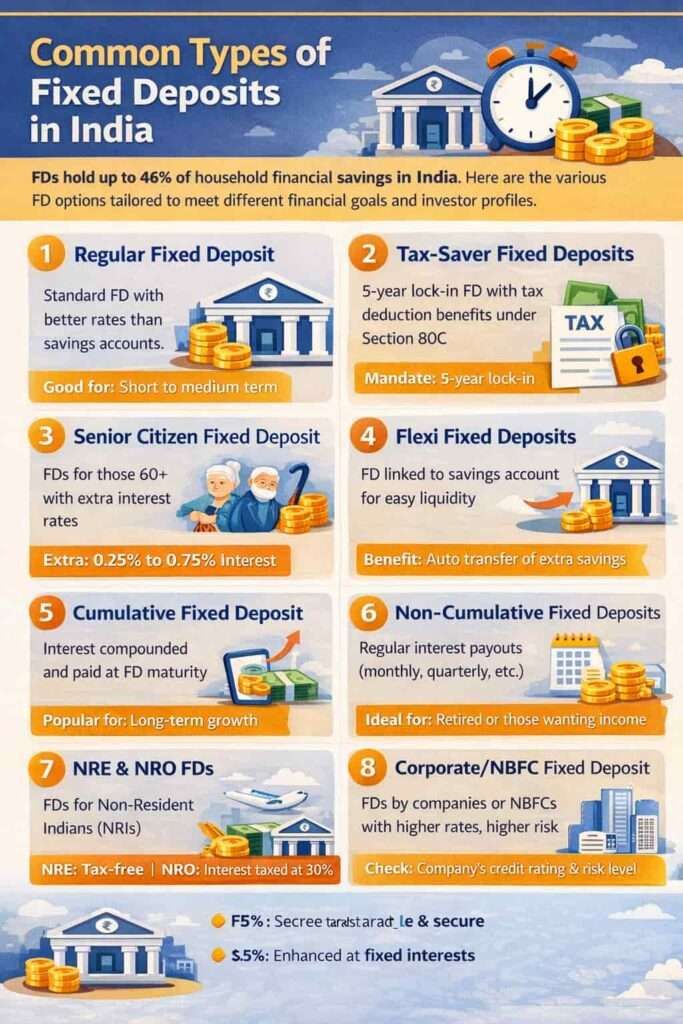
Fixed Deposits are one of the most popular investment options in India. According to RBI data, around 46% of household financial savings are invested in FDs. To meet different financial needs, banks offer several types of FDs for tax saving, regular income, senior citizens, and NRIs.
Here are the 7 main types of Fixed Deposits available in India –
1. Regular Fixed Deposit
As per its name, it is a standard FD available to most individuals. It goes from 7 days to 10 years, and the interest rates are higher than those of a savings account. It is taxable and simple, but to earn better interest rates, you can choose different banks, such as Small Finance Banks, which give higher FD returns than big banks.
- Who should use: People parking money for short or medium term.
- Example: ₹2 lakh for 18 months in HDFC Bank at ~6.45%.
2. Tax-Saver Fixed Deposits
These FDs come with a focus on tax savings. It gives a mandatory lock-in period of 5 years and offers tax deductions of a maximum of ₹1.5 lakh As per Section 80C of the Income Tax Act. But your premature withdrawal and loans against the deposit are not permitted.
- Common misunderstanding: Interest is NOT tax-free.
3. Senior Citizen Fixed Deposit
Again, as per it names, it is designed for individuals whose age 60 years and above. These FDs offer an additional interest rate, typically 0.25% to 0.75% higher than standard rates. It reaches up to 9.5% p.a. by a few banks. It comes with tax benefits up to ₹50,000 under Section 80TTB. All Basic features are allowed, such as Premature Withdrawal, Joint Accounts, and Nomination.
4. Flexi Fixed Deposits (Auto Fixed Deposits / Sweep-in)
These link your savings account to a fixed deposit, which you can access directly through the mobile banking app. Any extra money in your savings account is automatically moved to an FD so you earn more interest. When you need money, the FD is automatically broken, and the amount comes back to your savings account. So your money stays safe, earns more, and is always available when required.
- Use case: Emergency liquidity with better return than a savings account.
5. Cumulative Fixed Deposit
A Cumulative Fixed Deposit is a type of FD where you do not get monthly or yearly interest. The interest is added to your FD amount again and again. At the end of the FD period, you get the full amount together – your money plus all the interest. Most people use it for child education or marriage planning, mostly long-term.
- Tax reality: Interest is taxable every year, even if not received.
6. Non-Cumulative Fixed Deposits
In a Non-Cumulative Fixed Deposit, interest is paid out at regular intervals, such as monthly or quarterly, instead of being reinvested, unlike a Cumulative Fixed Deposit. This type of FD is usually used by:
- Retired person
- Those planning a regular pension-like income
Example: A fixed deposit of ₹10 lakh at an interest rate of 6.5% provides around ₹5,400 as monthly interest.
7. NRE OR NRO FDs
- NRE = It is designed for Non-Resident Indians (NRIs). The interest earned on NRE FDs is tax-free in India, and both the principal amount and interest are fully repatriable to the NRI’s overseas account.
- NRO = These are meant for managing income earned in India by NRIs, such as rent, pension, or dividends. The interest earned on NRO FDs is taxable in India at 30%, along with applicable surcharge and cess.
8. Corporate/NBFC Fixed Deposit
Corporate or NBFC Fixed Deposits generally offer higher interest rates compared to bank fixed deposits. However, they also carry a higher risk. Most corporate and NBFC FDs are not covered under DICGC insurance, unlike bank FDs. The basic safety formula here is to check all the history about NBFC and find DICGC certificates before applying.
- Important Tip: Corporate or NBFC fixed deposits should never be confused with bank fixed deposits, as the risk level and safety protection are different.
- Safety depends on the company’s credit rating
- Only top-rated companies (AAA / Stable by CRISIL, ICRA, etc.) are relatively safer
Key Features of Fixed Deposits
- Guaranteed Returns – Your interest rate is fixed from day one, so market ups and downs do not affect your returns.
- Flexible Tenure – You can choose an FD period anywhere between 7 days and 10 years based on your needs.
- Compounding Growth – The interest earned keeps getting added back to your deposit, helping your money grow faster over time.
- Senior Citizen Perks – Most banks offer higher FD rates to senior citizens, usually 0.50% to 0.75% extra.
- Highest Safety – FDs are considered one of the safest investment options, with deposits insured up to ₹5 lakh per bank.
- Emergency Loans – If you need money urgently, many banks allow you to take a loan against your FD.
- Income Payout Options – You can either receive regular interest payouts or let the interest accumulate until maturity.
- Tax Saving Choice – Certain 5-year FDs qualify for tax deductions under Section 80C of the Income Tax Act.
- Premature Exit Penalty – You can withdraw your FD before maturity, but the bank may reduce the applicable interest rate.
Important FD Rules and Charges
- Partial Withdrawal Rules – Some banks allow partial withdrawal, while others may require you to break the entire FD.
- No Account Maintenance Charges – Most Fixed Deposits do not have opening fees, annual charges, or maintenance costs.
- Auto-Renewal Rules – If you do not give instructions at maturity, the FD may automatically renew for the same tenure at the current interest rate.
- Loan Against FD Charges – Banks usually charge 1% to 2% more than your FD interest rate when you take a loan against the deposit.
- Sweep-In Facility Rules – Linked FDs can automatically provide funds when your savings account balance is insufficient.
- TDS Deduction Rules – Banks may deduct 10% TDS if your annual FD interest crosses the applicable limit.
- PAN Linking Rules – If PAN is not linked, TDS can increase from 10% to 20%.
- Tax Saver FD Restrictions – Tax Saver FDs have a mandatory 5-year lock-in period and do not allow premature withdrawal or loans against the deposit.
How Tax Works on Fixed Deposits (FDs) in India
Many people think FD interest is completely theirs to keep. In reality, FD interest is taxable in India and can reduce your final return.
FD interest is treated as “Income from Other Sources” and is taxed according to your income tax slab. One important thing to remember is that tax applies to the interest earned every year, even if you receive the money only at maturity.
(a.) TDS Rules (Simple Explanation)
- If you are below 60 years of age, banks may deduct TDS if your total FD interest exceeds ₹40,000 in a financial year.
- If you are a senior citizen (60+ years), TDS may apply if your interest exceeds ₹50,000 in a financial year.
- The standard TDS rate is 10%.
- If PAN is not linked or provided, the TDS rate can increase to 20%.
(b.) TDS Is Not Your Final Tax
Many people think that once TDS is deducted, there is no more tax to pay. This is not correct.
Your actual tax depends on your income tax slab.
Example: If your total FD interest in a year is ₹80,000
- 5% tax slab → Tax = ₹4,000
- 20% tax slab → Tax = ₹16,000
- 30% tax slab → Tax = ₹24,000
The bank may deduct only 10% TDS, but when you file your Income Tax Return (ITR), the final tax is calculated according to your slab.
(c.) Simple FD Example
Suppose you invest ₹50,000 in an FD.
- FD Amount: ₹50,000
- Tenure: 2 Years
- Interest Rate: 6.5% p.a.
After 2 years, the maturity amount may be around ₹56,800.
- Total Interest Earned = ₹6,800
- Now suppose you fall under the 20% tax slab.
- Tax on ₹6,800 = ₹1,360
So your effective amount after tax becomes approximately ₹55,440.
This is why the FD interest rate you see is not always the amount you actually take home after tax.
💡 A Fact Many FD Investors Don’t Know – Many people think FD tax applies only at maturity. But in a cumulative FD, the interest earned every year is taxable, even if you have not received it yet. Ignoring this can lead to incorrect ITR filing, tax notices, or penalties. FDs are simple to invest in, but many investors make mistakes when reporting FD interest.
How to Reduce FD Tax Legally
1. Submit Form 15G or Form 15H
- If your total annual income is below the taxable limit, you can submit:
- Form 15G (for regular individuals)
- Form 15H (for senior citizens)
- This can help prevent TDS deduction by the bank.
2. Use Senior Citizen Benefits
- As per the 2025-26 Budget, senior citizens can earn up to ₹1,00,000 in interest income before TDS is deducted by the bank.
3. Split FDs Among Family Members
- Some families distribute FD investments among members who have little or no taxable income.
- For example, money may be gifted to an adult child, parent, or other eligible family member to open an FD.
- Since their tax slab may be lower, the overall tax burden on FD interest can also be lower.
📌 Final Point – FDs remain one of the safest investment options in India. However, the real return is what you earn after tax, not just the interest rate shown by the bank. Always check your post-tax return before investing in a Fixed Deposit.
Are Fixed Deposits Safe in India?
Fixed Deposits are considered one of the safest investment options in India because they offer fixed returns and deposit insurance protection.
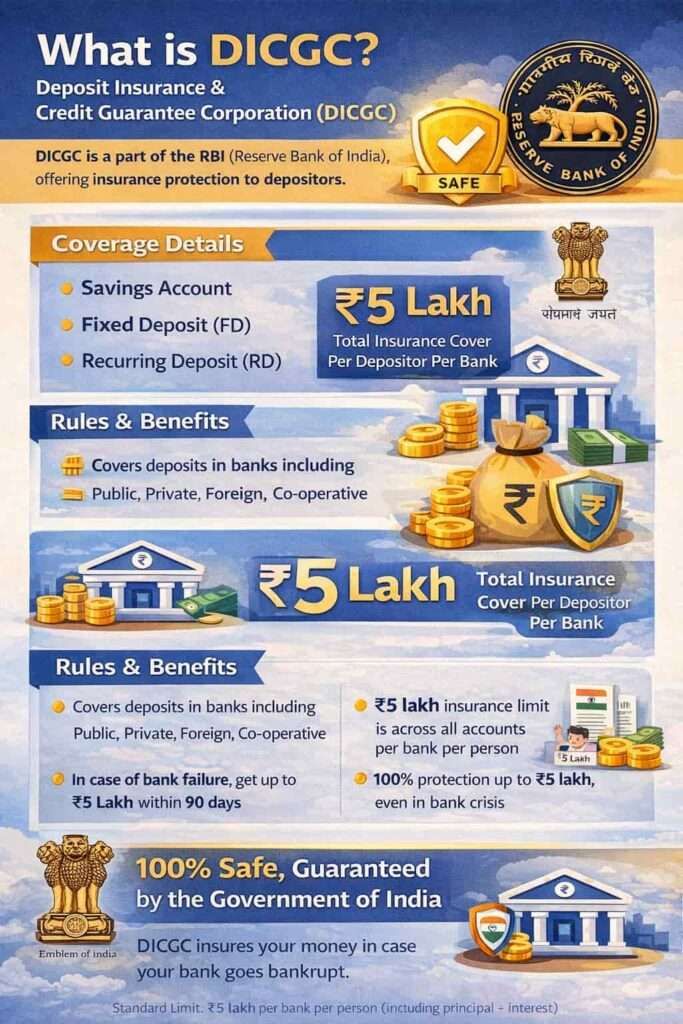
- Bank FDs are covered by DICGC insurance, a government-backed scheme under the RBI.
- Post Office FDs are backed by the Central Government and are considered very safe.
- Corporate and NBFC FDs usually offer higher returns but carry higher risk.
DICGC Insurance Rules
- Insurance cover: ₹5 lakh per depositor per bank
- Covers: Savings Account, Fixed Deposit (FD), and Recurring Deposit (RD)
- Applies to public banks, private banks, foreign banks in India, and co-operative banks
Example
- ₹25 lakh in one bank → Insurance cover is only ₹5 lakh
- ₹5 lakh each in 5 different banks → Total insurance cover becomes ₹25 lakh
Bonus Tip
- Some banks also offer credit cards against FDs, making approval easier for first-time users while helping build a credit score.
- This insurance protection is one of the main reasons why millions of Indians continue to trust Fixed Deposits for saving money.
Cumulative vs Non-Cumulative FD
1. Cumulative FD (Better for Wealth Growth)
In a cumulative FD, the interest earned is added back to the deposit and continues earning interest. You do not receive regular payouts during the tenure. The entire amount is paid at maturity.
Best for: Investors who do not need regular income and want maximum returns through compounding.
2. Non-Cumulative FD (Better for Regular Income)
In a non-cumulative FD, the interest is paid to you monthly, quarterly, half-yearly, or annually. Since the interest is withdrawn regularly, it does not earn additional interest.
Best for: Retirees and investors looking for a regular income stream.
Example
Suppose you invest ₹10,000 for 5 years at 7% interest.
| Feature | Cumulative FD | Non-Cumulative FD |
|---|---|---|
| Interest Payout | At Maturity | Monthly |
| Monthly Income | None | Around ₹58 |
| Total Interest Earned | ₹4,148 | ₹3,500 |
| Final Maturity Amount | ₹14,148 | ₹10,000 Principal |
What Is an FD Calculator?
An FD calculator is a dedicated digital financial tool designed to compute the exact maturity amount and total interest income you will earn on a fixed deposit. Instead of performing complex manual accounting equations, you input your planned deposit variables to get instant, error-free mathematical projections. It helps you visualize your savings growth before you commit your liquid cash to a bank lock-in period.
To simulate your exact compounding milestones or calculate your regular monthly cash flows, use our interactive tool: Easemoney Online Fixed Deposit (FD) Calculator.
Frequently Asked Questions
Why do banks offer higher FD rates sometimes?
Banks increase FD rates when they need money or competition is high. After RBI repo cuts in 2025, some banks still paid 7–8% to attract deposits quickly.
Should I put ₹25 lakh in one FD?
No. Real branch advice is to split. Put ₹5 lakh in five different banks. This way, full ₹25 lakh stays insured under DICGC instead of only ₹5 lakh.
Do I lose money if I break the FD early?
You don’t lose principal, but interest reduces. Bank recalculates interest for the actual period and applies a 0.5–1% penalty. Tip: break FD only for real emergency.
Why do seniors prefer FD more than others?
Senior citizens get an extra 0.5% interest and ₹50,000 yearly interest tax-free under Section 80TTB. which was increased to ₹1 lakh for FY 2025-26.
This makes FD a stable income tool after retirement.Are small finance bank FDs risky?
Risk is slightly higher, but DICGC insurance is the same as that of big banks. For amounts under ₹5 lakh, small finance banks giving 7.5–8.5% are practical.
When is an FD better than a mutual fund?
FD is better for short-term needs, emergency funds, or low-risk money. Mutual funds suit long-term growth. Real idea: never mix safety money with growth money.
What happens if I keep more than ₹5 lakh in one bank?
Anything above ₹5 lakh in a single bank is not insured. If the bank fails, recovery of the excess amount depends on liquidation, which can take years or may not fully happen.
Are Post Office FDs safer than bank FDs?
Post Office FDs are backed directly by the Government of India, so there is no ₹5 lakh limit. That’s why many people park long-term or retirement money in Post Office schemes.
Can I break my fixed deposit before the maturity date?
Yes, most banks permit premature liquidation or partial cash withdrawals if an emergency arises. However, doing so typically incurs an institutional penalty charge ranging from 0.50% to 1.00%, which is deducted directly from your effective interest rate.
Why do banks suggest FD-backed credit cards?
FD-backed cards are easy to get because the FD acts as security. They help first-time users build credit score, usually give 75–90% limit of FD value.
What is the minimum and maximum amount required to open an FD?
You can book a standard retail fixed deposit with a minimum investment of just ₹1,000. There is no official maximum statutory limit, though individual bookings exceeding ₹2 Crores are processed under distinct “Bulk Deposit” corporate rate schedules.
- READ THIS –
- What Are LIC Fixed Deposit Schemes & How Do They Work?
- What Are Gramin Bank FD Interest Rates in 2026? Top Best Banks for Rates
- What Are the Latest Co-operative Bank FD Interest Rates?
- Get Free SBM ZET Credit Card Against FD
- Canara Bank FD Calculator
- PNB FD Interest Rate Calculator
Hope you liked the content. Explore smart options below 👇
🔥 Recommended