

Co-operative bank FDs are currently offering attractive interest rates in India, with returns usually ranging between 6.50% and 8.00% p.a. for general customers.
Some special tenure schemes and senior citizen deposits are even offering up to 8.50% p.a., especially in selected urban co-operative banks.
| No. | Bank | General Rate | Senior Citizen Rate | Best Tenure |
|---|---|---|---|---|
| 1 | Saraswat Bank | 6.80% | 7.30% | 16 months |
| 2 | Cosmos Bank | 7.05% | 7.30% | 16 months |
| 3 | SVC Bank | 6.85% | 7.35% | 12–16 months |
| 4 | TJSB Sahakari Bank | 7.25% | 7.75% | 1–2 years |
| 5 | Bharat Bank | 6.55% | 7.50% | 15-24 month |
| 6 | Sree Thyagaraja Co-operative Bank | 8.00% | 8.50% | Aisiri Scheme |
| 7 | NKGSB Bank | 7.00% | 7.50% | 1–3 years |
| 8 | Janata Sahakari Bank | 7.25% | 7.75% | 12–36 months |
| 9 | Kalupur Commercial Bank | 7.10% | 7.60% | 1–2 years |
| 10 | Bombay Mercantile Co-operative Bank | 6.60% | 7.10% | Peak Term Slabs |
📌 Key Highlights
- Special tenures like 400 days and 16 months are giving higher returns
- Senior citizens can receive additional interest benefits above regular FD rates
- Several urban co-operative banks are currently offering rates above 7.50% p.a.
- Short and medium-term FDs are giving better yields in many cases
- Limited-period schemes may offer higher returns than regular deposits
💡 Important: India has thousands of co-operative banks, so your local bank may not appear in this table. Always check the latest FD brochure or visit the branch before investing.
📌 Quick Insight: If your bank is offering lower returns, comparing FD rates with nearby co-operative banks may help you find better yields.
⚠ Before Investing: Do not choose an FD only based on higher interest rates. Also check the bank’s reputation, financial strength, branch support, and customer service quality.
Alternative Option: Some Small Finance Banks are also offering FD returns between 8.00% and 8.40% p.a. during similar periods, especially for senior citizens and special tenure schemes.
You can also understand the complete Fixed Deposit (FD) meaning in India before comparing long-term investment options.
Check Below: Senior Citizen vs General FD Interest Rates, and How to Open a Co-operative Bank FD –
Top Co-operative Banks for Fixed Deposits
1. Saraswat Bank
One of India’s largest co-operative banks, known for strong customer trust and stable banking operations. Offers attractive FD rates especially around the 16-month tenure, along with loan facilities against deposits and a wide branch network.
2. Cosmos Bank
A well-established co-operative bank popular across western India. Provides flexible FD payout options like monthly and quarterly interest, plus convenient online renewal through mobile and internet banking.
3. SVC Bank
Recognized for stable financial performance and relatively low NPAs. The bank usually offers competitive FD rates in the 12–16 month range, while quarterly compounding helps improve overall returns.
4. TJSB Sahakari Bank
Known for reliable customer service and a strong safety reputation among depositors. FD schemes for 1–2 year tenures are popular, and investors can start deposits with as little as ₹1,000.
5. Bharat Bank
A trusted multi-state co-operative bank focused on secure deposit products. It offers stable FD plans along with additional interest benefits for senior citizen customers.
6. Sree Thyagaraja Co-operative Bank
Popular among retail savers for its attractive fixed deposit schemes. Certain special FD tenures may offer rates close to 8%, though the bank mainly operates through regional branches.
7. NKGSB Bank
A well-known urban co-operative bank with a strong branch presence in multiple cities. It provides flexible FD options between 1 and 3 years along with auto-renewal facilities for convenience.
8. Janata Sahakari Bank
Considered suitable for retirement and long-term savings planning. The bank offers stable FD returns on longer tenures and monthly income payout options for senior citizens.
9. Kalupur Commercial Co-operative Bank
A Gujarat-based co-operative bank known for disciplined risk management and deposit safety. Its FD schemes also include transparent premature withdrawal rules for better clarity to customers.
10. Bombay Mercantile Bank
One of India’s oldest co-operative banks with a long operating history. The bank generally provides better returns on medium-term fixed deposits while functioning under RBI banking regulations.
Senior Citizen vs General FD Interest Rates
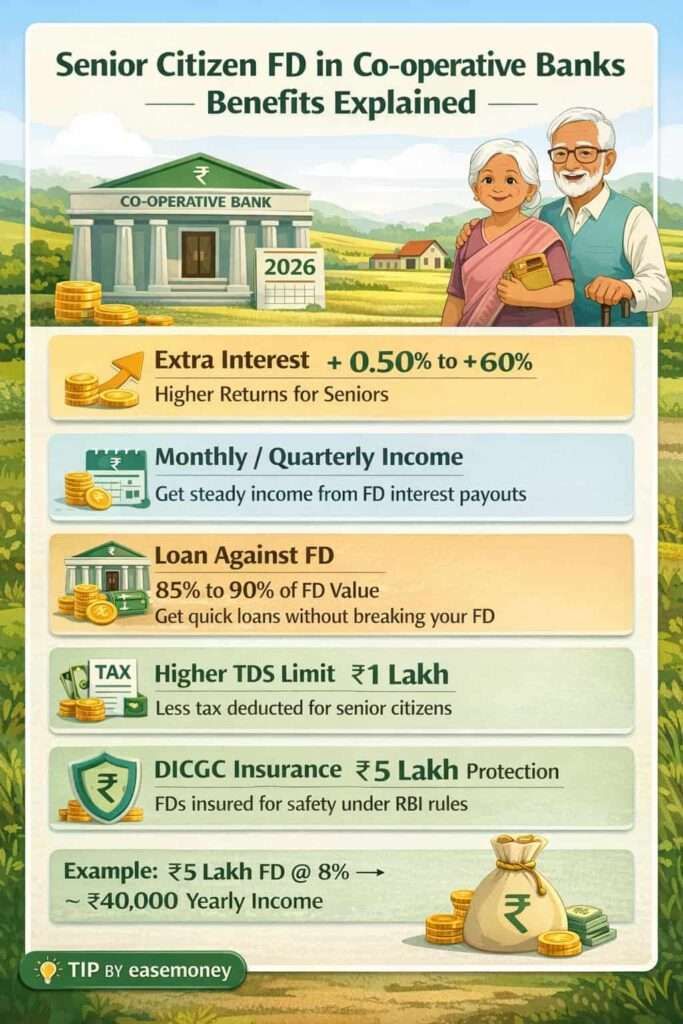
Co-operative banks usually give senior citizens extra FD interest compared to normal customers. In most banks, seniors get around 0.50% to 0.60% higher returns.
Many people in Tier-3 cities and small towns prefer co-operative bank FDs because the service feels more personal and the returns are stable.
1. Benefits for Senior Citizens
- Premium Returns: Peak FD rates reach up to 8.50% per year in selected urban co-operative schemes.
- Regular Income: Interest can be credited monthly or quarterly to cover daily retirement expenses.
- Market Insulation: Your money stays entirely safe from stock market fluctuations and volatility.
- Emergency Liquidity: Streamlined loan facilities are available directly against your FD receipt.
- Higher Tax Shield: Senior citizens enjoy an elevated TDS threshold of ₹50,000 yearly under Section 194A before tax deductions apply [1, 2].
- Zero Deduction Filings: Eligible individuals can submit Form 15H at the branch to prevent automated TDS completely.
2. Simple Example
If a senior citizen deposits ₹5 lakh in a top-tier co-operative bank fixed deposit for 16 months:
- Normal Public Rate: Averages around 7.00% p.a.
- Senior Citizen Rate: Steps up cleanly to roughly 7.50% or 7.60% p.a.
- Special Horizons: Custom term schemes can push the return threshold up to 8.50% p.a.
- Protected Growth: Your principal asset remains insured up to ₹5 Lakh under strict DICGC parameters, ensuring guaranteed returns upon final maturity.
Main Features of Co-operative Bank FDs
1. Loan Facility Against FD (When Money Is Urgently Needed)
- If you need money suddenly, you don’t have to break the FD.
- The bank can give a loan or overdraft against your FD.
- You can get 85% to 90% of the FD amount as a loan.
- Loan interest is slightly higher than FD interest, usually 1% to 2% extra.
- Very useful during medical treatment, marriage expenses, or small business cash problems.
2. Deposit Insurance and Safety (Money Protection)
- Most co-operative banks are covered under DICGC insurance.
- Your money is safe up to ₹5 lakh per person per bank.
- This cover includes the FD amount plus interest.
- This safety is given under RBI rules, so there is no difference between small and big customers.
3. Premature Withdrawal Rules (If FD Is Closed Early)
- If needed, FD can be closed before time in most banks.
- The bank will charge a small penalty, usually 0.50% to 1% less interest.
- A 5-year tax-saving FD cannot be broken before maturity.
Simple Tip – You always ask the bank staff for the FD receipt, interest rate, and insurance details. Never hurry. First understand, then invest.
4. Additional Features
- Fixed return, no tension – Once the FD is opened, the interest rate is fixed. Even if rates change outside, your FD return will not change.
- FD for a short or long time – You can keep FD for a few days or many years. Most co-operative banks give options from 7 days to 10 years.
- Deposit Amount – In co-operative banks, FD can start with ₹1,000 or ₹5,000. You can keep money for a few days or many years. There is no upper limit, but it depends on bank to Banks. Nomination and auto-renewal options are usually available.
- More interest than a savings account – A savings account gives very little interest. FD gives a much better return, so money grows faster.
- Interest as per your need – You can take interest every month for expenses, every three months, or add it back to the FD till the end.
Who Can Open a Co-operative Bank FD?
- Any resident individual can open an FD, alone or with a family member.
- Senior citizens can also open an FD and get extra interest.
- Children’s FD can be opened through a parent or guardian.
- HUFs can open an FD in the family name.
- Partnership firms can keep business money in an FD.
- Trusts and registered societies are also allowed.
Documents Required
Keep these basic KYC documents ready before opening an FD:
- Identity Proof
- PAN Card (important for tax purposes)
- Aadhaar Card or Passport
- Address Proof
- Voter ID
- Driving License
- Recent electricity or utility bill
- Bank Account Details
- Savings account passbook or cheque book
- Net banking or mobile banking details for payment
Most banks may also ask for a passport-size photo and mobile number during the FD process.
How to Open a Co-operative Bank FD
1. Offline Method (Most Common)
- First of all, you have to visit your nearest co-operative bank branch.
- Ask for the FD account open application form and fill in the simple details.
- Submit documents and deposit cash or cheque.
- FD receipt will be given by the bank.
2. Online Method (In Big Co-operative Banks)
- Some large co-operative banks allow FD booking online.
- FD can be opened using the bank website or mobile app.
- A few platforms also help in FD booking, depending on the bank.
Is Your Money Safe? (DICGC Insurance)
Many people check safety first before investing in co-operative bank FDs.
Under RBI rules, deposits in scheduled co-operative banks are protected by DICGC insurance. This means up to ₹5 lakh per customer (including principal + interest) is insured if the bank faces problems.
Simple Safety Rule
- Keep up to ₹5 lakh in one bank for full insurance protection.
- If you want to invest more, divide the money across different banks.
- This helps keep your total deposit amount safer.
For many investors, this insurance support gives extra confidence while choosing higher FD interest rates in co-operative banks.
How to Choose the Best Co-operative Bank FD
Before investing in a co-operative bank FD, always check a few important points:
- Make sure the bank is a scheduled co-operative bank regulated by RBI. check RBI registered List.
- Compare FD rates and choose better returns with trusted banks.
- Prefer shorter FD periods like 12 to 24 months for better flexibility.
- Check if the bank allows easy FD withdrawal during emergencies.
- See whether loan or overdraft facility is available against the FD.
- Choose banks with good customer service and stable reputation.
A little checking before investing can help you get better returns while keeping your money safer and more accessible.
Frequently Asked Questions
What is the 444-day FD scheme people talk about?
The 444-day FD is a special scheme by banks like SBI and Indian Bank. It gives higher interest than normal FDs, suits short-term savers, and allows loan or premature withdrawal with a small penalty.
Is the 444-day FD better than a normal one-year FD?
In most cases, yes. Branch staff explain that 444-day schemes pay 0.20%–0.40% more than one-year FDs, without locking money for two or three years.
What is the current FD rate in RGB (Regional Gramin Bank)?
RGB FDs give around 6.05% for 6–12 months, 6.60% for one year, and 6.50% for up to three years. Senior citizens generally get 0.50% extra interest.
Should senior citizens choose co-operative banks or Gramin banks for FD?
From real experience, seniors choose co-operative banks for higher interest and Gramin banks for safety and comfort. Many smart investors split money—₹3–4 lakh in each—to balance return and protection.
Are very high FD rates like 9% or more always safe?
Not always. Branch staff advise checking DICGC insurance, bank size, and tenure. Keeping deposits within ₹5 lakh per bank reduces risk, even when interest rates look attractive.
Is it okay to invest more than ₹5 lakh in one co-operative bank FD?
Staff usually suggest splitting deposits across two banks. Keeping more than ₹5 lakh in one bank reduces insurance protection. Many smart investors open two FDs of ₹4–₹5 lakh separately.
Why do co-operative banks give higher FD interest than PSU banks?
Co-operative banks depend more on local deposits. To attract money, they offer 0.50%–1% higher rates, especially on special tenures like 400 days or 16 months, which PSU banks usually avoid.
Hope you liked the content. Explore smart options below 👇
🔥 Recommended