Missing your credit card bill can trigger immediate penalties including late payment charges, heavy interest accumulation, and long-term credit score damage.
Most Indian banks charge late fees up to ₹1,300 and apply interest rates between 36% and 48% per annum on unpaid balances. Delayed payments are also reported to CIBIL, which can reduce your credit score quickly.
| Timeline | What Happens |
|---|---|
| Day 1–30 | Late fees apply, interest starts accumulating, and the interest-free grace period gets cancelled |
| Day 31–90 | CIBIL score may drop by 50–100 points and recovery reminder calls usually begin |
| After Day 90 | The card may get permanently blocked and the account can be marked as a defaulted asset |
📌 Important Things To Know
- Even one missed payment can negatively affect your CIBIL history
- Interest charges continue every month until the full outstanding amount is cleared
- Paying only the minimum due does not stop interest on the remaining balance
- Repeated missed payments can reduce future loan and credit card approval chances
💡 Nanne’s Core Insight: If your payment gets delayed by 24–48 hours due to UPI issues, server downtime, or technical banking errors, do not panic immediately.
As per RBI rules , banks usually cannot report the delay to CIBIL or apply late fees until the payment becomes more than 3 days overdue.
📌 Quick Insight: If a late fee is wrongly charged within the RBI grace window, you can email the bank’s grievance department and request a reversal.
⚠ Important: Once the overdue crosses 90 days, the account may be classified as a serious default, which can severely damage your long-term credit profile.
Read Below: The Timeline of Penalties (Day 1 to Day 90)
1. The Timeline of Penalties (Day 1 to Day 90)
Missing one credit card payment may look small in the beginning, but the impact slowly becomes bigger with time. Here is how things usually move step-by-step:
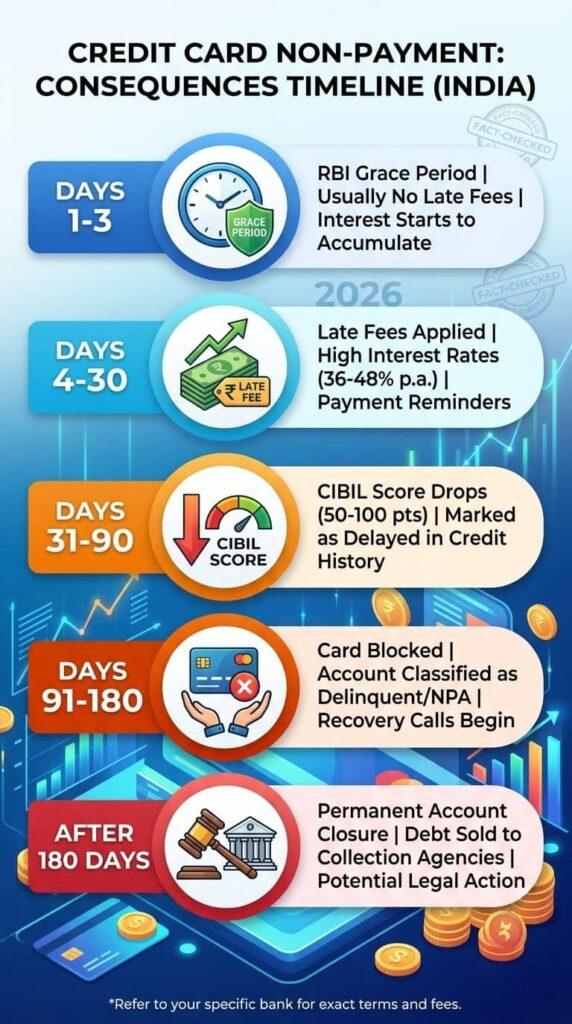
Day 1 to 3: Small Buffer Time
Most banks give a small 3-day grace period after the due date.
- Your payment is usually not reported immediately to CIBIL or other bureaus
- But interest may still start getting added on the unpaid amount
- New purchases may also lose the interest-free benefit until the full dues are cleared
Day 4 to 30: Late Fee Starts
After the grace period ends, the real charges begin.
- Late payment fee gets added to your bill
- Interest rates can become very high, sometimes 30% to 48% yearly
- The bank may start calling, sending SMS, emails, and payment reminders
Day 31 to 90: Credit Score Damage
If the payment is still pending for more than a month, it starts affecting your credit profile.
- The bank reports the delay to CIBIL, Experian, etc.
- Your credit score can fall by 50 to 100+ points
- Getting future loans, cards, or even rental approvals becomes harder
- Some banks may temporarily block your card usage
Day 91 to 180: Recovery Process Starts
At this stage, the account becomes a serious overdue case.
- The bank may mark the account as delinquent or NPA
- Recovery agents or collection teams may contact you regularly
- In some cases, field visits to home or office can also happen
- Other lenders may become strict in approving future credit
After 180 Days: Legal and Collection Action
If the dues are still unpaid for many months, stronger action can happen.
- The bank may permanently close the card account
- The unpaid debt can be sold to a recovery agency
- Legal recovery cases may also be filed in civil court
- If the court gives judgment against the borrower, recovery can happen through bank accounts or assets under legal process.
2. Exact Late Payment Fees Across Major Indian Banks
In India, credit card late payment charges mainly depend on your total outstanding bill amount. The higher the unpaid amount, the higher the penalty.
| Outstanding Bill Amount | Average Late Fee | Extra Charges |
|---|---|---|
| Less than ₹500 | ₹0 to ₹100 | +18% GST |
| ₹501 to ₹10,000 | ₹500 to ₹750 | +18% GST |
| ₹10,001 to ₹25,000 | ₹950 to ₹1,100 | +18% GST |
| Above ₹50,000 | ₹1,200 to ₹1,300 | +18% GST |
⚠️ Important: Always check your credit card statement or official card booklet once. Some card variants may have different late payment charges.
3. How It Instantly Destroys Your CIBIL Score
Your payment history makes up 35% of your total CIBIL score calculation.
- A single credit card statement marked as “Late” or “Default” can wipe out 50 to 100 points from your credit profile in less than 30 days.
- This creates a permanent entry in your “Days Past Due (DPD)” history column. Future lenders looking at this ledger will view you as a high-risk borrower, making it incredibly difficult to get home loans, car loans, or premium credit cards for the next 7 years.
4. What To Do If You Cannot Pay Your Credit Card Bill
If you are facing a temporary money problem, do not ignore the bill. These options can help you avoid serious damage to your CIBIL score:
1. Pay the Minimum Amount Due (MAD)
Banks usually ask for around 5% of the total bill as the minimum payment.
- Helps you avoid late payment marking
- Reduces risk of CIBIL default reporting
- But interest will still apply on the remaining amount
2. Convert the Bill Into EMI
Most banks allow you to convert large dues into monthly EMIs directly from the mobile app.
- Open your credit card app
- Select the outstanding amount
- Tap “Convert to EMI”
This can reduce your interest burden compared to normal credit card charges.
3. Use a Balance Transfer
Some banks allow you to move your unpaid balance to another credit card with lower interest.
- Useful during short-term cash problems
- Some offers provide low or temporary 0% interest periods
- Gives extra time to clear the dues properly
💡 Expert Tip: If you cannot pay the full bill, stop using the card completely for 1–2 months. Many people keep spending after paying MAD, and the debt quietly doubles through interest and GST.
⚠️ Important: These methods only help temporarily. Clearing the full outstanding amount as early as possible is always the safest option.
FAQs
Can a bank arrest me if I do not pay my credit card bill in India?
No. Credit card defaults are classified as civil disputes, not criminal offenses. Banks cannot arrest you. However, they can legally file a civil suit in a debt recovery tribunal to recover their funds.
Does paying the Minimum Amount Due stop interest charges?
No. Paying the MAD only protects you from late payment fees and negative CIBIL reporting. Heavy interest charges will still compound daily on your remaining unpaid balance until it is cleared.
Will one late credit card payment affect my CIBIL score?
Yes. Even a single delayed payment can reduce your CIBIL score if the bank reports it after the grace period.
How many days late is considered a default?
Usually, payments delayed beyond 30 days are reported to credit bureaus like CIBIL as overdue or default.
Can banks block my credit card for non-payment?
Yes. If the bill remains unpaid for a long time, the bank may temporarily freeze or permanently close the card.
Best Tool – Credit Card Late Payment Charges Calculator
Hope you liked the content. Explore smart options below 👇
🔥 Recommended