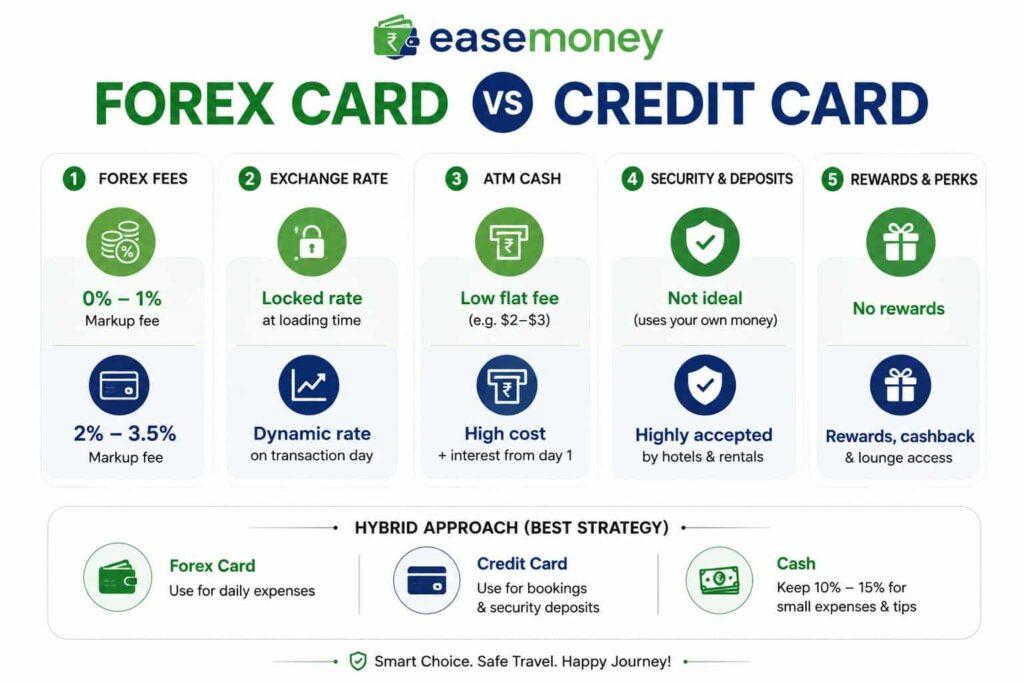
Forex Cards are usually cheaper than regular credit cards for international spending because they lock exchange rates in advance and often charge only 0%–1% forex markup fees.
However, Zero Forex Markup Credit Cards are often better for frequent travelers who want lounge access, hotel bookings, cashback rewards, and premium travel perks without preloading foreign currency.
| Feature | Forex Card | Credit Card |
|---|---|---|
| How it Works | Prepaid travel card loaded before travel | Pay-later spending using bank credit |
| Exchange Rate | Locked during loading | Live rate changes daily |
| Forex Markup | Usually 0%–1% | 2%–3.5% + GST |
| ATM Withdrawal | Low fixed fee (~$2–$3) | 2.5% fee + instant interest |
| Security Deposits | Funds get blocked temporarily | Preferred for hotel & car rentals |
| Rewards | Limited benefits | Cashback, lounges & travel rewards |
📌 Real-Life Difference
- Forex Card: You preload currencies like USD or EUR before travel, and spending abroad works like a prepaid debit card
- Credit Card: International purchases convert into INR using live exchange rates, and banks usually add 2%–3.5% forex markup fees
💡 Travel Tip: Avoid using Forex Cards for hotel check-ins or car rentals. Merchants may block around $200–$500, and refund reversal can take 15–20 days.
📌 Quick Insight: Under current Indian tax rules , international spending above ₹7 Lakhs in one financial year may attract 20% TCS, adjustable later during ITR filing.
⚠ Important: Always choose local currency instead of INR at foreign POS machines. Selecting INR activates Dynamic Currency Conversion (DCC), which may inflate your bill by around 5%–7%.
You can also check official RBI guidelines for international card usage and forex regulations.
Read Below: Hidden Fees & ATM Withdrawal Charges • The 70/30 Travel Card Strategy
1. In-Depth Breakdown: Prepaid Forex Cards
A Forex card is a prepaid travel card where you load foreign currency before leaving India. It works like a travel wallet and helps reduce daily currency conversion charges during international spending.
- Rate Lock Advantage: The biggest benefit is exchange rate locking. For example, if you load USD at ₹84.50, your balance stays fixed at that rate even if the Rupee later falls to ₹86 or ₹87 during your vacation. This helps protect your overall travel budget.
- Multi-Currency Support: Cards like Niyo Global Card, HDFC Regalia ForexPlus Card, or SBI Multi-Currency Foreign Travel Card can hold up to 20 global currencies together on one card, making Europe or multi-country Asia trips much smoother.
- The Loading Drag: The main downside is liquidity locking. You need to buy and preload foreign currency before travelling, which blocks your active savings money inside the card until the trip ends.
💳 Real Human Insight: Many travelers load 20%–30% extra money “just in case.” Later, unused balance gets converted back into INR at lower reverse conversion rates, causing a small hidden loss again.
2. In-Depth Breakdown: International Credit Cards
Using an international credit card means spending through a live credit limit while travelling abroad. Instead of preloading money like a Forex card, the bank converts your transactions into INR later during billing.
- Standard Credit Cards: Most normal Indian credit cards charge around 3% to 3.5% forex markup fees on every international transaction. On top of this, banks also add 18% GST on the markup fee, making foreign spending noticeably expensive.
- Zero Forex Markup Cards: Premium cards like AU Ixigo Credit Card, Scapia Federal Credit Card, or IDFC FIRST WOW Credit Card remove the standard forex markup charges completely. Transactions usually get converted using near-live Visa or Mastercard exchange rates.
- Travel Rewards & Benefits: Premium travel cards also provide extra benefits, such as accelerated air miles, international lounge access, complimentary travel insurance, and milestone-based rewards on higher spending.
💳 Real Tip: Many first-time travelers ignore forex markup fees because they look “small” at 3%–3.5%. But on a ₹2 lakh international trip, these charges alone can quietly cross ₹7,000–₹8,000 after GST.
3. Detailed Comparison: Hidden Fees & ATM Withdrawal Realities
To understand the hidden costs of international spending, analyze how various charges combine during transaction clearings:
| Fee Category | Prepaid Forex Cards | Standard Credit Cards | Zero Forex Markup Cards |
|---|---|---|---|
| Initial Issuance Fee | ₹100–₹500 | Nil | Nil |
| Reload / Top-Up Fee | ₹50–₹100 | Not Applicable | Not Applicable |
| Forex Markup Charges | 0% on loaded currency | 2.5%–3.5% + GST | 0% |
| Overseas ATM Withdrawal | Flat $2–$3 fee | 2.5% fee (Min ₹500) + instant interest | 2.5% fee + interest later |
| Inactivity Charges | Possible after 6–12 months | Nil | Nil |
📌 Example: If you withdraw foreign cash worth ₹20,000 using a normal credit card ATM abroad:
- ATM fee: Minimum ₹500
- GST on fee: ₹90
- Interest starts immediately
Your total extra cost can quickly cross ₹700–₹1,000 even before repayment. For ATM cash withdrawals abroad, Forex cards are usually much cheaper because most only charge a flat $2–$3 fee without heavy daily interest charges.
4. Practical Travel Strategy: The 70/30 Portfolio Rule
To reduce fees and improve safety during international travel, experienced travelers usually avoid depending on just one payment method. Instead, they follow a simple 70/30 strategy.
- Use 70% Through a Forex Card or Zero Forex Card: Use this for planned daily spending like metro tickets, restaurants, supermarkets, shopping, and local transport payments. This helps reduce forex markup charges.
- Keep 30% on a Premium Credit Card: Reserve your credit card mainly for hotel deposits, car rentals, emergency medical spending, or backup situations where prepaid cards may not work properly.
- Carry Small Amount of Cash Only: Withdraw local currency once after landing using your Forex card instead of converting money at airport exchange counters, where rates are usually very expensive.
📖 Travel Example: A traveler with a ₹2 lakh Europe budget may keep around ₹1.4 lakh on a Forex/Zero Forex card, ₹50,000–₹60,000 available on a premium credit card, and only ₹10,000–₹15,000 equivalent cash for taxis, tips, or small local shops.
5. Cons of a Forex Card
- Reloading money abroad can sometimes take time and may include extra fees
- Some banks charge inactivity fees if the card remains unused for 6–12 months
- Leftover foreign currency can cause small losses during reverse conversion to INR
- Using a USD Forex card in Europe can trigger extra cross-currency charges
- Some petrol pumps, toll booths, and car rental systems may reject prepaid Forex cards
📌 Example: If you return with €300 unused balance, the reverse conversion rate may be weaker, causing a small ₹500–₹1,000 loss during conversion back to INR.
6. Cons of International Credit Cards
- Standard cards usually charge 2%–3.5% forex markup plus GST
- ATM cash withdrawals abroad become very expensive due to cash advance fees and instant interest
- Currency exchange rates keep changing until final settlement
- Fraud disputes may temporarily block part of your credit limit
- Overspending during travel can later turn into high-interest debt
📌 Example: On a ₹1 lakh international trip, a normal 3.5% forex markup card can quietly add ₹4,000+ extra charges after GST.
FAQs
Can I use my domestic Indian credit card abroad without activating it?
No. For security reasons, Indian banks automatically block international usage on all newly issued credit cards. Before traveling, you must log into your bank’s net banking portal or mobile application, navigate to the “Card Controls” tab, and manually enable international POS, ATM, and online transactions.
Does the ₹7 Lakh TCS limit apply per card or per individual?
The ₹7 Lakh Tax Collected at Source (TCS) exemption threshold applies per individual across all financial accounts in a single fiscal year. It tracks your combined PAN identity footprint. Splitting transactions across five different cards from different banks will not reset your threshold limit.
Why did a merchant charge me extra even though I used a Zero Forex Markup card?
This happens due to the Merchant Terminal Fee. In countries like Thailand or Japan, local bank networks add an independent local processing fee (e.g., 220 Baht in Thailand) to all international card swipes. This fee is added by the merchant’s machine directly, and cannot be waived by your Indian bank.
Which is cheaper for international travel?
Forex cards are usually cheaper for regular spending because they avoid high 2%–3.5% forex markup charges added on standard credit cards.
Are Zero Forex Credit Cards better than Forex Cards?
For shopping and hotel payments, yes. But for ATM cash withdrawals abroad, Forex cards are usually much cheaper.
Hope you liked the content. Explore smart options below 👇
🔥 Recommended