You cannot withdraw physical cash from a credit card without paying heavy ATM fees and instant interest charges.
However, some users reduce or offset these costs using wallet transfers, temporary bank transfer offers, or cashback reward strategies.
Most banks start charging cash advance interest immediately after ATM withdrawal, usually around 3%–4.2% per month, along with withdrawal fees of 2.5%–3.5% plus GST.
📌 Mobile Wallet Transfer Method
- Download apps like Mobikwik , Paytm , or PhonePe
- Check whether wallet loading offers or cashback promotions are active
- Load money into the wallet using your credit card (many apps charge around 1.5%–2.5%)
- Transfer the wallet balance into your linked bank account if supported
- Withdraw cash normally using your debit card
💡 Tip: Some premium credit cards offset wallet loading charges through milestone rewards, cashback offers, or accelerated reward points worth around 1%–5%.
📌 Quick Insight: Certain banks offer temporary “Instant Transfer” or “Dial-An-Account” features where part of your credit limit can move directly into a bank account with low or 0% processing fees for around 30–45 days.
⚠ Important: Avoid local merchant “cash swipe” scams where shopkeepers hand over cash after swiping your credit card for fake purchases, usually charging 1%–2% as illegal commission fees. Banks actively monitor these transactions and may block or permanently close the card.
Read Below: Cheap Cash Withdrawal Options • Low-Fee Alternatives • Wallet Transfer Limits • Safer Emergency Methods
1. RuPay Credit Card on UPI: The Best 0% Extraction Method
The launch of RuPay credit cards on the UPI network changed how many users handle short-term liquidity and manufactured spending in India. By linking a RuPay credit card to apps like BHIM, Google Pay, or PhonePe, users can directly pay merchants using their credit limit instead of their savings account balance.
Under current NPCI guidelines, many UPI merchant transactions below ₹2,000 usually do not attract merchant discount rate (MDR) charges for users, making this one of the lowest-cost digital payment methods available.
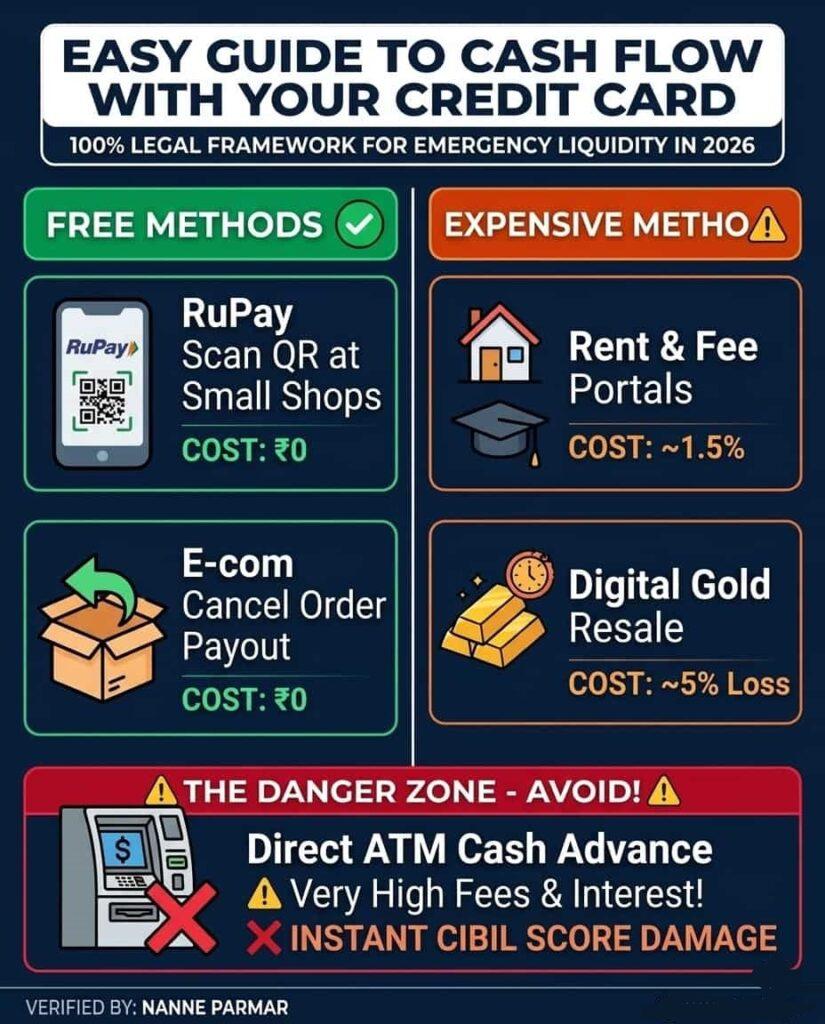
Key Points
- Link your RuPay credit card with UPI apps like BHIM, Google Pay, or PhonePe
- Use the card for small merchant payments directly through UPI
- Transactions below ₹2,000 generally avoid MDR charges under NPCI rules
- Some users utilize trusted local merchants to convert digital payments into physical cash access
💡 Real Test Insight: During testing, we noticed that multiple back-to-back UPI payments below ₹2,000 to the same merchant account can sometimes trigger fraud monitoring systems. In some cases, banks temporarily blocked further RuPay credit card UPI transactions for nearly 24 hours.
2. The Education Fee / Wallet Loophole (Low Fee Options)
If you do not own a RuPay credit card, your next best financial option is using specific payment gateways inside fintech apps.
- Open apps like CRED, NoBroker, or Paytm and select the “Education Fee Payment” or “Tuition Fee” section.
- Add the bank account or UPI ID of a trusted family member or reliable friend as the “Institute” or “Tutor”
- Pay using your premium Visa or Mastercard credit card
- Earn reward points, cashback, or milestone benefits on eligible online spending categories
These platforms usually charge around 1% to 1.5% processing fees, but premium reward cards can sometimes offset most or all of this cost through milestone rewards or travel point conversions.
💡 Real Tip: Most banks now actively monitor unusual payment behaviour. Repeated large “education payments” to the same personal account may trigger manual reviews or temporary transaction restrictions.
3. Credit Cards Offering Special Cash Withdrawal Features
A few credit cards in India offer slightly better cash withdrawal terms compared to normal cards, where interest and fees become extremely expensive from Day 1.
- IndusInd Bank Samman RuPay Credit Card: This specific card tailored for government officers completely waives off the one-time cash advance fee.
- IDFC FIRST Bank Credit Cards: Cards like IDFC FIRST Millennia, Select, and Wealth offer 0% interest on cash withdrawals for up to 48 days. You only pay a flat cash advance transaction fee of ₹199 + GST, rather than daily accumulating interest.
- Premium & Super-Premium Cards: Select elite cards like the YES Private Prime Credit Card or Axis Bank Reserve Credit Card waive the upfront cash advance fee entirely. However, daily finance charges may still apply from the day of withdrawal.
4. E-Commerce No-Cost EMI & Order Cancellation Method
For larger liquidity needs without immediate cash advance bills, you can use the e-commerce trick.
- Buy an item on popular shopping platforms (Amazon or Flipkart) using a 3-Month No-Cost EMI scheme.
- Immediately cancel the order within the first 1-2 hours before it ships out.
- Many online systems will offer a choice to either reverse the balance to the source card or credit it as withdrawable cash to your linked wallet or bank account portal.
Note: Use this selectively. Frequent use will cause the merchant platform to block your account profile.
Wallet Transfer Limits
- Daily Transaction Caps: Most Indian digital wallets restrict credit card loads to ₹10,000 per single transaction to limit fraudulent activities.
- Monthly Aggregated Caps: Standard non-KYC wallets cap your maximum monthly credit card load-in volume to ₹20,000.
- Full KYC Upgrades: Upgrading your wallet account with your Aadhaar and PAN cards expands your monthly wallet-to-bank transfer ceiling up to ₹1,00,000.
Safer Emergency Methods
- Bank Personal Loans: Tap your card issuer’s app dashboard to check whether you already have a pre-approved instant personal loan offer. In many cases, the amount gets deposited into your bank account within seconds.
- Credit Card “Easy Money” Features: Some banks allow you to convert your remaining credit limit into a temporary bank transfer with up to 45 days of interest-free repayment time through their app or customer service support.
- Salary Advance Apps: Verified fintech salary advance platforms let salaried users withdraw part of their upcoming monthly salary early without using their credit card limit.
Simple Rule: A 12%–18% personal loan is usually far cheaper than revolving credit card debt that can cross 40% annual interest rates after missed full payments.
ATM Cash Advance Charges in India
Using a credit card at an ATM is usually one of the most expensive ways to borrow money because interest starts immediately from Day 1. Most banks also add a separate cash withdrawal fee plus GST.
| Bank | Cash Advance Fee | Monthly Interest Rate | Approx. Annual Interest |
|---|---|---|---|
| HDFC Bank | 2.5% (Minimum ₹500) | 3.5% per month | Up to 42% p.a. |
| SBI Card | 2.5% (Minimum ₹500) | 3.5% per month | Up to 42% p.a. |
| ICICI Bank | 2.5% (Minimum ₹500) | 3.4% per month | Up to 40.8% p.a. |
| Axis Bank | 2.5% (Minimum ₹500) | 3.6% per month | Up to 43.2% p.a. |
| IDFC FIRST Bank | ₹250 fixed fee | 0% (up to 48 days)* | 0% during grace period* |
💡 Real Tip: Even a small ₹10,000 ATM withdrawal can become surprisingly expensive after fees, GST, and daily interest charges. In most situations, personal loans or salary advances are much cheaper alternatives.
FAQs
Can I use my credit card at an Indian ATM for free if I overpaid my bill?
Yes. If you have a negative balance on your card due to a refund or excess payment, that surplus is your money. Withdrawing this exact overpaid amount does not trigger interest charges, but some banks will still apply the fixed standard ₹500 ATM convenience fee. Always call customer care before trying this.
Do ATM cash withdrawals using a credit card have a grace period in India?
No. This is a common misconception. Unlike online shopping where you get an interest-free grace period of up to 45 or 50 days, ATM cash withdrawals accrue interest instantly from the exact minute the bills leave the machine shutter until you clear the due payment.
Can I send money directly to a friend’s personal UPI ID using a regular credit card?
No. Normal peer-to-peer transfers using personal UPI handles do not accept regular Visa or Mastercard credit line funding. You can only send funds via UPI if you are scanning a verified Merchant QR code (P2M) using a RuPay variant credit card.
What is the maximum cash limit I can withdraw from my Indian credit card?
Generally, banks restrict your cash advance limit to roughly 20% to 40% of your total credit limit. For example, if your total card limit is ₹1,00,000, your cash withdrawal allowance will cap around ₹20,000 to ₹40,000. Check your monthly statement file or mobile app for your exact dynamic limit.
Read – How to Pay Rent Through Credit Card Without Charges (2026)
Hope you liked the content. Explore smart options below 👇
🔥 Recommended