
📄 Closure Breakdown
What Is Personal Loan Foreclosure?
Personal loan foreclosure simply means paying the full pending loan amount in one single payment before the original tenure finishes. Once you do this, the loan account gets closed early and you don’t have to continue the monthly EMIs anymore, so future installments and interest stop from that point. Once the payment is cleared, the lender issues a No Objection Certificate instantly after foreclosure.
Example: EMI ₹9,200 monthly — after foreclosure, next month no EMI deduction.
What is the Personal Loan Closure Calculator & How it Works?
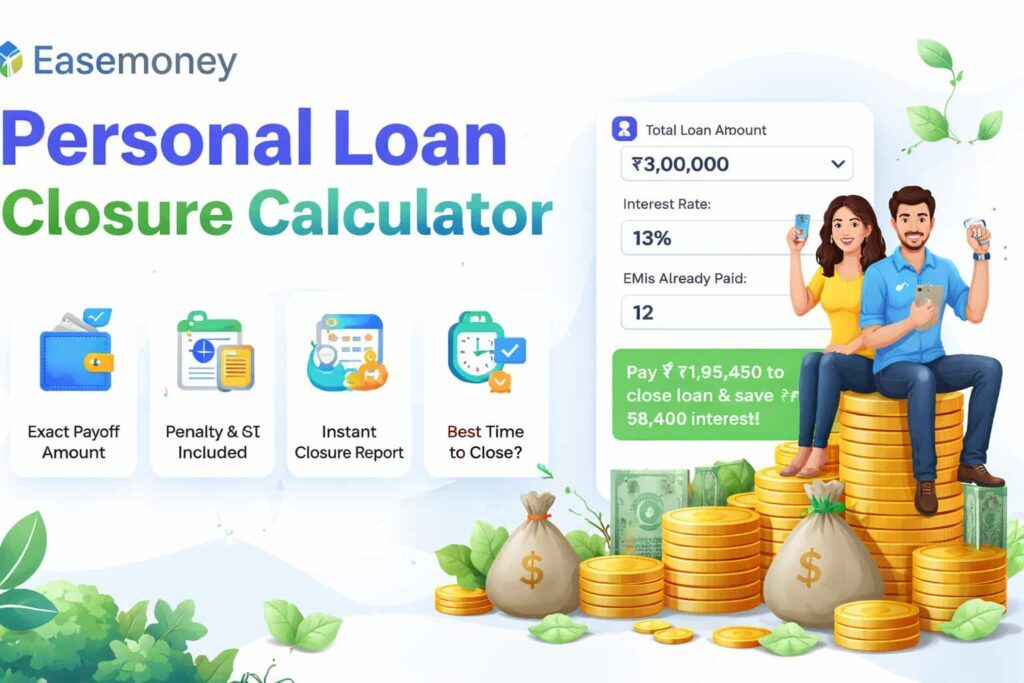
A personal loan closure (or foreclosure) calculator basically helps you check how much you have to pay if you plan to close the loan early, before the full tenure finishes. It shows the remaining principal amount, plus interest till that date, and if the bank is charging any foreclosure or prepayment fee, it also includes that.
So you can get an idea first, only whether closing now is beneficial or better to continue EMI, depending on the charges and interest left. Many people think that if they want to close a loan early, they just have to add the remaining EMIs and pay. Actually, banks don’t calculate like that.
Every EMI you pay has two portions:
- Interest – this is the bank’s earning part
- Principal – this is your actual loan amount getting reduced
In the starting months of a personal loan, most of your EMI goes into interest only, not much into principal. Because of that you’ll notice even after paying many EMIs, the outstanding amount still looks high — customers get confused here only.
This calculator works almost like a bank repayment system. It recreates your loan month-by-month and then shows:
- 1. Outstanding Principal = The actual loan amount still pending as of today.
- 2. Remaining Interest = How much extra interest you would end up paying if you continue the loan till the full tenure.
- 3. Foreclosure Charges = Penalty the lender may take if you close the loan before the time.
- 4. GST on Charges = As per Indian rules, GST is applied on those foreclosure charges also.
- 5. Final Closure Amount = Approx total amount you need to pay now to completely settle the loan.
- 6. Interest Savings = How much future interest you can avoid if you close the loan today.
Real Life of Sandeep Singh Example –
Sandeep Singh had taken a ₹5 lakh personal loan at 12% interest. After paying EMIs for around 2 years, his pending principal was still close to ₹3 lakh, which actually surprised him. He got a company bonus and thought to finish the loan early. The bank added 3% foreclosure charge, GST, and 15 days’ interest, so he paid about ₹3.12 lakh. But by closing now, he avoided the remaining years’ interest — roughly ₹60,000+ savings — which he first checked using the calculator before visiting the branch.
When Is the Right Time to Close a Personal Loan?
Generally speaking:
- Very early stage (first 6–8 months): the benefit is not much, because the interest is mostly already paid
- Middle period (around 30%–60% tenure completed): usually the best time to close
- Last few months: savings become very small, sometimes not worth it
If your interest rate is high, or too many EMIs are running together, then closing or combining the loan can actually reduce the monthly pressure a lot. Many customers feel relief after that only.
How to Use the Personal Loan Closure Calculator
Using this calculator is very simple, taking hardly any time. You don’t even need a full bank statement; only basic loan information is enough.
Step 1 — Enter Loan Amount
Put the total loan amount you originally took from the bank or NBFC (for example, ₹3,00,000).
Step 2 — Add Interest Rate
Enter the yearly interest rate written in your loan agreement. In India, most personal loans normally come somewhere between 11% to 20%, depending on profile. Some NBFCs go 18 to 34%.
Step 3 — Select Total Tenure
Write your full loan duration in months only. not go with the years. Example: A 3-year loan means 36 months.
Step 4 — Enter EMIs Already Paid
Add how many EMIs you have already paid till now. You can check quickly in your bank app or loan app also, so no issue.
Step 5 — Bank Charges (Optional)
Usually, banks/NBFCs take around 2%–5% foreclosure charge plus GST (usually 18%). If you don’t know the exact figure, you can keep the default values only; it will still give a near estimate.
After you enter these details, the calculator immediately shows:
- How much principal is still pending
- How much interest is left in future EMIs
- foreclosure penalty amount
- total payoff amount if you close today
No need to press submit or calculate button — result updates automatically as you type, so you can adjust and see different scenarios also.
What are the Personal Loan Closure Charges (India, 2026)
Foreclosure charges actually depend a lot on what type of lender you took the loan from — Public Sector Bank, Private Bank, or NBFC. Each one has slightly different rules and penalties.
But as per the latest update (Feb 2026), RBI has clearly said that for floating-rate personal loans taken or renewed on or after 1 January 2026, lenders cannot charge any foreclosure or prepayment fee. So if your loan falls under this category, you can close the loan early without penalty — you only pay the pending principal and interest till that date, nothing extra.
1. Foreclosure Charges Comparison by Type of Firm
For fixed-rate loans or older floating-rate loans, the following structures generally apply:
| Firm Type | Typical Foreclosure Charges | Lock-in Period |
|---|---|---|
| Public Sector Banks | Usually lower side, around 2%–3% (sometimes Nil in special cases) | Around 6–12 months |
| Private Sector Banks | Moderate, approx 2%–4%, and slowly reduces as the loan gets older | Mostly 12–24 months |
| NBFCs | Higher side, roughly 4%–7% on outstanding | Minimum 6–12 months compulsory |
| Digital/App Lenders | Flexible — sometimes 2%–5%, sometimes zero, also depending on app | No fixed rule, varies lender to lender |
Simple understanding: PSU banks are strict but cheaper, private banks are balanced, and NBFCs have easy approval but closure cost normally higher.
Important “Wise” Rules (customers usually miss this)
- GST also applies – Whatever the foreclosure % bank tells, add 18% GST on it. Example: 4% charge → actually ~4.72% you pay.
- Floating vs Fixed matters a lot – New floating-rate loan (after Jan 2026) → 0 charges. Fixed-rate or old floating → charges applicable
- Source of payment – Some lenders reduce or remove a penalty if you close from your own savings. But if you close using another bank’s loan (balance transfer), they may charge full.
- Lock-in period – Most lenders don’t allow closing immediately. Usually first 6–12 months, you must continue EMIs; after that only foreclosure is allowed.
Small tip: before closing the loan, always ask the bank or NBFCs for a foreclosure statement. Many times, customer thinks saving interest, but after adding penalty + GST, the benefit becomes very little — so better to check once and then decide.
Prepayment vs Foreclosure — What’s the Actual Difference?
People normally use both words the same, but technically they are not the same.
- Part-Prepayment = You pay some extra amount towards the principal, but loan still continues. EMI may reduce or tenure becomes shorter. Account remains active.
- Foreclosure (Pre-closure) = You pay the full remaining amount in one shot before tenure ends, and the loan completely finishes. After that, no EMI, no interest.
Simple example: You still have ₹2.8 lakh pending. Pay ₹50,000 extra → prepayment, But if you Pay full ₹2.8 lakh → foreclosure
Does Closing a Personal Loan Affect CIBIL Score?
Yes — and actually in more than one way.
- Positive impact = Your total debt reduces and banks see you as financially disciplined. Liability goes down, which is good for future loan approval.
- Small temporary drop = Sometimes score dips a little immediately after closure. Reason is your active loan account reduces and credit history length slightly changes. Usually this is short-term only.
- Long-term benefit = If all EMIs were paid on time, the report will show “Closed”, and this stays as a positive record for years. Lenders like this.
Important: Always confirm bank marks status as Closed, not Settled. “Settled” means you didn’t pay full dues and this can seriously damage your credit score.
Should You Close the Loan or Continue EMIs?
It depends on simple math — charges vs interest saved.
| Factor | Close the Loan | Continue EMIs |
|---|---|---|
| Interest Savings | Good if loan still in early/middle stage | Very low if loan almost finished |
| Foreclosure Charges | Worth it only if savings > penalty | Better if penalty is high |
| Credit Profile | Good if you already have decent credit | Helpful for first-time credit building |
| Cash Situation | If you have extra money sitting idle | If closing will empty your savings |
Practical tip: If you have extra funds, but that is your emergency savings, better continue EMI. But if your interest rate is high and money is spare, foreclosure reduces financial pressure a lot.
One Last Step (Very Important) = After paying the full amount, always take the NOC (No Objection Certificate) or the loan closure letter from the lender. Without NOC, sometimes the loan still shows active in the credit report and causes problems in future loan applications.
FAQs
Can the bank or NBFC refuse my personal loan foreclosure request?
Normally no. After lock-in (usually 6–12 EMIs), bank must allow closure. Just submit written request and ID. If floating-rate loan after 1 Jan 2026, they cannot charge penalty also.
Why is my outstanding still high after paying many EMIs?
Because starting EMIs mostly go into interest, not principal. Example ₹5 lakh loan — even after 18 EMIs, principal may still be around ₹3.7 lakh. Calculator shows real reduction clearly.
When is the best time to close a personal loan?
Middle tenure is best, around 30%–60% EMIs completed. Early months savings are low, last months almost no benefit. Always compare interest saving vs 2%–5% foreclosure charges before deciding.
What documents should I take after loan closure?
Take NOC letter, loan closure statement, and updated CIBIL status. Within 30–45 days check report. If still “active”, immediately email bank — later problems come during home or car loan.
Can I close loan using another bank loan (balance transfer)?
Yes possible, but some lenders charge higher foreclosure fee if paid from another bank. Using your own savings sometimes reduces charges. Always ask branch first — many customers don’t know this.
How accurate is the closure calculator compared to bank amount?
Usually 95% close to bank foreclosure statement. Small difference comes from daily interest calculation date. But it gives correct estimate so you won’t get shocked when branch tells final payable amount.
Does foreclosure improve my CIBIL score immediately?
Not instantly. Sometimes score drops 5–15 points for short time. After few months it improves because debt reduces. Important thing: account must show “Closed”, never “Settled”, otherwise score damage.