

The confusion is natural. All cards look same — same plastic, chip and swipe. But inside, three networks work: RuPay, Visa and Mastercard. Bank gives card, but network moves money from your bank to shopkeeper bank. We can see one by one to understand.
- RuPay is India system. Good for use inside country. Charges are low and it works well with UPI.
- Visa and Mastercard work in many countries. Good for travel and extra services.
- In India, RuPay costs less. Visa and Mastercard cost little more but give global use and some extra benefits.
Tip: Use RuPay for local. Use Visa or Mastercard for outside India.
What Is a Card Network?
A card network, also called a card scheme, is basically the system working in the backend which allows payment to go from the customer’s bank to the merchant’s bank. When you swipe, tap or do online payment, the money does not go directly — this network comes in between and handles it.
It works like a middle party only. First it checks whether the card is valid and balance/limit is available, then it gives approval to the transaction, processes the payment and after that the amount is finally settled to the shopkeeper’s bank account. This can happen inside India or even outside India also, depending on the card type.
Types of Networks
- Open Networks: In this type, the network company itself does not give the card directly to customers. They tie up with different banks, and the bank issues the card. The network only manages the payment system in the background. Examples are Visa and Mastercard.
- Closed Networks: Here, the same company works as both network and card issuer. Means they provide the card also and handle the payment system also. Examples are American Express and Discover.
- Domestic Networks: These are country-based networks made mainly to reduce dependency on international companies and keep transaction cost lower inside the country. For example, RuPay in India and UnionPay in China.
Difference: Rupay Vs Visa Vs Mastercard
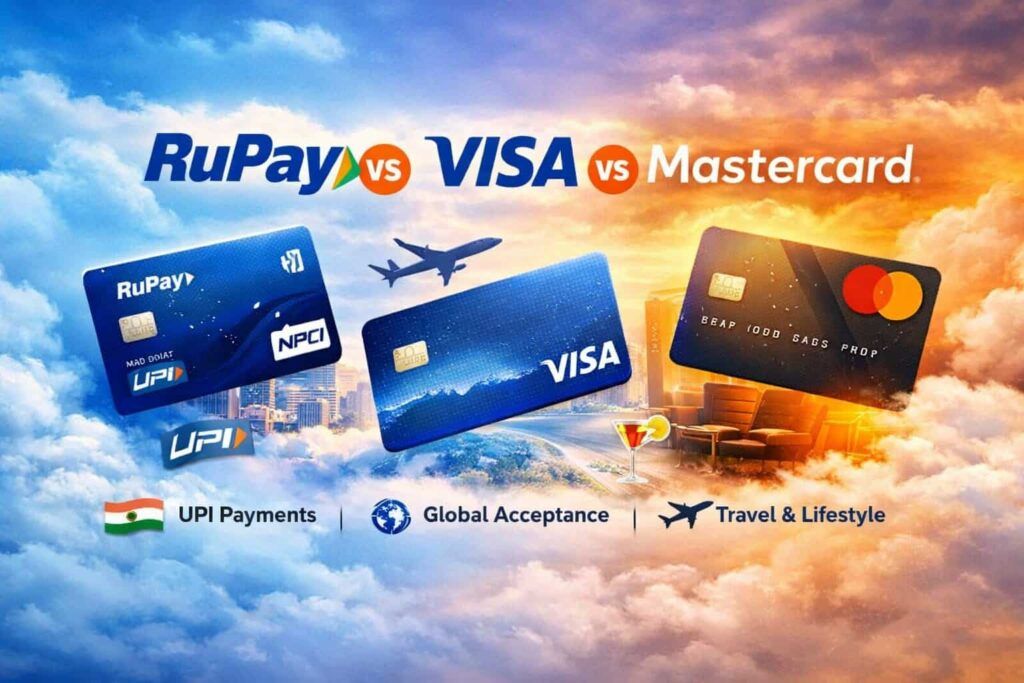
As of early 2026, the main difference between these networks is control of the ecosystem versus worldwide reach. RuPay is now becoming the preferred option for regular day-to-day payments in India, mainly because its credit cards can be linked directly with UPI, which others don’t fully provide in the same way.
As per RBI data and PIB news, by late 2025, RuPay handled around 40% of the total credit card transaction volume in India. This growth mainly came due to its UPI linking feature, and it has clearly challenged the earlier dominance of Visa and Mastercard, which used to control more than 95% earlier.
Now the combined share of Visa and Mastercard in India’s digital payments is around 21%, which has come down a lot compared to about 43% share back in 2018.
RuPay (India Use)
| Feature | Details |
|---|---|
| Origin & Use | India (NPCI), mainly local use |
| Acceptance | Strong in India (90L+ merchants, 35Cr+ UPI points) |
| UPI Support | Direct link, QR scan works |
| Data Processing | Inside India, faster settlement |
| Bank Fees | No joining or quarterly fee |
| User Use | Good for small daily payments |
| Security | High, data stays in India |
| Market Share | ~18% value, ~38% transactions |
Visa & Mastercard (Global Use)
| Feature | Details |
|---|---|
| Origin & Use | USA based, global usage |
| Acceptance | 200+ countries, millions of merchants |
| UPI Support | Limited, still developing |
| Data Processing | Global/international servers |
| Bank Fees | Membership fees apply |
| User Use | Travel, lounges, premium benefits |
| Security | Strong tokenisation, zero-liability |
| Market Share | Strong and widely used globally |
Key Highlights for 2026
- UPI Habit: RuPay is no longer only a “backup” or domestic option. Now people are using it daily. As per Cashfree, More than 50% of RuPay credit card transactions are happening through UPI QR payments only.
- Transaction Speed: For domestic payments and refunds, RuPay is often faster — many settlements happen within 24 hours because the verification data stays inside India and does not go to foreign servers.
- International Strategy: Visa and Mastercard are still stronger for use abroad. But RuPay is expanding outside India also through tie-ups with Discover (USA), JCB (Japan) and UnionPay (China).
- Dual-Network Trend: Now, many Indian banks are giving RuPay add-on cards along with existing Visa or Mastercard credit cards. Customers mainly take it so they can use a credit card on UPI QR payments for daily spending.
RuPay Network
RuPay is India’s own card payment network started by NPCI in 2012. Initially banks issued it mainly with Jan-Dhan accounts for financial inclusion, but by 2026 it has moved beyond that and become a regular-use card network. The major push came after credit cards were allowed to connect directly with UPI, which changed how customers actually use cards in daily life.
1. What makes RuPay different in practical use
- UPI credit usage: Customer can link RuPay credit card in apps like Google Pay, PhonePe or BHIM and pay by scanning QR. Amount goes from the credit limit, not bank balance.
- Small ticket spending shift: Many ₹20–₹500 payments, such as kirana shop, medical, milk booth, petrol pump. Did you know, RuPay Credit Card UPI payments surge 91% in FY25, touching ₹63825 crore.
- Lower cost for banks: No joining fee and no quarterly network membership fee, so banks often issue lifetime-free cards.
- Rural adoption: Widely used in semi-urban and village branches because customers are already familiar with UPI QR payments.
2. RuPay Cards — Snapshot
| Area | Details (Practical Banking View) |
|---|---|
| Launch Year | 2012 |
| Debit Card Presence | ~60% of India’s debit cards (As per PIB, mainly Jan-Dhan & savings accounts) |
| UPI Linking | Direct credit card linking available |
| Typical Spend Use | Grocery, pharmacy, fuel, utility bills |
| Settlement Speed | Often within 24 hours for domestic refunds |
| Fees to Banks | No quarterly network membership fee |
3. Credit Cards
RuPay credit cards’ main feature is UPI linkage. A customer can scan any merchant QR and pay using the card limit. Earlier credit cards were used mainly for big purchases (mobile, travel, EMI), but now even daily payments are moving to credit usage.
Banks also keep annual fees low because network charges are less. Rewards are usually India-focused — fuel surcharge waiver, utility cashback and festival offers instead of luxury travel rewards.
4. Debit Cards
RuPay debit cards dominate basic banking accounts. Most government benefit accounts and rural savings accounts received RuPay cards, which is why the share became so high.
- Variants: Classic, Platinum and Select
- Select version gives lounge access in some airports
- Many cards support tap-and-go metro/bus payments (NCMC)
5. Processing, Security & International Use
- Transactions are processed on servers located in India
- Customer data remains within the Indian regulatory system
- Refunds and reversals are usually faster domestically
Some Limitations – For foreign use, RuPay works through Discover, JCB and Diners Club partnerships. However, acceptance abroad is still uneven. Some international apps and websites, streaming services and smaller overseas merchants may not accept or recognise RuPay, so indian customers travelling frequently still keep a Visa or Mastercard for backup, especially for global payments and travel insurance benefits.
Visa Network
Visa is the world’s largest card payment network, and its main strength is acceptance. The card generally works in more than 200 countries, so for foreign travel, hotel booking or international websites it is still considered the safest option. Even in 2026 it remains the preferred network for high-value payments, although inside India it now faces competition because daily QR payments have shifted towards UPI-linked cards.
1. How Visa actually works in India
Visa itself is not a bank. It does not give cards directly to customers. Banks like HDFC Bank, SBI, ICICI Bank etc. issue the card, and Visa only provides the secure payment system through which the transaction is processed.
2. Common Limitations seen locally
- No native UPI credit linking: Visa credit cards cannot directly scan merchant QR on UPI apps, so for ₹100–₹300 daily payments, customers still use UPI from their bank account instead of the card. but as per outlookbusiness media, Visa to Enter UPI Space Soon.
- Higher network cost: Since settlement happens through international systems (often billed in USD), banks’ operating cost increases and annual fees or forex charges are usually higher.
- Processing time: Domestic refunds and reversals may take slightly longer compared to locally routed networks because transaction verification passes through overseas servers.
3. Visa Card Levels in India
| Variant | Typical Usage |
|---|---|
| Visa Classic | Basic usage, ATM + normal purchases |
| Visa Gold / Platinum | Reward points and lifestyle offers |
| Visa Signature / Infinite | Premium cards — airport lounge, concierge, travel benefits |
In simple words, Visa remains very strong for you for any international spending and premium travel benefits, but for any small everyday QR payments inside India, it is less convenient compared to UPI-linked options.
Mastercard Network
Mastercard is an international card payment network. It works almost the same way as Visa. The company itself does not open accounts or give cards to customers — banks like SBI Card, HDFC Bank or ICICI Bank issue the card, and Mastercard runs the payment system behind the scenes.
Its main strength is reliability in international payments and premium reward programs. For foreign travel, airline bookings or costly online purchases, many customers still prefer Mastercard because acceptance is very wide.
1. What customers actually use it for
Debit Card
- Directly connected to savings or current account
- Used for ATM withdrawal, swipe machine payment and online purchases
- Higher variants (like Platinum) usually have higher withdrawal and spending limits, and sometimes dining or travel discounts
Credit Card
- Bank gives a fixed spending limit and customer pays later
- Mostly used for large purchases, EMI conversion, online shopping and ticket booking
- Many cards focus on reward points, air miles and airport lounge visits
Transactions & Safety
- Transactions are approved quickly both inside India and abroad
- Contactless tap-and-pay works on most machines
- Extra security features like tokenisation and fraud monitoring are used for online payments
2. Practical limitations in India
- No direct QR credit payment: Same as VISA, Mastercard credit cards normally cannot be linked for scanning UPI) are still done from a bank account or cash
- Higher yearly charges: Banks pay network usage fees, so card annual fees and foreign transaction charges are generally higher than domestic network cards
- Refund timing: Domestic refund or reversal can take a little more time because transaction verification passes through international routing
Simple usage understanding
| Where customer spends | Usually works better |
|---|---|
| Small daily shop payments | RuPay |
| Travel abroad / foreign website | Mastercard or Visa |
| Reward points & lounge access | Mastercard or Visa |
| Government scheme or basic banking | RuPay |
2026 Reporting Rule
As per the new draft tax rules for 2026, banks must report if a customer’s credit card spending crosses ₹10 lakh in a year (non-cash) or ₹1 lakh cash payment. This rule applies to every network — Mastercard, Visa and RuPay — and is only for financial reporting, not a penalty.
Which is better — RuPay, Visa or Mastercard? (2026)
In reality, none of the three is “best” for every person. Visa and Mastercard are both global payment networks and their core working is almost the same. For most customers, the bank issuing the card (HDFC, ICICI, Axis, SBI etc.) and the card level (basic, platinum, signature, world type) makes more difference than the network name printed on the card.
If you are applying today, you should first check practical things — reward rate, yearly charges and lounge access — rather than only choosing the network.
Quick understanding
| Situation | Better choice |
|---|---|
| Daily QR payments in India | RuPay |
| Foreign travel or international websites | Visa / Mastercard |
| Premium travel benefits | Visa / Mastercard (higher variants) |
| Low yearly cost | RuPay (generally cheaper) |
Why do people choose differently
- A premium card from a good bank usually gives more value than a basic card from a weaker bank. (Example: a high-tier Visa card from a major bank can easily beat a basic Mastercard with fewer benefits)
- RuPay is very convenient inside India because of UPI credit linking and lower annual fees
- Visa and Mastercard remain stronger for hotels, airline bookings, foreign POS machines and overseas websites
Practical advice many customers now follow
Many users keep two cards:
- One RuPay card → for daily small payments and UPI QR usage
- One Visa or Mastercard → for travel, big purchases and international payments
This “backup” method gives almost full acceptance everywhere and avoids payment failure in serious situations.
So the answer is simple: There is no single winner — the best card depends on how you spend, not only which network you choose.
FAQs
Why is RuPay not accepted everywhere?
RuPay works mainly through Discover or JCB partners outside India. Many foreign websites and small overseas shops don’t integrate these rails yet, so payment sometimes fails, especially US-based subscriptions and niche merchants.
Is MasterCard better than Visa in India?
Inside India there is hardly any major difference. Both work on POS machines, ATMs and online shopping. Mastercard sometimes gives slightly better reward tie-ups, while Visa may have wider travel offers.
What is the advantage of RuPay credit card vs Visa credit card?
RuPay credit card links directly with UPI. You can scan QR and pay using credit limit even for ₹120 grocery purchase. Visa credit card normally cannot do merchant QR payment in India yet.
Which is safer, Visa or Mastercard?
Security level is almost same. Both use tokenisation, OTP verification and zero-liability protection. Fraud risk mainly depends on user behaviour — sharing OTP, unsafe websites or public Wi-Fi, not the network brand.
Any simple tip before choosing a card in 2026?
Check three things first: annual fee, reward value per ₹100 spend, and lounge access count. A lifetime-free card with useful benefits is usually better than a fancy high-fee card you barely use.
Hope you liked the content. Explore smart options below 👇
