In India, a fuel surcharge is an extra processing fee added when you pay for petrol using a credit card. The petrol pump has to pay transaction charges to the bank and card network, and since fuel margins are very low, that cost is passed to the customer.
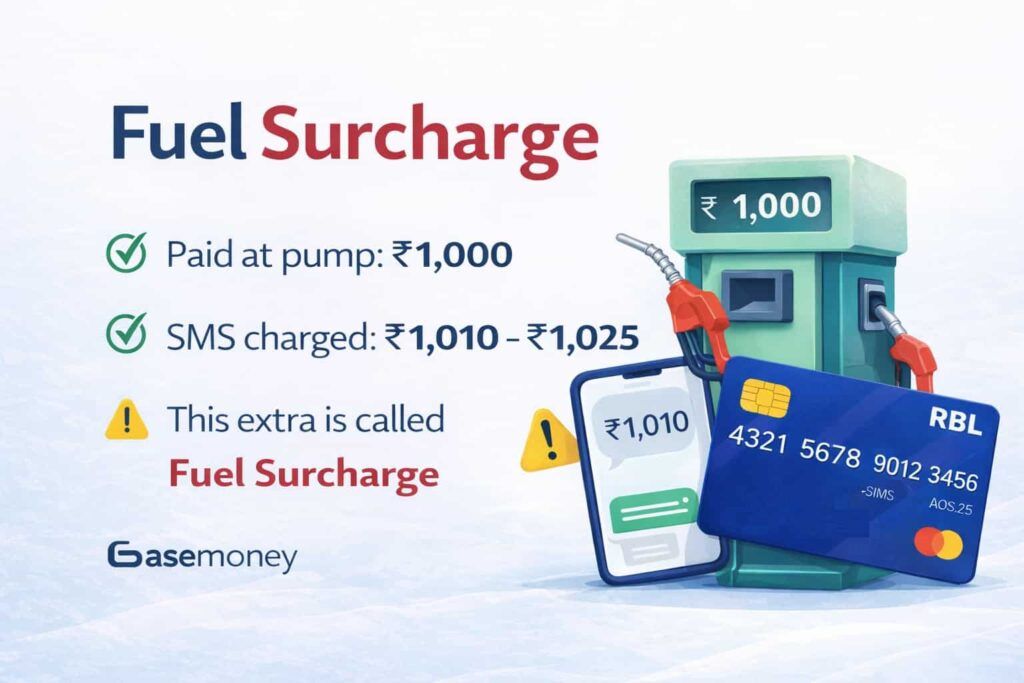
- Typical charge: about 1% of the fuel amount. sometimes, higher.
- Example For You: if you fill petrol worth ₹2,000, roughly ₹20–₹50 extra may be added on the bill. Total looks like ₹2,020-₹2,025 after fee.
This additional amount is known as the fuel surcharge.
Many cardholders think the petrol pump is overcharging. Actually, it is a normal banking charge. The good part is that most credit cards provide a fuel surcharge waiver, which refunds that extra amount back to you.
Key parts of a fuel surcharge (India)
When you pay at a petrol pump, the extra amount is not random. It has a few components and also depends on how you pay.
- Base surcharge rate = Normally around 1% of the bill, but some banks or networks can go up to about 2–2.5%.
- GST on surcharge = An extra 18% GST is applied only on your surcharge fee amount, not on your petrol price.
- Example = if the surcharge becomes ₹20, GST adds about ₹3.60 more.
Where it applies (payment method-wise)
- Credit Card = Almost all credit cards, such as VISA, MasterCard, RuPay, first charge this surcharge. Some cards later give a “fuel surcharge waiver” as a cashback/adjustment in the statement.
- Debit Card = Usually not charged at many pumps because banks often waive it to promote digital payments. Some premium debit cards also auto-refund if it appears.
- UPI (GPay / PhonePe / BHIM) = Normally, no surcharge for personal payments to you make. This is why many customers prefer UPI for fuel payments. The amount shown is the final payable.
- UPI Credit Card at Petrol Pump = When you pay for fuel by scanning the QR code using a UPI-linked RuPay credit card, the usual petrol pump surcharge normally does not apply.
So instead of the typical 1% or 2% extra charge seen on card swipes, the amount charged is usually just the fuel bill itself, making it cheaper than a regular credit-card swipe.
Credit card fuel surcharge rules (India – 2025/2026)
Fuel surcharge on credit cards is allowed in India. RBI has not banned it, but banks must follow certain conditions and transparency rules.
From 25 November 2025, NPCI introduced a system validation for RuPay cards. Because of this, petrol pumps cannot charge more than 1% of the transaction amount (Also, GST) on RuPay credit card payments.
As per RBI guidelines, it requires that all charges, such as this fuel surcharge, must be clearly disclosed to the customer at the time of issuing the card. A bank cannot suddenly add a new fee later without informing and getting consent from the cardholder.
In simple terms, the surcharge is legal, but it must stay within limits, and the bank must inform you in advance.
What is a Fuel Surcharge Waiver?
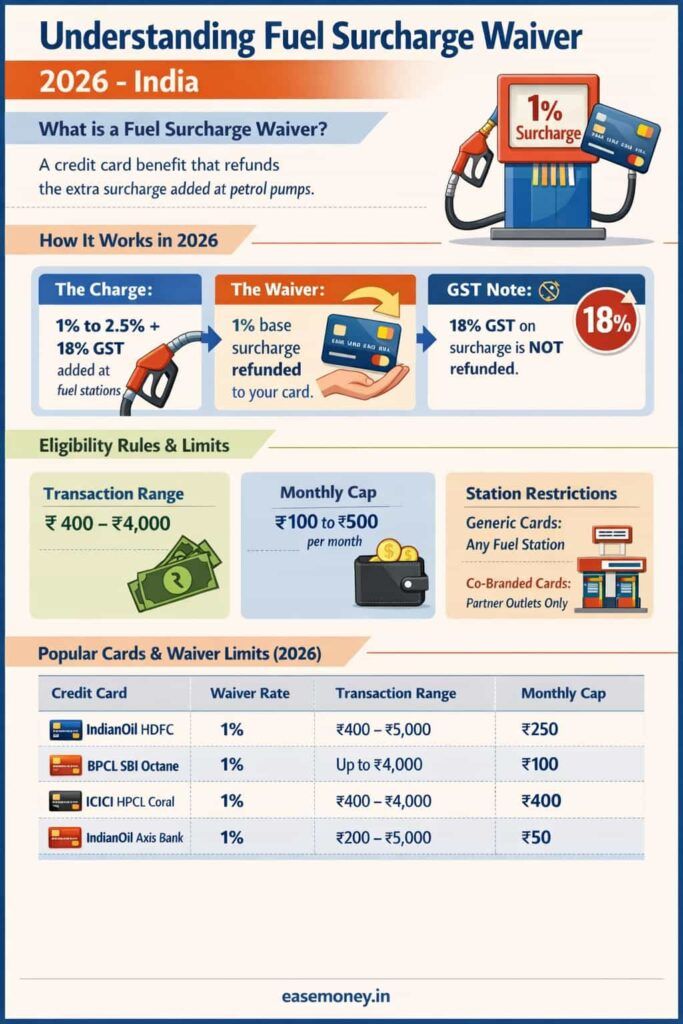
A fuel surcharge waiver is a credit card benefit where the bank refunds the processing fee charged at petrol pumps. Normally, when you swipe a credit card, about 1%–2.5% extra is added as a surcharge. because the pump pays transaction charges to the bank and card network. With a waiver, the bank absorbs that base fee and credits it back to you later.
Important tip for you: the price at the pump does not reduce instantly after payment at the petrol pump. First, you pay the full amount, then the refund appears in your next statement.
How it works (real example)
- Petrol filled: ₹2,000
- Surcharge (1%): ₹20
- GST on surcharge (18%): ₹3.60
Later, the bank credits about ₹20 back to your card. The amount you paid, ₹3.60 GST, usually remains — this is why you still see a very small extra cost.
Top Components of the Waiver
- Waiver rate: Usually 1% (some premium cards up to 2–3%)
- GST rule: 18% GST on surcharge, normally not refunded
- Monthly cap: Refund limit often ₹100–₹500 per billing cycle
- Transaction range: Valid only if the fuel bill is roughly ₹400–₹4,000 in most credit cards in India.
Key Features & Insights
- Automatic benefit: No need to apply; your bank reverses it in the statement (2–30 days)
- No reward points: Most cards don’t give reward points on fuel spends
- Co-branded condition: Some cards work best only at partner pumps (like HPCL/IOCL/BPCL)
- Statement entry: Appears as “Fuel Surcharge Reversal” or “Fuel Fee Waiver”
A missing thing many customers don’t know: The waiver usually applies only on POS “fuel merchant category code”. If the pump uses a different machine or wallet routing, the bank may not identify it as a fuel transaction.
How to use it correctly at the petrol pump
- Keep bill in range — when you fuel up, it must be kept in ₹500–₹4,000 to get the benefit.
- Use the card directly — insert/tap on the pump’s POS machine (If you use the petrol pump QR Code, there is no additional fee, it is not UPI)
- Avoid wallet routing — Paytm wallet or third-party payment may not qualify
- Use partner outlet (if co-branded) — This is important, Fuel surcharge waiver works only with the co-brand fuel card you use. Example: HPCL card at HPCL pump. However, most cards also offer all fuel station benefits.
- Watch the monthly cap — if your card caps at ₹250 monthly, extra refuels won’t be refunded
Practical tip
If your monthly petrol expense is high, split refuelling into 2–3 smaller transactions within the allowed range. One single ₹6,000 fill often loses the waiver, but two ₹3,000 fills usually get the refund. In simple terms, your petrol pump charges first, and your bank give benefit in quietly returning the base fee later — that returned amount is the fuel surcharge waiver.
Why Banks Offer This Benefit
Petrol is a daily expense in India for all. Banks know customers swipe cards regularly at fuel stations.
By offering a surcharge waiver:
- Customers prefer using that card
- card usage increases
- The bank earns interest and interchange revenue
So the bank refunds the fee as a promotional benefit to encourage spending.
When Waiver Does Not Work
Fuel surcharge reversal may not appear if:
- Card swiped outside the fuel merchant category
- International POS machine used
- transaction below ₹400
- Monthly cap reached
- The card does not support a fuel waiver
- Fastag or wallet loaded instead of fuel purchase
Fuel Surcharge Waiver vs Cashback (Common Confusion in India)
Many people think a fuel waiver is cashback. It is not. As per it names, It is just a waiver.
| Fuel Waiver | Cashback |
|---|---|
| Removes penalty fee | Gives extra money |
| Saves charges | Gives reward |
| Not profit | Actual earning |
A ₹20 waiver means you avoided paying ₹20 — you did not earn ₹20.
Top Fuel Credit Cards in India (2026) — Fuel Surcharge Waiver + Rewards
In India, almost every fuel credit card gives around 1% surcharge waiver, but actual saving comes from reward points. If you use the right petrol pump brand, total return can reach 5%–8.5%. But if you fill anywhere randomly, your benefit drops a lot — many people don’t notice this part.
Best Fuel Cards (Overall Picks)
| Credit Card | Best For | Surcharge Waiver | Approx Fuel Value-Back |
|---|---|---|---|
| IndianOil RBL XTRA | Daily commuters | 1% (≈₹200/month cap) | ~8.5% at IOCL |
| BPCL SBI Octane | Premium users | 1% | ~7.25% at BPCL |
| HPCL IDFC FIRST Power+ | UPI + fuel users | 1% (HP Pay) | ~6.5% at HPCL |
| ICICI HPCL Super Saver | Mixed usage | 1% | ~5% |
| IndianOil HDFC Card | Beginners | 1% (≈₹250 cap) | ~5% |
So you can see — the saving looks high, but only when you fill fuel at the partner pump. If you go to another company pump, reward mostly becomes normal cashback only.
Key highlights (real understanding)
- IndianOil RBL XTRA — very good for people who drive daily. Around 15 points per ₹100 fuel, so with waiver it reaches about 8.5% saving.
- BPCL SBI Octane — slightly costlier card, but you also get lounge visits yearly, so travellers prefer it.
- HPCL IDFC FIRST Power+ (RuPay) — interesting card because even UPI payment via HP Pay gives reward. Good for people who don’t like carrying physical card.
- Airtel Axis Bank Card — not a proper fuel card, but still useful because it works across many pumps unlike co-branded cards.
If you always fill at the same company pump, a fuel card works best. But if sometimes IOCL, sometimes HPCL, sometimes local pump — then a flat cashback card can give more actual saving than a specialised fuel card.
You can also read the full breakdown here: https://easemoney.in/best-credit-card-for-fuel-in-india/
FAQs
Does ICICI Coral credit card have a fuel surcharge waiver?
Yes, ICICI Coral usually refunds the 1% fuel surcharge for transactions about ₹400–₹4,000 at most petrol pumps. The refund appears in the next statement cycle, but GST on the surcharge is still charged.
Is fuel surcharge charged on debit cards?
At many pumps debit cards are not charged, or the bank auto-reverses it. Some premium debit cards explicitly show waiver. UPI still remains cheapest, usually zero extra charge for personal payments.
Does SBI SimplySAVE credit card waive fuel surcharge?
Yes, SBI SimplySAVE generally gives a 1% surcharge waiver within set limits. If you fill ₹2,000 petrol, about ₹20 returns later in statement, but GST portion remains unpaid by bank.
Do all SBI credit cards charge fuel surcharge?
Initially yes, almost every swipe adds about 1%–2.5%. But eligible SBI cards reverse the base fee later as a waiver, subject to monthly cap (often around ₹100–₹250 per billing cycle).
What is the fuel surcharge on HDFC credit cards?
HDFC credit cards also add around 1% surcharge first. Many cards refund it for fuel bills roughly ₹400–₹5,000. Reversal usually posts within 3–15 days after transaction settlement.
Why do banks not waive GST on the surcharge?
Because GST is a government tax, not a bank fee. Banks can refund their processing charge, but tax collected on that fee legally cannot be reversed to the customer.
Best way to avoid fuel surcharge completely?
Use a UPI-linked RuPay credit card QR payment or a normal UPI. In most petrol pumps during 2026, QR payments do not attract a surcharge, so the billed amount equals the meter amount.