For ICICI Bank, a late payment means you did not pay the card bill before the due date printed on your credit card statement. You don’t have to clear the full bill to stay safe, but you must pay the minimum amount on time. Even a one-day delay is treated as late payment, and here the fee is applied, and the monthly interest works on your remaining outstanding amount.
Example For You: Ravi’s statement bill was ₹12,400, and his minimum due was ₹620 with a due date of 18th. If he pays ₹620 on or before the 18th, it’s fine. But if he pays on the 19th, the bank counts it as a late payment and charges a penalty and interest.
What is the ICICI Card Late Payment Fee?
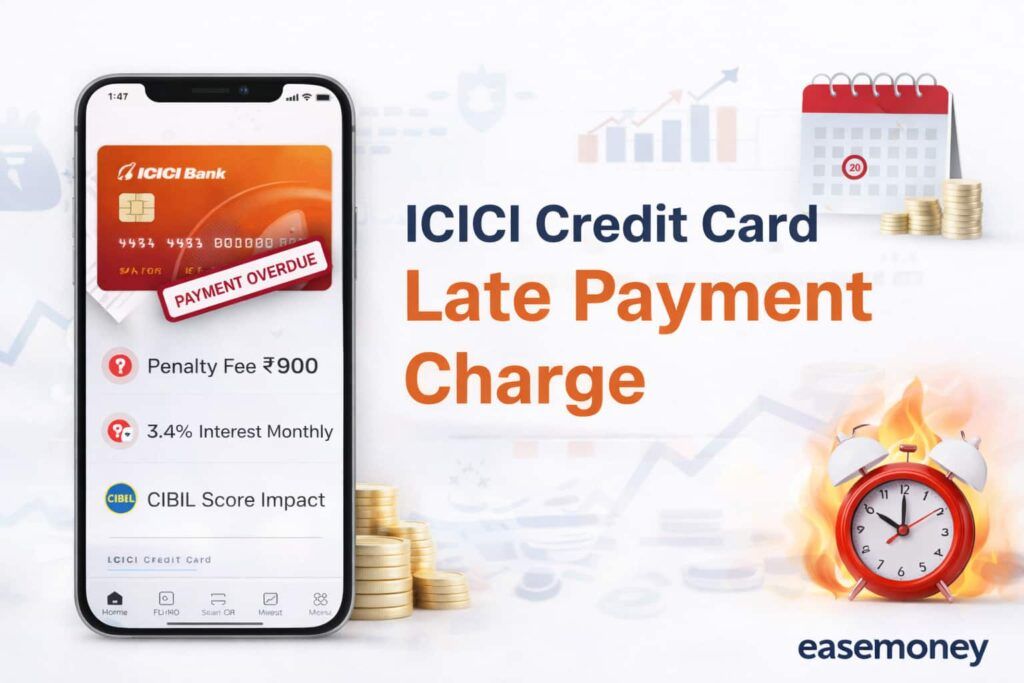
It starts after the due date. The Late Payment Fee (LPC) is a penalty ICICI charges when you miss paying at least the Minimum Amount Due (MAD) by the due date of your card.
Two different things happen after missing the date:
- Late Payment Fee → one-time penalty
- Finance Charges (interest) → continuous monthly cost
So the fee hurts once, but the interest keeps running until you clear the bill.
It does not matter whether you forgot, missed by one day, or planned to pay later — once the due date passes, the account becomes overdue and charges begin.
Important: Late fee is only the beginning. The higher cost is the interest that starts immediately after the due date.
Late Payment Fee Slab (ICICI Credit Cards – 2026)
| Total Amount Due (Bill) | Late Payment Fee |
|---|---|
| Up to ₹100 | Nil |
| ₹101 – ₹500 | ₹100 |
| ₹501 – ₹1,000 | ₹500 |
| ₹1,001 – ₹5,000 | ₹600 |
| ₹5,001 – ₹10,000 | ₹750 |
| ₹10,001 – ₹25,000 | ₹900 |
| ₹25,001 – ₹50,000 | ₹1,100 |
| Above ₹50,000 | ₹1,300 |
Note: 18% GST is added to this fee.
Example: Your bill is ₹15,000, and you pay nothing, even the minimum due. The bank adds late fee about ₹900 plus 18% GST (~₹162). Interest around 3.5% monthly starts on full ₹15,000 (~₹525). The next statement becomes roughly ₹16,587, and interest continues until your entire outstanding amount is cleared completely.
How MAD vs Full Payment Changes Everything
| What you pay | What bank does |
|---|---|
| Full bill | No fee, no interest |
| Only Minimum Due | No late fee, but interest starts |
| Less than MAD OR nothing | Late fee + interest both applied |
MAD is usually about 5% of your total bill.
What Happens Step-by-Step After Missing the Due Date
| Stage | What Happens | Effect on You |
|---|---|---|
| Day 1 (due date missed) | Bank marks late | Grace period cancelled |
| 2–3 days | Late Payment Fee added | Extra ₹600–₹1,300 charge |
| Same billing cycle | Interest starts from purchase date | Entire bill begins accruing interest |
| Next statement | Finance charges appear | Bill becomes bigger than expected |
| After 30+ days | Reported to credit bureau | CIBIL score drops |
| Continued non-payment | Collection calls start | Card may get blocked |
Important: Late fee is painful, but interest is the real danger. The card becomes expensive only when balance is carried forward, not when used properly and paid in full.
What are the Late Payment Interest Rates (Finance Charges)
ICICI calls the interest on unpaid credit card bills Finance Charges. f you don’t pay the full bill by the due date, fact: interest starts — even if you paid the Minimum Amount Due (MAD).
Standard Interest Rate
| Type | Rate |
|---|---|
| Monthly interest | 3.40% – 3.75% per month |
| Yearly (APR) | ~40.8% – 45% per year |
| Tax | 18% GST extra on interest |
So the late fee hurts once, but the interest keeps running every month until you clear the balance.
Important Rule (Most People Don’t Know): Just paying the minimum due amount only saves you from the late fee, but does NOT stop interest. Also, your interest-free period (normally 18–48 days) is cancelled immediately.
How Interest Actually Starts
- Charged from the purchase date, not the due date
- Calculated daily (average daily balance method)
- New purchases also start accruing interest instantly
- Continues until the full outstanding becomes zero
Real Example (Very Practical)
You have a amazon ICICI credit card, and your monthly bill came =
- Your Card Bill: ₹10,000
- Bank offer you to pay the minimum due: ₹500
- Interest rate: 3.5% monthly (~42% yearly)
You pay ₹500 on time as a Minimum Due. What happens:
| Item | Amount |
|---|---|
| Remaining balance | ₹9,500 |
| Interest (approx for month) | ~₹330–₹420 |
| GST on interest | extra added |
The next statement becomes around ₹9,850–₹9,950, even if you didn’t use the card again. This is why people feel “I already paid, still the bill increased”.
Card-Type Based Rates (Typical)
| Card Type | Monthly Interest |
|---|---|
| Amazon Pay / Coral / Rubyx | ~3.5%–3.75% |
| Premium (Sapphiro/Emerald) | ~3.6%+ |
| FD / Instant cards | ~2.49% (lower) |
Expert Advice: A credit card becomes expensive not when you use it, but when you carry a balance. Best practice: pay the Total Amount Due or set auto-debit for full payment. That alone saves you from almost all charges.
Late Payment — Top 7 Effects on Your CIBIL OR Credit Score
A late credit card payment hurts more than the fee. The bank reports your behaviour to the credit bureau, and that record stays visible to every future lender.
- Immediate score drop = One missed payment can reduce your score roughly 50–100 points, especially if your score was previously good (750+).
- DPD mark appears = After about 30 days overdue, your report shows “DPD / 30 days past due”, which signals risk to banks reviewing your loan application.
- Record stays long-term = Even after you clear the bill, the late-payment history can remain on your credit report for up to 7 years.
- High utilisation damage = Since dues remain unpaid, your usage percentage rises above 30%, which further pushes the score downward.
- Loan approvals become difficult = Home loan, car loan, or new credit card applications may get rejected because lenders want a clean recent repayment history.
- Higher interest on future loans = Some banks may still approve loans but charge higher interest because your risk category increased.
- Existing credit limits affected = Repeated late payments break repayment consistency, and the bank may reduce your card limit or stop future upgrades.
Quick tip: If you missed the date by only a couple of days, pay immediately. Early payment sometimes prevents the bank from reporting a serious default status to the bureau.
What is the RBI 3-Day Grace Rule?
As per RBI Card Guidelines, this rule means that one small delay doesn’t destroy your credit history. Sometimes payment gets stuck due to the bank server, holiday, or UPI delay. So banks like ICICI cannot immediately mark you a defaulter.
1. How the 3-day buffer actually works
- If your due date is 10th, the bank will wait till 13th
- During these 3 days, you can still pay and protect your credit record
- They should not report you to CIBIL before the window ends
So if you forgot one day, don’t panic — but you must act quickly.
2. What happens inside these 3 days
- You can still pay and request a late fee reversal
- CIBIL is normally not updated yet
- But interest may still be calculated from the original due date
Yes — this is important.
You are protected from credit damage, but not always from interest.
3. After the 3rd day (Day 4 onward)
Now the bank treats it as a real late payment:
- Late fee applied
- CIBIL record affected
- Collection reminders start
And this stays on your report for years.
4. Quick Comparison
| Situation | Within 3 Days | After 3 Days |
|---|---|---|
| Late Fee | Can be reversed/waived | Charged |
| CIBIL impact | No reporting | Reported late |
| Interest | Still applicable | Continues |
If you paid on Day 2, you should call customer care and ask for a late fee waiver. Many people don’t ask, but banks often reverse it when payment is made quickly. Also, remember — these are calendar days, not working days. If the due date is Friday, Saturday and Sunday still count.
Best habit: pay 2 days before the due date. You avoid server issues, holidays, and stress completely.
ICICI Late Payment Fee Waiver OR Reversal
Good news For You, ICICI often reverses the late payment fee (LPC) if you act quickly. Banks know delays happen (UPI failure, holiday, forgot date). If your record is clean, they usually help.
1. Use the RBI 3-Day Window First
If you paid within 3 days after the due date, you have a strong case. You can politely tell them: payment already done within buffer period, please reverse late fee. In many cases the bank removes both the late fee and GST. (Interest usually stays because it is system-calculated.)
2. First-Time Miss = Highest Chance
If you normally pay on time and this happened once in 12 months, ICICI treats it as a “good customer mistake”. You can call 1800 1080 and explain honestly:
- emergency
- salary delay
- technical issue
- Forgot the date
Don’t argue — request. Tone matters more than wording.
3. Step-by-Step: What You Should Do
- Pay immediately (minimum or full amount first)
- Call customer care or use the iMobile app chat
- Ask for a “late payment fee waiver”
- If refused, send an email to customer.care@icicibank.com
Always request after payment, not before. The bank will not consider an unpaid account.
4. What Banks Can and Cannot Reverse
| Charge Type | Waiver Chances |
|---|---|
| Late fee (₹100–₹1,300) | Usually reversible |
| GST on fee | Reversed with fee |
| Interest charges | Rarely reversed |
5. Simple Email Format You Can Use
“Dear Team, I noticed a late fee on my card (ending XXXX). I have cleared the outstanding amount. This delay was unintentional. Kindly reverse the late payment fee and GST as a goodwill request.”
Helpful tip = Call during daytime working hours. Night agents often cannot approve waivers. Also, once waived, immediately enable auto-debit for the total amount due — most people never face the issue again.
FAQs
What is the penalty for late payment of an ICICI credit card?
Late fee ranges ₹100–₹1,300 depending on bill amount plus 18% GST. Also finance charges about 3.5% monthly start on outstanding. Example ₹15k unpaid can add roughly ₹1,000+ extra next statement.
Can I pay my ICICI credit card 3 days late?
Yes, you can, but act fast. Paying within 3 calendar days usually avoids CIBIL reporting. Still interest may apply. Call support after payment and request late fee waiver politely.
What is the grace period for ICICI credit card payment?
RBI buffer allows about 3 days after due date before reporting default. But this is not a free extension — interest calculation may still begin from original due date.
Is there a 3-day grace period for ICICI late payment charges?
Technically yes for reporting and penalty reversal request. If you clear dues by Day-3, many customers successfully get late fee reversed, especially when account history was clean.
Amazon Pay ICICI credit card late payment charges same or different?
Same rules apply. Amazon Pay ICICI also charges slab late fee and ~3.5% monthly interest. Rewards stop until dues cleared and utilisation rises, affecting credit score slightly.
Can I pay ICICI credit card using other bank or BillDesk?
Yes, you can pay via other bank netbanking, UPI or BillDesk. But settlement may take 1–2 working days, so pay earlier than due date to avoid accidental late marking.
What is Quick Pay in ICICI credit card?
Quick Pay is instant payment page where you enter card number, mobile OTP and pay without login. Useful in emergencies when app access not working or travelling outside home.