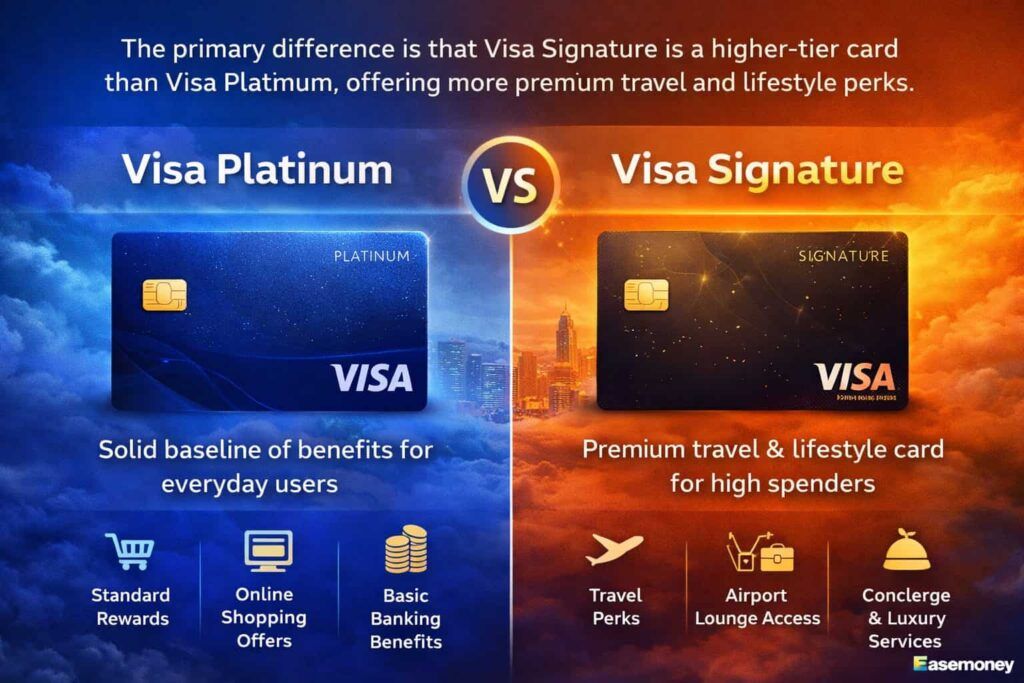
What is a Visa Card Tier (Platinum & Signature)?
Visa Platinum and Visa Signature are not two different networks or companies. They are simply card levels (variants) set by Visa and the bank. This level decides how much benefit, such as lounge access, higher spending capacity and travel cover, also depends on this category. Your likely credit limit, approval possibility, rewards and spending power the cardholder will get. Both come under the premium category, but Signature is considered one step above Platinum.
Both cards are part of the Visa payment network. The network is basically the payment system in the background — it connects your bank account with the shopkeeper’s bank and completes the transaction.
Visa + Mastercard together holds more than 80% of the total credit card spending value. As per the fxcIntel Report, VISA is heavily used for online shopping (60%+ of spending), travel booking and expensive retail purchases
1. Hierarchy of Visa Tiers
| Tier | What it means practically |
|---|---|
| Classic | Basic card for normal ATM, swipe and online payments |
| Gold | Slightly higher limits and some purchase protection |
| Platinum | Mid-premium, lifestyle offers and service benefits |
| Signature | Higher limit eligibility and travel-related privileges |
| Infinite | Top level — insurance cover, concierge and lounge access |
Normally, as tier increases, bank expects stronger income proof and better repayment record. A new borrower usually starts from Classic or Gold, and after some repayment history bank upgrades.
2. Do tiers apply to both credit and debit cards both?
Yes, these tiers apply to both credit cards and debit cards, but the benefits are not exactly the same. In credit cards, you get reward points, higher limits and travel benefits, while in debit cards, it mostly means higher withdrawal limits and some priority banking facilities.
- Credit Card: Here tier has direct impact. Signature cards generally require a good credit score and higher income. Many banks keep starting limits around ₹3,00,000 or above. Benefits include reward points, airport lounge visits and travel insurance. Billing cycle usually gives 20–50 days interest-free period.
- Debit Card: Here it depends on the type of savings account. Premium account holders get Platinum or Signature debit cards. These usually have higher ATM withdrawal limits and sometimes priority banking service or a dedicated helpdesk.
Simple understanding
So the tier printed on the card is not decoration. It quietly decides:
- How much credit limit can a bank approve
- How easy is your card approval becomes
- What offers and facilities do you receive
In short, Platinum means good category, but Signature means the bank is giving you a higher service level and trusting your repayment capacity more.
Visa Signature vs Visa Platinum (Credit Card India 2026)
Both are Visa credit cards, but the difference is the level of service. Visa Platinum is a mid-premium everyday card, while Visa Signature is treated by banks as a higher-trust customer category meant for travel and higher spending users.
Same swipe machine, same acceptance — but limit, benefits and approval conditions change a lot.
1. Full Comparison
| Feature | Visa Platinum | Visa Signature |
|---|---|---|
| Tier Level | Intermediate premium | Higher premium category |
| Target User | Regular spenders, first premium card | Frequent travellers, high spenders |
| Typical Credit Limit | Around ₹1,00,000 starting | Usually ₹3,00,000+ starting |
| Rewards | Flat cashback / points (≈1–1.5%) | Higher reward rate, bonus on dining & travel |
| Lounge Access | Often none or very limited | Commonly 2 per quarter (≈8 yearly domestic) |
| Concierge | Basic bank helpdesk | 24×7 booking & reservation assistance |
| Travel Benefits | Basic travel help | Hotel upgrades, booking privileges |
| Insurance Cover | Purchase protection, warranty | Trip delay, baggage loss, higher accident cover |
| Annual Fee | Low or lifetime-free in many banks | Usually higher yearly fee |
| Eligibility | Good credit score (~700+) | Strong credit (~750+) & higher income |
2. Important differences you actually feel
Lounge access: This is the biggest practical gap. Most Platinum cards today either removed lounge or give 1–2 visits. Signature cards usually give around 8 domestic lounge visits per year (2 each quarter) in many banks.
Income requirement: Banks generally expect higher earnings for Signature cards. Some banks keep a roughly ₹8–9 lakh yearly income range for approval, while Platinum can be approved with moderate salary and stable repayment record.
Spending power: Signature cards start with higher limit, so flight tickets, hotel bookings and big online purchases become easier without hitting the limit quickly.
3. Lifestyle benefits (Signature advantage)
Signature cardholders often get:
- Visa Luxury Hotel offers (room upgrade, breakfast, late checkout)
- travel booking help
- restaurant reservations
- event ticket assistance
Platinum mostly focuses on safe shopping — warranty extension and purchase protection.
4. Which one should you choose?
Choose Visa Platinum if:
- this is your first premium credit card
- you want low or zero annual fee
- you mainly use card for shopping and bills
Choose Visa Signature if:
- You travel few times a year
- Monthly spending is high
- You will actually use lounge visits and travel benefits
Practical idea: If your yearly card spend is below about ₹2 lakh, Platinum is usually enough. Above that, Signature benefits start paying back its annual fee.
Visa Signature vs Visa Platinum (Debit Card Only – India 2026)
In debit cards, the difference is mainly about the type of bank account holder.
Visa Platinum is normally given with regular savings accounts, but Visa Signature debit is issued to priority or high-balance customers. Same ATM machine, same swipe — but limits and facilities change a lot.
You can understand like this: Platinum is a normal premium account card, Signature is a “relationship customer” level card from bank side.
Basic Comparison
| Feature | Visa Platinum Debit | Visa Signature Debit |
|---|---|---|
| Banking Segment | Regular savings account | Priority / Wealth banking |
| Daily ATM Withdrawal | ₹25,000 – ₹50,000 | ₹1,00,000 – ₹3,00,000 |
| Daily Shopping Limit | ₹1–2 lakh approx | ₹3–6 lakh approx |
| Lounge Access | Rare or conditional | Usually 2 per quarter (≈8 yearly) |
| Movie Offers | Small discount | Often Buy-1-Get-1 type offers |
| Insurance Cover | ₹2–5 lakh accidental | ₹10 lakh up to ₹1 crore air accident |
| Annual Charges | ₹250–₹500 | ₹1,000–₹3,000 (often waived for premium accounts) |
| Extra Facilities | Normal merchant offers | Concierge help, golf or travel support |
1) Transaction Limits (practical difference)
Platinum debit is made for safe daily use — ATM withdrawal, grocery shopping, bill payment. If a customer tries a very big swipe (for example jewellery or expensive electronics around ₹2 lakh+), sometimes transaction declines due to limit.
Signature debit is issued to high-balance customers, so bank keeps much higher daily limits. People doing property token payment, travel booking or high shopping can use it without splitting transactions.
2) Airport Lounge Reality
Nowadays, most Platinum debit cards either removed lounge or keep a spend condition (for example, previous month ₹5,000–₹10,000 card usage required).
For example, as per Economic Times media, by 2026, HDFC Bank – have reduced easy lounge access on Platinum debit cards. Now, customers usually have to complete a minimum card spend of around ₹10,000 in the previous quarter to activate complimentary visits, and even then it is normally limited to about 2 lounge entries per quarter only.
Signature debit is still the reliable one for the lounge. Many banks give 2 complimentary domestic visits per quarter without heavy conditions for their priority account holders.
3) Lifestyle & Entertainment
Platinum: normal merchant discounts and standard online sale offers.
Signature: extra services — you can even call concierge to help with hotel booking, restaurant reservation or ticket arrangement. Movie ticket offers are also better in many banks.
4) Insurance & Protection
Signature debit cards carry much higher accidental cover — sometimes 5× to 10× of Platinum. Some banks also include baggage loss or purchase protection, which usually does not come with normal debit cards.
How banks usually issue them
- Visa Platinum: normally given when savings account maintains around ₹10,000–₹25,000 monthly balance
- Visa Signature: issued when customer keeps higher balance or joins priority/wealth banking program
So in simple words, Platinum is a good everyday debit card, but Signature is the one bank gives when they treat the customer as a high-value relationship holder.
Charges & Fees — Visa Platinum vs Visa Signature
Many customers only see lounge access and rewards, but the actual difference also comes in charges and small fees. Below is the practical fee comparison you normally see in Indian banks.
Basic Fee Comparison
| Fee Type | Visa Platinum (Credit/Debit) | Visa Signature (Credit/Debit) |
|---|---|---|
| Annual Fee – Credit Card | ₹0 – ₹500 (many lifetime-free) | ₹1,000 – ₹5,000 or more |
| Annual Fee – Debit Card | ₹200 – ₹350 + GST | ₹500 – ₹2,500 + GST |
| Interest Rate (Credit) | ~2.5% – 3.75% monthly (≈30–45% yearly) | ~1.9% – 3.75% monthly (some premium slightly lower) |
| Cash Withdrawal Charge | 2.5% – 3.5% (min ₹300–₹500) | 2.5% – 3.5% (min ₹250–₹500) |
| Foreign Currency Markup | Around 3.5% + GST | ~1.99% – 3.5% depending on card |
| Late Payment Fee | About ₹1,000 – ₹1,300 | About ₹1,200 – ₹1,300 |
Simple understanding: Platinum is cheaper to keep. Signature costs more yearly, but gives benefits which can recover the fee if you actually use travel or lounge facilities.
Hidden Charges people realise later
- Reward redemption fee: Many banks charge around ₹99 + GST when converting reward points into vouchers or cashback
- Fuel or rent surcharge: Around 1% extra on fuel pumps or rent payment platforms
- GST impact: Every fee — annual fee, interest or late charge — has 18% GST added on top
- Dynamic Currency Conversion: Paying in INR on a foreign machine can quietly add 1%–1.5% extra conversion margin
- Lost debit card replacement: Usually ₹200–₹500 depending on bank
Small practical tip
If your yearly card spending is low (say under ₹2 lakh), a paid Signature card often does not justify its fee. But if you travel even 2–3 times a year and use lounges, hotel offers and lower forex markup, the higher-tier card can actually become cheaper overall than a free Platinum card.
How to choose — Visa Platinum or Visa Signature (Quick 7-Step Guide)
Choosing is actually simple if you see your own spending habit, not only the card name. In branch, staff usually tell customers to check these points first:
1) Check eligibility first = If the monthly income is around ₹25,000–₹40,000, banks usually approve Platinum easily. Signature generally starts where income reaches roughly ₹75,000+ monthly or a strong existing banking relationship.
2) See lounge usage = If you never go to airports, Signature benefit goes waste. But if you travel even 2–3 times yearly, the 2 lounge visits per quarter alone can justify the higher card.
3) Calculate yearly spending = Signature annual fee (₹1,500–₹5,000) is often waived when yearly card spend crosses about ₹2–3 lakh. If your spend is low, a lifetime-free Platinum makes more sense.
4) Compare reward points = Online shopping users benefit more from Signature. Many cards give 2×–5× points on travel or e-commerce purchases. For small utility bill usage, Platinum is enough.
5) Check concierge need = Signature gives 24×7 booking help (tickets, hotels, reservations). Useful for frequent travellers, otherwise you may never use it.
6) Review insurance cover = Signature cards usually include higher lost-card liability and travel covers (like baggage delay). Platinum has basic protection only — good for safety, but not for travel protection.
7) Look at lifestyle offers = Movie and dining offers are normally stronger on Signature (often Buy-1-Get-1 ticket deals). Platinum nowadays mostly gives limited discount offers.
FAQs
Is a Signature card better than a Platinum card?
Better only if you actually use travel benefits. Signature gives higher limit and about 8 yearly lounge visits, but if monthly spend stays below ₹20,000, Platinum usually gives more practical value.
What comes above Visa Signature?
Above Signature sits Visa Infinite. Banks usually give it to wealth or HNI customers, often ₹15–₹25 lakh annual income profile, very high limits and strong travel insurance, concierge and golf privileges.
Is there a card higher than Platinum?
Yes, the order goes Platinum → Signature → Infinite. Platinum is mid-premium, Signature higher trust category, and Infinite top-tier. Each step increases credit limit range, approval scrutiny and service priority from the bank.
Is a Visa Platinum Credit card hard to get?
Not really. With a stable salary around ₹25,000–₹30,000 monthly and a 700+ credit score, many banks approve it. Even some secured cards convert to Platinum after 6–12 months repayment history.
Do Signature cards always give higher credit limit?
Usually yes, because banks link tier with risk profile. Many Signature cards start near ₹3 lakh limit in 2026, while Platinum commonly starts near ₹1 lakh, though final limit depends repayment record.
Can a bank upgrade Platinum to Signature automatically?
Yes, after 9–18 months good usage. If you pay bills on time and yearly spending crosses about ₹2–3 lakh, banks often offer upgrade call or pre-approved replacement card.
Should beginners apply directly for Signature?
If income and credit history are strong you can, but first-time borrowers often get rejection. Starting with Platinum, building 6–12 months clean record, then upgrading gives higher approval chances and limit.