



What is a Home Loan (India)?
A home loan is a long-term loan given by banks, housing finance companies, or NBFCs to help a person buy, construct, repair, or extend their house. It is a good alternative to paying the full house price at one time; the bank pays most of the money directly to the seller or builder. After that, the person who takes the loan returns the money to the bank every month in a fixed payment called EMI (Equated Monthly Instalment).
Usually, the loan runs for 10 to 30 years, because arranging such a big amount in cash is not possible for most middle-class and small-town families.
During the loan period, the house itself acts as the bank’s security.
- You and your family live in the house
- You use and maintain the property
- But legally, the bank keeps a financial right over it until the full loan and interest are cleared
After the last EMI is paid and the bank gives a No-Dues Certificate, the bank’s charge on the property is removed, and the house becomes yours completely. If a person stops paying EMIs for a long time, the bank has legal power under the SARFAESI Act, 2002, to recover its money by selling the house.
Because the loan is backed by property security, a home loan is called a secured loan.
Simple Example (Small Town Family)
Location: A family living in a town like Churu (Rajasthan) or Sitamarhi (Bihar)
- House price: ₹18,00,000
- Family savings (down payment): ₹3,00,000
- Bank loan: ₹15,00,000
- Interest rate: about 8.75% per year (typical range in 2025–2026: around 8.4%–9.5%)
- Loan period: 20 years
- Monthly EMI: about ₹13,200
Instead of arranging ₹18 lakh together — which is very difficult for families dependent on farming, small shops, or local service work — the family pays a monthly amount similar to house rent.
Why Home Loans Are Important in Small Cities
In tier-3 towns, land and construction cost is lower than in metro cities, but income is also lower. Most families depend on:
- savings
- gold
- agriculture income
- small business earnings
They usually cannot collect a big lump-sum amount. A home loan helps them own a house 10–15 years earlier instead of waiting many years to save enough money. In many rural districts, government schemes like Pradhan Mantri Awas Yojana (PMAY) also give an interest subsidy up to ₹2.67 lakh, which reduces the EMI burden for eligible families.
Key Facts
- Down payment: usually 10% to 25% of property value
- Maximum tenure: up to 30 years
- EMI includes principal + interest
- The interest rate normally changes according to the RBI repo rate (floating rate loan)
- In most floating-rate loans, prepayment can be done without penalty
10 Important Features of Home Loans in India
- High Loan Amount – Usually, banks finance around 75% to 90% of the property value. You only arrange the down payment part.
- Long Repayment Period – The tenure can go up to 20–30 years. Because of this long period, the EMI stays manageable for salaried families.
- Lower Interest Rate – Since the house is secured, the interest is much lower compared to personal loans or credit card dues.
- Tax Benefit – Under the old income tax regime, both principal and interest payments can give a tax deduction, which helps reduce the yearly tax burden.
- No Charge for Early Closure – In most floating-rate home loans, you can repay early or close the loan faster without an extra penalty.
- Fixed or Floating Interest Choice – You may choose a fixed EMI for stability or a floating rate linked with the RBI repo rate, which can go up or down over time.
- Property Verification by Bank – Before approval, the bank checks property papers and ownership records. This also helps the buyer avoid risky or disputed property.
- Balance Transfer Facility – If another bank offers a lower rate, you can shift your existing loan there to reduce EMI or interest burden.
- Top-Up Loan Option – Existing borrowers can take an additional loan on the same property for renovation, interior work, or family needs at a cheaper rate than personal loans.
- Construction Period Relief (Pre-EMI)– During the construction stage, banks may allow paying only interest initially. Full EMI starts after possession or completion.
In short, a home loan is a big commitment, but also the most affordable loan available — it works well as long as the EMI payment is regular and disciplined.
What is a Home Loan EMI Calculator?
A Home Loan EMI Calculator is a small calculation tool used to estimate the monthly repayment amount a customer has to pay to the bank after taking a housing loan. It shows the EMI based on loan amount, interest rate, and loan tenure.
| Year | EMI | Principal Paid | Interest Paid | Balance |
|---|
What are the Home Loan Interest Rates in India?
When customers come for a housing loan, most of them first focus only on loan eligibility — “how much loan can I get”. But in actual banking, the bigger factor is interest rate, because that decides your final cost of the house. For a long loan (20–25 years), even a 0.50% change in interest can change the total payment by ₹2–5 lakh easily.
For bigger loans like ₹40–50 lakh, the difference can cross ₹8–10 lakh over the full tenure. That is why, before sanction, bank always explain the rate type properly. In India, home loans are given mainly in two rate systems:
- Fixed Rate
- Floating Rate
What is the Fixed Rate vs Floating Rate?
1. Fixed Rate
In fixed rate home loan, your interest remains constant from the first EMI to the last EMI. Let’s take an example –
- Loan Amount: ₹25,00,000
- Tenure: 20 years
- Interest (Fixed): 9.25%
Your EMI will remain almost the same for the entire 240 months. No increase, no decrease. This helps people who want predictable expenses — especially pensioners or single-income families. But one thing: fixed rate normally starts higher than floating. The bank keeps a higher rate because it is taking the future risk.
2. Floating Rate
In a floating rate, interest is not permanent. It changes when the RBI changes the repo rate. Today, most banks in India follow repo-linked housing loans. At the start floating rate is cheaper. But later it can go up or down. Example:
- Loan: ₹25,00,000
- Tenure: 20 years
- Starting Rate: 8.40%
- EMI approx: ₹21,600
If RBI increases the rate by 1% →, EMI becomes around ₹23,200, or the bank may keep EMI the same and extend the loan period. This is why floating rate feels good initially, but customers must understand movement risk. Still, around 80–90% new borrowers in India choose a floating rate, because historically rates fall after some years.
Interest Rate History (Real Movement: 2000 – 2026)
Housing loan rates in India changed a lot in last 25 years. Earlier loans were very costly.
| Period | Typical Rate | What was happening |
|---|---|---|
| 2000 – 2004 | 12% – 14.5% | High inflation, borrowing expensive |
| 2005 – 2010 | 8% – 11% | Bank competition increased |
| 2011 – 2015 | 9.5% – 10.5% | Base Rate system introduced |
| 2016 – 2019 | 8.5% – 9.5% | MCLR system started |
| 2020 – 2022 | 6.5% – 7.5% | COVID period, RBI cut repo heavily |
| May 2022 – Feb 2023 | Repo raised from 4.0% to 6.5% | EMIs increased across banks |
| 2023 – 2025 | 8.1% – 9.5% | Inflation control policy |
| 2026 (current range) | 7.1% – 8.7% | Repo-linked loans stabilized |
You can see clearly that rates go up and down in cycles. They never stay permanent for 20 years. Many customers who took a loan around 2003–2004 at 13% later refinanced their loan when rates dropped to near 7% during 2020–2021.
How Interest Actually Works 2026 (Repo Linked System)
Now, almost all major banks follow RLLR — Repo Linked Lending Rate. Your loan interest is not decided randomly. It is calculated:
Final Rate = RBI Repo Rate + Bank Spread (around 2%–3%)
Example (Early 2026 type situation):
- RBI Repo Rate ≈ 6.50%
- Bank Spread ≈ 2.10%
- Customer Interest ≈ 8.60%
Important point: Banks check and reset your interest every 3 months.
So: If RBI cuts repo → EMI reduces, and if RBI increases repo → EMI increases or tenure increases. Usually bank first increase tenure, not EMI, to reduce customer shock. That is why some people suddenly see the loan extending from 20 years to 24 years.
Which bank is giving what type (ground reality)
Nowadays, almost all banks not giving old-style fixed interest loans much. Most are repo-linked floating only, because RBI rate changing frequently.
- SBI — mostly repo linked floating home loan only. Rate moves when RBI changes repo.
- HDFC Bank — they give floating also, and some plans where first few years fixed then later floating.
- ICICI Bank — fully repo-linked floating type.
- Bank of Baroda — normal floating home loan.
- Axis Bank — floating loan, but they offer step-up EMI also (starting EMI low, later increases).
- LIC Housing Finance — both fixed and floating they keep, depends on scheme.
- Kotak Mahindra Bank — floating repo-based.
- Bajaj Housing Finance — flexible tenure floating loans, they adjust EMI or tenure.
So basically today, fixed rate loan is now rare in practical banking. Almost all customers finally go in floating only.
What are the Benefits of Home Loan in India
A home loan is not just a bank giving money. It is a long-term arrangement. The bank helps you buy house today, and you repay slowly over many years through emi. because honestly, most families cannot arrange full amount in cash. For example, if your flat price is around ₹35–40 lakh, collecting this much savings may take 15–20 years.
And during that time, property rate also keeps increasing. So many people keep waiting and never actually purchase. Since the loan is secured on the house itself, bank risk is lower. That is why interest rate also lower and EMI becomes manageable monthly.
1. Early Home Ownership
- You can shift into your own house immediately after purchase.
- No need to wait many years for full payment collection.
- EMI runs gradually, but ownership starts now.
- Many customers directly move from rented house to own house using loan.
2. Lower Interest Compared to Other Loans
- Home loan interest is cheaper than a personal loan or a credit loan.
- Reason — the property stays as bank security.
- Bank risk less, so rate also less.
Typical comparison bank show customers: Personal loan: approx 12%–18%, but Home loan: approx 7%–9%. Over 20–25 years, this difference becomes very big in total payment.
3. Tax Saving Benefit (Only mainly useful under the old tax regime)
The customer can claim a deduction every year: Principal repayment — Section 80C and Interest payment — Section 24. For salaried persons, taxable income reduces and yearly tax saving happens.
4. Balance Transfer Facility
- A loan is not permanently locked in one bank.
- If another bank offers lower rate later, customer can shift the loan.
- The new bank closes the old bank loan and continues the EMI.
Many people do this when market interest rates fall.
5. Top-Up Loan Option
- After few years repayment, the customer can take an additional loan on the same property.
- This is called top-up loan.
- Interest is cheaper than a personal loan.
Common uses: house renovation, children’s education, OR medical expenses
6. Long Tenure Flexibility
- Home loan tenure can go up to 25–30 years.
- Because tenure is long, EMI becomes affordable for middle-income families.
- Without long tenure, many applicants would not be eligible for a house purchase.
How the RBI Customer Protection Rules work in Home Loan?
RBI mainly wants one thing: borrowers should not feel trapped after taking a home loan. So rules focus on fair treatment, clear information, and proper recovery behaviour.
Key RBI Home Loan Protections
| Area | What It Means for Customer |
|---|---|
| Prepayment / Foreclosure | No penalty on floating-rate home loans. You can close loan early or pay lump-sum anytime. |
| Loan Transfer | You are allowed to shift loan to another bank for better rate. Existing bank must respond within about 21 days. |
| Interest Rate Changes | Bank must inform whenever interest rate changes (reset). Customer can also request conversion to fixed option if available. |
| Recovery Agent Conduct | Recovery staff must be authorized, no harassment, and calls/visits allowed only between 7 AM – 7 PM. |
| Hidden Charges | All charges — processing, legal, documentation — must be told clearly before sanction. |
| Fair Treatment & Privacy | Bank must not discriminate and must keep customer financial data confidential. |
| Property Documents | After loan closure, bank must return all original property papers within specified time. |
| Complaint Resolution | If bank does not resolve complaint within 30 days, customer can approach RBI Ombudsman. |
Official RBI consumer guideline reference: https://www.rbi.org.in/Commonman/English/Scripts/CustomerServiceGuidelines.aspx
What this actually means
- Bank cannot trap you with penalty if you want to repay early.
- The bank cannot hide conditions after you sign.
- Bank cannot send recovery agents to threaten or disturb family.
- The bank must keep proper communication regarding interest rate changes.
- Even after sanction, you still have rights as a borrower.
Basically, a home loan is long-term, so the RBI wants transparency from day one till closure.
What is the Home Loan Eligibility in India
Home-loan approval is not random checking. Bank mainly sees one thing — during your earning years, can you repay safely or not? Every bank form may look different, but internally, almost all banks check the same core points:
- income stability
- repayment capacity
- credit history
- property value
If these look comfortable, the case moves forward. If not, file usually stops before sanction stage.
1) Basic Eligibility Requirements (first screening)
Before even opening the full file, bank check basic conditions:
- Applicant should be a resident Indian (NRI has a separate scheme)
- Minimum age is normally 21 years at application
- At last EMI time, age generally should not cross around 65–70 years
- Salaried person must have a stable job with a regular monthly salary credit
- Self-employed person should show running business continuity (normally 3 years)
If these basic points not matching, bank normally cannot proceed further.
2) Income & Salary Requirement
Here bank does not see only salary amount — consistency matters more.
- Salaried income usually minimum around ₹18,000–₹25,000 per month (bank & city dependent)
- Self-employed annual income generally ₹2–3 lakh or higher
- Work experience expected minimum 2–3 years
- Stable income is preferred over high but irregular income
- Adding co-applicant (spouse/parent) increases eligibility and loan amount
Many customers qualify only after making a joint application.
3) Credit Score (Most Important Check)
| Credit Score | Practical Outcome |
|---|---|
| 750+ | Best rate and fast approval |
| 700–749 | Normal approval |
| 650–699 | Limited loan or higher interest |
| Below 650 | Approval difficult in most banks |
4) RBI Lending Limits & Margin Money
The bank cannot finance the full property value. The customer must also invest their own portion.
- Up to ~90% funding for lower value property
- Around ~80% for mid-range property
- Around ~75% for higher value property
- Stamp duty & registration cost are not counted in the property value
- No prepayment penalty on a floating-rate home loan
- After loan closure, the original property documents must be returned within 30 days
So, before booking a property, the margin money should be ready.
5) Required Documents
| Category | Salaried Applicant | Self-Employed Applicant |
|---|---|---|
| KYC | PAN, Aadhaar, Voter ID, or Passport | Same documents |
| Income Proof | Last 3 salary slips + Form-16 | ITR (2–3 years) |
| Bank Statement | Last 6 months salary account | 6–12 months current account |
| Property Papers | Sale agreement & approved plan | Same |
6) EMI Capacity Rule (FOIR)
A bank does not give loan only seeing income. bank calculate how much EMI you can actually handle every month. Normally, total EMI should stay around 40%–50% of monthly income.
- Existing loans (car, personal loan, credit card EMI) reduce eligibility
- Less debt increases the loan amount
- Longer tenure increases eligibility but increases total interest
Many times, bank advise customers that closing small loans first increases eligibility, even without a salary increase.
Bank first checks repayment safety. Only after that valuation and sanction start. If eligibility weak, good property won’t help. Keep credit score clean, close small loans, and keep margin ready before applying.
What are the Home Loan Fees & Charges
Nowadays, hidden charges are much less than earlier because the RBI made rules strict. Still, home loan is not only EMI. At disbursement time, some bank charges and some government registration expenses come, and many customers get surprised because they calculated only EMI.
One-Time Charges (at processing/disbursement)
| Charge Type | Practical Meaning |
|---|---|
| Processing Fee | Around 0.25%–1.5% of loan amount depending on bank and customer profile |
| GST | 18% GST applicable on processing and bank service charges |
| Legal & Technical | ₹3,000–₹10,000; lawyer checks papers and engineer verifies property value |
| CERSAI Entry | ₹50–₹100; central record so same property cannot be mortgaged in two banks |
| MODT / Mortgage | ~0.1%–0.5% of loan amount (state-wise); legal registration of mortgage |
These charges usually come just before the bank releases the loan amount.
Service Charges After Loan Starts
- No foreclosure/prepayment penalty on floating-rate home loan
- Late EMI penalty if installment delayed
- Rate conversion fee if you request a lower interest rate later
- ECS/NACH bounce charge (about ₹300–₹750) if auto-debit fails due to low balance
So keeping balance in the EMI account before the debit date is very important. Before disbursement, legal and mortgage expenses will definitely come, so don’t plan only the down payment amount. Keep some buffer money also.
How to Apply for a Home Loan in India — Step-by-Step
Nowadays, you can start an application online, but approval is not only a computer decision. The bank still manually checks income, repayment capacity, and property papers. Reason simple, this loan will run 20–30 years, so proper verification is necessary.
Many cases get rejected not because the customer is a bad profile, but because they applied for a higher loan than their repayment capacity. Better decide EMI first → then choose the loan amount.
Step-by-Step Process
- Fill Application Form – You can apply online or by visiting a branch. Basic personal details, job/business details, income, and property info are entered.
- Submit Documents – Your Bank asks for KYC and financial proof: Aadhaar, PAN, income proof, bank statements, and property papers (if selected).
- Pay Processing Fee – Around 0.25%–1.5% of the loan amount (bank & profile dependent). This starts credit checking and verification work.
- Bank Discussion / Interaction – The loan officer contacts you and understands the requirement. They mainly check whether EMI suits your monthly income.
- Residence & Office Verification – A bank representative may visit your house or workplace. This is normal — only to confirm the applicant actually lives/works there.
- Credit Appraisal – Bank checks CIBIL score, credit card usage, and existing EMIs. More running loans = lower eligibility.
- Sanction Letter Issued –
- If the profile is fine, the bank gives an approval letter.
- It contains the loan amount, interest rate, and tenure.
- Valid generally for around 3–6 months.
- Legal & Technical Property Check –
- Lawyer verifies ownership documents.
- The engineer checks the property value and construction condition.
- Without this clearance, the loan cannot be released.
- Loan Agreement Preparation – Final documents are prepared and stamped with all terms & conditions.
- Agreement Signing & EMI Setup – You sign the agreement and give auto-debit (NACH/ECS) from your bank account. EMI schedule becomes active.
- Loan Disbursement – Bank releases money:
- Ready property → full payment to seller/builder
- Under-construction → stage-wise payment
What the Easemoney Home Loan Eligibility Planner Can Do?
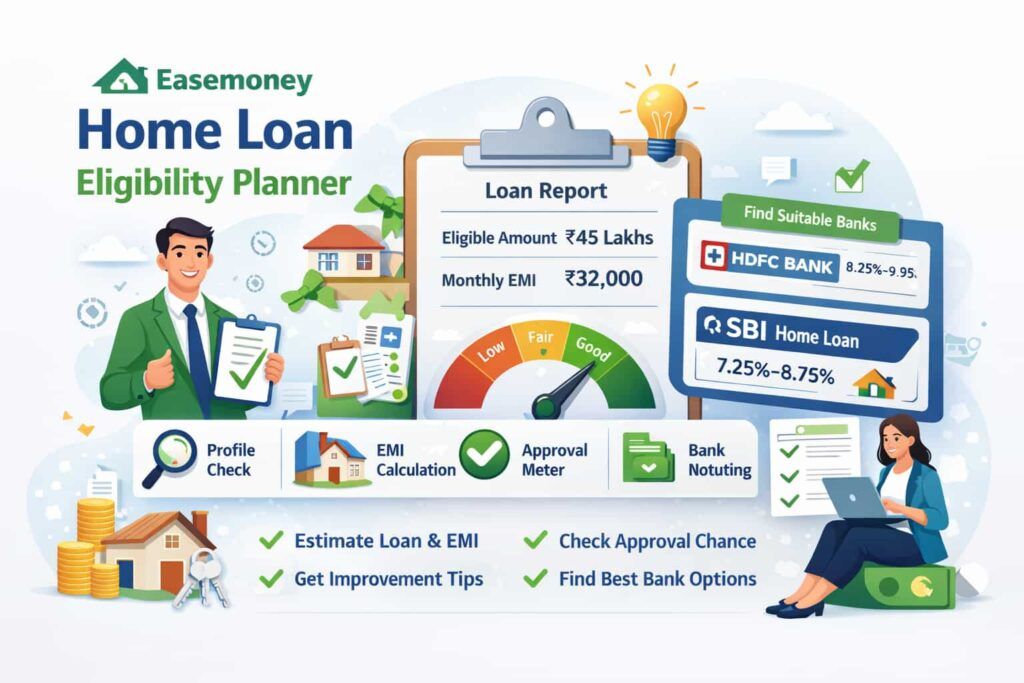
The Easemoney planner works like a pre-check before visiting a bank. Instead of directly applying and facing rejection, a user can first understand whether the loan looks affordable and realistic according to normal banking standards.
The tool reads financial details and property information and then estimates approval chances, safe EMI and suitable lenders. If you are eligible, it show offer directly below. such as HDFC Home Loan OR SBI home Loan.
Main Functions
| Feature | What the Planner Shows |
|---|---|
| Profile Check | Reviews income, age, CIBIL score and existing EMIs to judge repayment strength |
| EMI Calculation | Estimates loan amount and monthly EMI based on property value and tenure |
| Approval Meter | Indicates rejection risk or approval comfort level similar to a bank’s first screening |
| Advice Section | Suggests corrections like increasing down payment or reducing current loans |
| Report Card | Generates summary with safe loan amount and recommended EMI range |
| Bank Matching | Suggests banks that fit the user’s eligibility profile |
Key Benefits
- Helps avoid loan rejection by checking eligibility first
- Prevents over-borrowing and selecting too costly a property
- Guides the user to improve credit or reduce liabilities
- Saves time before submitting documents to a bank
Simple understanding: The planner does what a branch loan officer normally does in the first meeting — checks repayment comfort, not just EMI. After using it, a user approaches the bank prepared, with realistic expectations and better approval chances.
FAQs
How much EMI for a 20 lakh Home Loan?
At 8.5% interest for 20 years EMI comes near ₹17,356 monthly. For 30 years EMI around ₹15,400 but interest becomes almost ₹17 lakh total. Longer tenure looks easy but costs heavy.
How to reduce a 20 year Home Loan to 10 years?
Increase EMI after salary increment and pay one extra EMI yearly. Even ₹2,000 extra monthly payment can cut 20 year loan near 11 years and save huge interest amount.
Which bank is best to take a Home Loan?
PSU banks like SBI or Bank of Baroda are safer and transparent. Private banks approve faster but paperwork strict and eligibility checking tighter for irregular income borrowers.
How much home loan for ₹70,000 salary?
Banks allow EMI around 50% salary. For ₹70,000 income EMI near ₹35,000 allowed. That gives roughly ₹40–48 lakh loan depending credit score and existing loans.
What is the best time to take a Home Loan?
Best time is when RBI reduces repo rate cycle. Banks cut rates within few months. Also apply after clearing personal loan and improving credit score above 730.
Which home loan is cheapest?
Cheapest means lowest total cost not lowest interest. Check processing fee, reset period and insurance. Many 7.2% loans become costlier than 7.6% loans overall.
What is 5-20-30-40 rule for home loan?
5% savings ready, EMI below 20% income ideally, tenure under 30 years, and keep emergency fund equal four months EMI before applying loan.
Does CIBIL score matter a lot?
Yes below 650 difficult approval. Above 750 best interest rate. Improving score even 30 points can save lakhs interest across loan lifetime.
What is PMAY subsidy scheme?
Government gives subsidy up to 6.5% interest benefit credited to loan account. EMI reduces significantly for eligible lower income families.