

Did you know? Since the 2015 amendment, you don’t need ₹1 lakh capital to start a Private Limited Company. Now, you can begin even with ₹1,000, which makes entry much easier.
In India, a Private Limited Company works under the Companies Act, 2013 and is widely used by startups and growing businesses. It offers –
- Separate legal identity → business and owner are different
- Limited liability → your personal assets stay safe in long term
- Better trust → customers and investors take it seriously
- Funding advantage → easier to raise money later and very simple profile.
Choosing the right structure at the start matters. It affects how your business runs, grows, and handles legal work.
- Before that → many small businesses stayed unregistered and most people try to avoid paperwork.
- Now → more people prefer formal registration for growth and trust
Real insight: Many founders don’t face problems in starting, but later during funding or compliance. A Private Limited structure solves most of these early, so future growth becomes smoother.
Understanding Private Limited Company Registration

Private Limited Company Registration means you are legally starting your business under the Indian Law and Companies Act, 2013. Once registered, your business becomes a separate legal entity. That means you and your company are different.
Like this, your company can open a bank account, sign contracts, Own PAN Card, and run operations in its own name. Unlike normal unregistered businesses, this gives you more trust and structure.
Key Characteristics & Basic Requirements
If you are planning to start a Private Limited Company, these are the main things you should understand.
- Limited Liability → You are only responsible for the amount you invest. Your personal assets stay safe, unlike in normal business
- Members → Minimum 2 and maximum 200 shareholders allowed
- Directors → At least 2 and up to 15, with 1 Indian resident (182+ days rule)
- Perpetual Nature → Company continues even if owner changes or something happens
- Restricted Shares → Shares are not freely sold like public companies
Now basic setup requirements for You (if startup or small business):
- You need 2 people minimum to start
- No big capital needed → even ₹1,000 is fine
- Office address required → for legal communication
If you are starting with a friend or small team, this structure works well for long-term growth.
Registration Requirements
To register your company, you need to complete a few basic things. Process is simple, but small mistakes can delay approval.
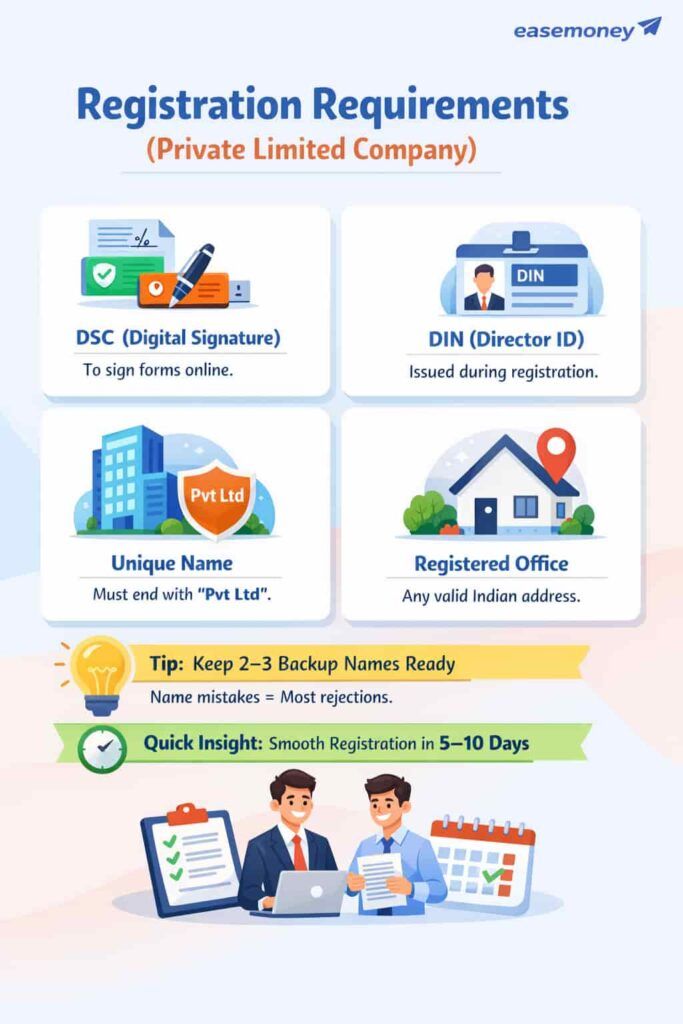
- DSC (Digital Signature) → Needed to sign forms online
- DIN (Director ID) → You get this during registration itself
- Unique Name → Must follow MCA rules and end with “Pvt Ltd”
- Registered Office → Any valid Indian address (home or office both work)
Example: If you start with your friend, both of you will take DSC, apply DIN through SPICe+, choose a unique name, and use your home address as registered office.
- Tip: Always keep 2–3 backup names ready. Many applications get rejected due to name similarity.
- Real insight: Most delays happen in name approval and document mismatch. If you upload correct documents and choose a unique name, registration can complete smoothly in 5–10 days.
Why Small Businesses Should Consider Pvt Ltd Company Registration
Now in 2026, choosing a Private Limited Company is not just a legal step, it is a strategic move. It gives you risk protection + growth potential together.
As per Startup India (DPIIT data), India has crossed 1.2 lakh+ recognised startups (2025–26), and most of them are structured as Private Limited Companies. This clearly shows where serious businesses are going.
1. Protection of Personal Wealth
- Limited liability → your personal assets stay safe
- If business fails, only company assets are used
Example: If company has ₹10 lakh loss, your personal savings are not affected. means you have proper management, it feel like a chrome browser with multiple profile. (if one site crashes, it doesn’t take down your whole computer)
2. Better Access to Funding
- VCs and investors prefer Pvt Ltd structure
- Easy to issue shares and raise capital
- Banks offer better loan limits and interest rates
Insight: Around 80–90% funded startups in India use Pvt Ltd structure.
3. Tax Efficiency (FY 2025–26 / 2026–27)
Now tax is one area where Private Limited Company gives a clear advantage, especially if your income grows.
- Lower Corporate Tax → Small companies (turnover below ₹400 crore) usually pay around 25% tax, which can be lower than high personal tax slabs.
- Expense Benefits → You can claim expenses like rent, salary, marketing, software costs. This helps reduce your taxable profit.
- Startup Benefits → As per Startup India (DPIIT), eligible startups can get a 3-year tax holiday and also relief from Angel Tax.
If you plan to grow income beyond ₹10–15 lakh, a Private Limited structure can help you manage taxes better compared to individual taxation
Example: If your business earns ₹10 lakh profit, after deducting expenses like rent and salary, your taxable income reduces. This means you pay less tax legally.
4. Brand Credibility & Market Position
Now this is where many small businesses see real difference after registration.
- Professional Image → Adding “Pvt Ltd” instantly makes your business look more genuine and structured. Clients, vendors, and even banks trust you more
- Better Opportunities → It becomes easier to apply for corporate contracts and government tenders, because many companies prefer working with registered entities
- Global Scope → This structure is globally recognised. In many sectors, you can receive 100% FDI under automatic route, which helps if you plan to expand or bring foreign investment
Example: If you approach a big company as a sole business vs a Pvt Ltd, chances are higher they will prefer the registered company.
Quick Fact for You: In real market, trust matters more than marketing. A Private Limited Company builds that trust from day one.
5. Operational Longevity
This is one benefit many people ignore, but it matters a lot in long term.
- Perpetual Succession → A Private Limited Company continues even if a director leaves or something happens. Unlike small businesses, it does not stop suddenly.
- Business Continuity → Ownership can change, but company keeps running smoothly.
- Talent Advantage → You can offer ESOPs (Employee Stock Options) to employees. This helps you attract good talent even if you cannot pay very high salary initially.
If one founder exits, company still runs without legal issue.
Private Limited vs Sole Proprietorship – Real Difference
In 2026, choosing between Private Limited Company and Sole Proprietorship depends on what you want long-term. If you want small, simple setup → proprietorship. If you want growth, funding → Pvt Ltd.
Quick Comparison
| Feature | Sole Proprietorship | Private Limited Company |
|---|---|---|
| Legal Identity | Same as owner | Separate entity |
| Liability | Unlimited (risk on personal assets) | Limited (only share value) |
| Members | 1 person | Min 2 directors + shareholders |
| Tax | As per personal slab | ~22–25% corporate tax |
| Funding | Very hard | Easy (investors prefer) |
| Compliance | Low | High (ROC, audit, filings) |
| Audit | Above ₹1 Cr turnover | Mandatory always |
| Cost | ₹2k – ₹5k | ₹7k – ₹30k |
What You Actually Feel in Real Life
- Sole Proprietorship
- You control everything, no approval needed
- Good if small shop, freelance, local work
- Less headache in compliance
- But risk is high → if loss happens, your personal money also affected
- Private Limited Company
- Your personal assets stay safe (big benefit)
- Banks, investors trust more → easy loan or funding
- You can grow, hire team, even raise investment
- As per Startup India, eligible startups can get 3-year tax holiday (DPIIT)
Pro Tip – Many people start as proprietorship to save cost, but when business grows, they shift to Pvt Ltd. If you already plan scaling, better start as Private Limited from beginning — saves time later.
Step-by-Step Process of Private Limited Company Registration
In 2026, Private Limited Company registration in India is fully online. No office visit, no paper work. Everything you do from mobile or laptop using MCA V3 portal.
Below is real process how people actually do it today:
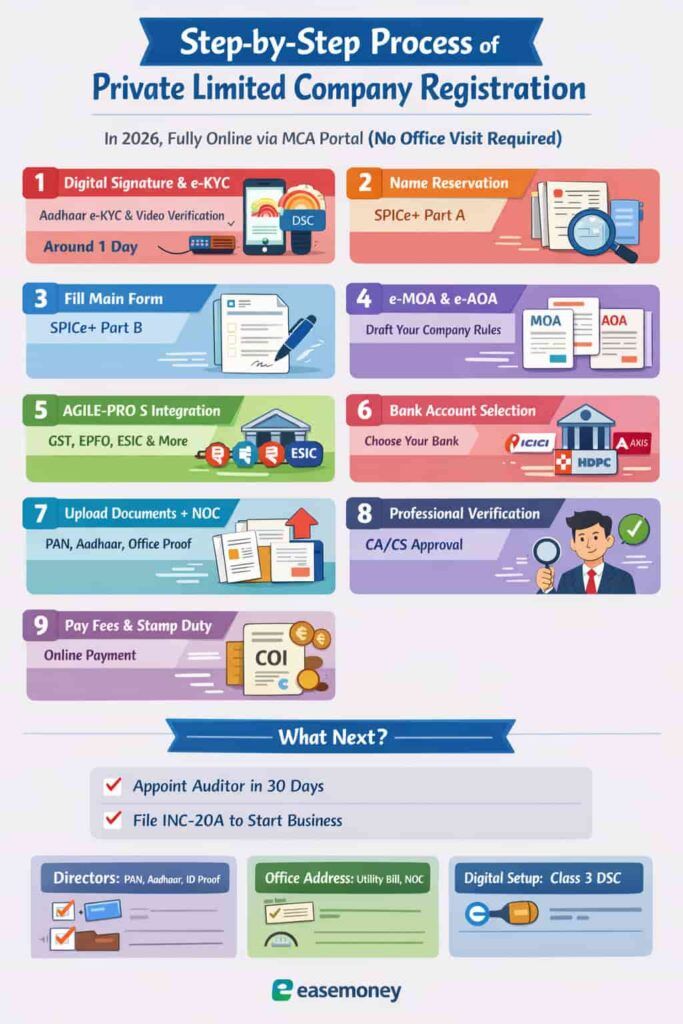
1. Digital Signature (DSC) & e-KYC
- First thing, all directors need DSC. Without this nothing moves. You will do Aadhaar e-KYC and small video verification on phone. You can check Emudhra or other reliable platform for that.
- Time: around 1 day
2. Name Reservation (SPICe+ Part A)
- You apply 2 names like AuraTech Solutions Pvt Ltd.
- System checks automatically if name already exists or looks similar. such as AuraTech Digital Solutions Pvt Ltd.
- If approved, name stays reserved for 20 days.
3. Fill Main Form (SPICe+ Part B)
This is main part. You enter full company details:
- Capital → example ₹1 lakh
- Office address → where company is registered
- Director details → DIN also generated here if not available
4. Draft e-MOA & e-AOA
Here you define what your company will do and how it will run:
- e-MOA → business work (IT, trading, etc.)
- e-AOA → rules (shares, meetings, control)
5. AGILE-PRO S Integration
In same process, you apply for:
- GST (optional but better now)
- EPFO & ESIC (employee related)
- Professional Tax (in some states)
6. Bank Account Selection
During the AGILE-PRO step, you select a bank (e.g., ICICI, HDFC, or Axis) from a dropdown.
Real-life check: The bank uses the data from your incorporation form to pre-fill your Current Account application.
7. Document Upload + NOC
You upload:
- PAN, Aadhaar of directors
- Office proof (electricity bill under 2 months)
- NOC from owner if rented place
8. Professional Verification
CA or CS checks everything and signs digitally. Without this, file will not go forward.
9. Pay Fees & Stamp Duty
- You pay online via UPI or net banking.
- Government fee is mostly ₹0 (up to ₹15 lakh capital),
- but stamp duty still depends on state.
10. Certificate of Incorporation (COI)
MCA checks your file. If all correct, you get COI on email.
- You also get PAN + TAN with it
What Next (Important)
- Within 30 days, you must appoint auditor
- You cannot start business until filing INC-20A (Commencement)
Real talk: Process is simple, but if you enter wrong detail or upload wrong document, it can delay easily. If done properly, company can be ready in 5–7 working days.
What documents may required?
If you want to register currently, , you need basic documents for directors/shareholders + office address. Everything is uploaded online (no physical submission).
| Category | Required Documents |
|---|---|
| Directors & Shareholders | PAN Card (mandatory), Aadhaar/Voter ID/Passport/Driving License, Latest bank statement or utility bill (under 2 months), Passport-size photo |
| Registered Office | Electricity/Water/Gas bill (latest), NOC from owner, Rent agreement (if rented) or Sale deed (if owned) |
| Digital Setup | Class 3 DSC for all directors (mandatory for signing forms) |
| MOA (Memorandum of Association) | what business you will do |
| AOA (Articles of Association) | how company will run |
2. Best Strategy for New Startups
If you are starting a startup, Private Limited Company is the best option because it supports funding, growth, and legal structure.
- Step 1: Register company via SPICe+ (you get COI, PAN, TAN together)
- Step 2: Apply for DPIIT Recognition on Startup India portal
- Extra Docs Needed:
- Short idea write-up (what your startup does)
- Website or pitch deck
- Step 3: Apply for tax benefit (Section 80-IAC → 3-year tax holiday)
3. Foreign Founder Case (If Applicable)
If one of the founders is not an Indian citizen, then a few extra steps come in.
- Passport is compulsory (no other ID works here)
- All documents (ID + address proof) must be notarised and apostilled
- If apostille is not available, then documents must be attested by the Indian Embassy in that country
Real-Life Example (Age 18)
If you are 18 and want to start alone, you can’t do it fully solo. You need one more director (18+). Example: You + your father/mother can register company together, then you can manage business yourself.
Post-Incorporation Steps for Small Businesses
Once you receive your Certificate of Incorporation (COI), your company is legally created. But you cannot start business or raise invoices immediately. You have to complete a few important steps first, otherwise penalties or even company strike-off can happen.
Immediate Checklist (What You Must Do First)
- First Board Meeting (within 30 days) = You have to conduct your first meeting. Main goal → approve auditor and confirm bank account setup.
- Appoint Auditor (within 30 days) = You must appoint a CA as auditor. File Form ADT-1 with ROC.
- Deposit Capital (within 60 days) = Shareholders transfer capital (example ₹1,00,000) into company account. Keep bank proof safely.
- File INC-20A (Most Important Step) = You cannot start operations or borrow money without this. Deadline: 180 days. Penalty: ₹50,000 + ₹1,000/day for directors
- Issue Share Certificates (within 60 days)= Provide share certificates and pay stamp duty (state-wise).
- Startup Benefits (Optional but Useful) = Apply for DPIIT Recognition → Helps in tax holiday (80-IAC), easier compliance, patent support
- Display Company Identity = Company name, address, CIN must be shown at office, invoices, website.
Annual Compliance (Every Year)
| Form / Task | Purpose | Due Time |
|---|---|---|
| DIR-3 KYC | Director identity update | By Sept 30 |
| MBP-1 & DIR-8 | Director interest disclosure | First Board Meeting |
| AOC-4 | Financial statements filing | 30 days after AGM |
| MGT-7 | Annual return | 60 days after AGM |
| ITR-6 | Income tax return | By Oct 31 |
Real Understanding
Even if company is registered, it becomes fully operational only after completing these steps—especially INC-20A and capital deposit. Also, maintaining records and filings is necessary to stay legally active.
Pro Tip
Most new businesses ignore compliance in first year. But penalties start ₹100 per day per form. If you stay regular from beginning, you save both money and stress later.
Cost to Register a Private Limited Company (2026) + Trademark Reality
In 2026, starting a Pvt Ltd company is quite affordable, especially for small startups. Government fee is mostly ₹0 (up to ₹15 lakh capital), but other costs still apply.
Estimated Cost Table
| Expense Item | Estimated Cost (₹) | What It Means (Real Talk) |
|---|---|---|
| DSC (2 Directors) | ₹2,000 – ₹4,000 | Needed for signing forms online |
| Name Reservation | ₹0 – ₹1,000 | Optional if applied via SPICe+ |
| MCA Govt Fee | ₹0 | Free for small capital companies |
| Stamp Duty | ₹500 – ₹5,000 | Depends on state (can vary a lot) |
| PAN & TAN | ₹131 | Auto-generated with registration |
| Professional Fees | ₹5,000 – ₹12,000 | CA/CS charges for handling work |
| Total Cost | ₹8,500 – ₹22,000 | Final cost to get COI |
- If you do some work yourself → cost goes down
- If you fully depend on CA/consultant → cost goes up
- State matters → Maharashtra/Kerala can be higher than Delhi
Is Trademark Required?
Short answer: No, not mandatory. But in real life, you should seriously consider it.
- Company Name ≠ Brand Protection
- If you register “TechZen Pvt Ltd”, it only protects legal name.
- Someone else can still use “TechZen” brand unless trademark is taken.
- Name Rejection Risk
- If your company name matches an existing trademark, MCA can reject your application.
- Investor & Growth Angle
- Investors prefer startups with trademark because brand is secured.
- Without it, your brand can be copied easily.
- Investors prefer startups with trademark because brand is secured.
You can start company first, but if you are building a serious brand, you can think trandmark, it could be beneficial(cost ~₹4,500–₹9,000).
Top FAQs
How much money is required to start a Pvt Ltd company?
In 2026, no minimum capital required. You can start even with ₹1,000. But practical cost including DSC, stamp duty, CA fees comes around ₹8,500 to ₹22,000 total.
Who is eligible to start a Private Limited Company?
Any person above 18 years with PAN and Aadhaar can start. Minimum 2 people needed. Example: you and your friend or parent can become directors and start company easily.
Which is better: Pvt Ltd or LLC for Indian business?
In India, Pvt Ltd is better because LLC concept is not standard here. Investors, banks, and government systems fully support Pvt Ltd structure for funding and business growth.
How do I register a Private Limited company online?
You have to apply through MCA SPICe+ form. Fill details, upload documents, pay fees, and get approval. If everything correct, company can be registered in 5–7 working days.
What is the government fee for Pvt Ltd registration?
Government fee is ₹0 for capital up to ₹15 lakh in 2026. But stamp duty and professional charges still apply, so total cost usually comes between ₹8,500 to ₹22,000.
Can I register a Pvt Ltd company myself in 2026?
Yes, you can register yourself using MCA portal, but small mistake can delay 7–10 days. Most people take CA help (₹5,000–₹10,000) to avoid rejection and resubmission.
What is the minimum turnover required for a Pvt Ltd company?
There is no minimum turnover requirement. Even if your business earns ₹0 in first year, company must still file compliance like ITR, AOC-4, and MGT-7 every year.