

In India, as per the RBI data and recent PDF, there are more than 50 lakh cheques processed every month in 2025. If we talk volume of these transactions, it is around Rs. 2.5 lakh crore per month. But most people do not know what to do if a cheque bounces and what legal crime case against it has.
Cheque bounce not feeling like crime at start. People think bank delay or temporary issue. But real shock comes when legal notice reaches home with Section 138 and court details.
- Cheque bounce is legal offence
- Case starts after notice
- Court process comes later
Understanding law, process, cost, and outcome can change full situation. So first start with basic question to follow flow properly.
What is a Cheque Bounce?
A cheque is said to “bounce” when the bank returns it unpaid due to reasons or mistakes by the account holder. Let’s check a few popular reasons below –
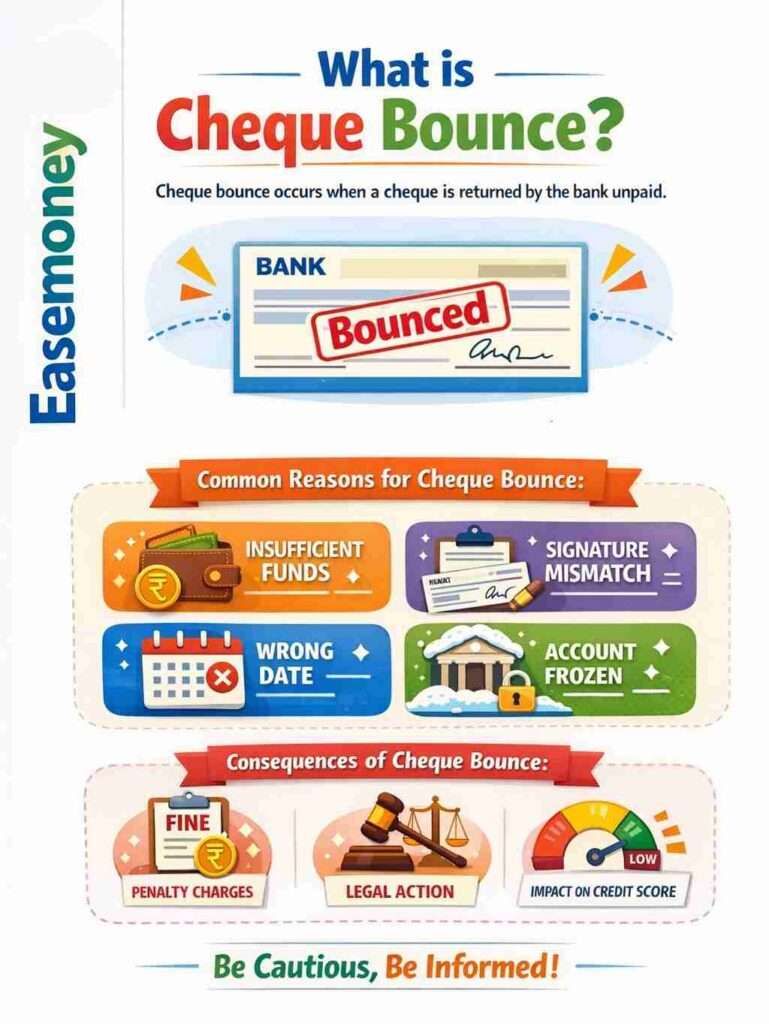
- Insufficient funds (low or not the same balance as mentioned in the cheque)
- Account closed, or KYC pending
- Signature mismatch
- Payment was stopped by the drawer
- Cheque expired (if it happens, if your cheque book is older than 3 months)
- Most of the time post-dated cheque can bounce due to the entered date leading to an Insufficient balance at the time
Some of these reasons sound technical or basic in real life, but legally, most of them still attract Section 138 if payment is not made later.
Quick tip – to escape cheque bounce issues, you have to make sure you write everything correctly, importantly, the signature and date, your account is fully active, and your account has sufficient funds.
How does it become a Legal case when a Cheque bounces?
A cheque bounce case arises when a cheque issued for payment is returned unpaid by the bank, and the issuer fails to pay even after receiving a formal legal notice from the court. Here, both are valid via email or via post at home. In India, this is governed by Section 138. The name is the Negotiable Instruments Act, 1881.
Let me give you an important insight that many blogs miss: The law does not punish a bounced cheque; it punishes the refusal or neglect to correct it by paying it.
In india, PSU or private banks return cheques every day, it is normal and common due to tons of reasons such as low balance to signature mismatch. Most common pending KYC, sometimes, the bank triggers it without notifying. It does not mean it automatically makes someone a criminal. But the real law starts here – Criminal liability begins only when the drawer is given a legal chance to pay and chooses not to. Also, they deny something to everything, the notice, reminders, and bank policies.
Real-life example for you – A trader writes a bank cheque, such as Rs. 1,20,000, but with the hope that funds will come in a week. But the cheque bounces. If he pays after receiving notice, the law steps back. If he does not, the law steps in.
Let’s talk about Case Time Limit and how it really works –
A cheque bounce becomes a Section 138 case only if all steps are followed properly.
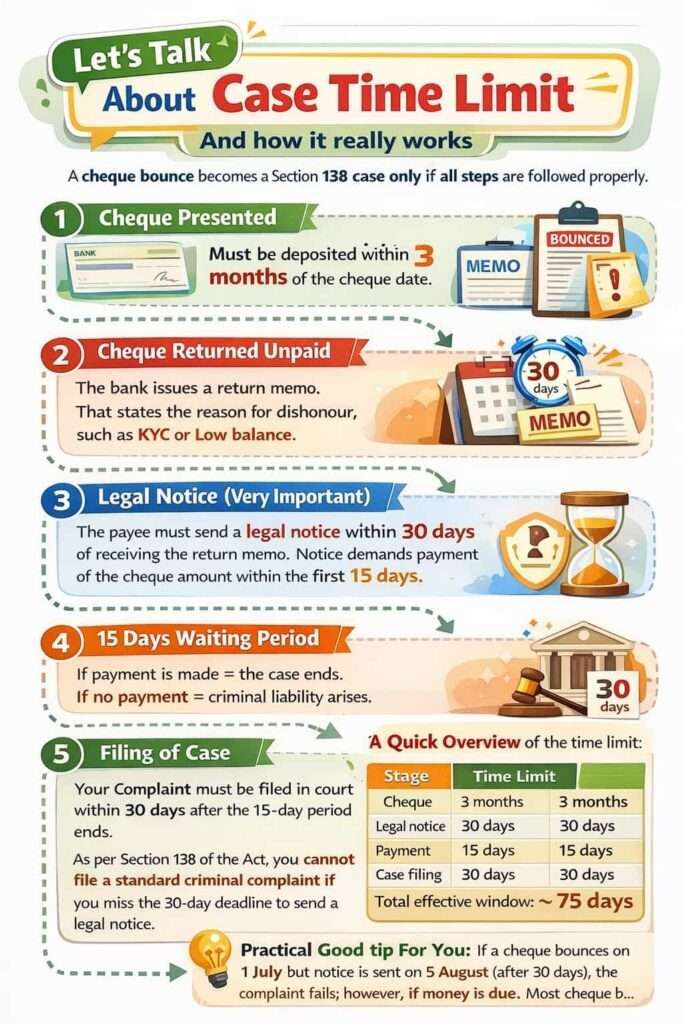
1. Cheque Presented
- Must be deposited within 3 months of the cheque date.
2. Cheque Returned Unpaid
- The bank issues a return memo. That states the reason for dishonour, such as KYC or Low balance.
3. Legal Notice (Very Important)
- The payee must send a legal notice within 30 days of receiving the return memo.
- Notice demands payment of the cheque amount within the first 15 days.
4. 15 Days Waiting Period
- If payment is made = the case ends.
- If no payment = criminal liability arises.
5. Filing of Case
- Your Complaint must be filed in court within 30 days after the 15-day period ends. As per Section 138 of the Act, you cannot file a standard criminal complaint if you miss the 30-day deadline to send a legal notice. This timeline is mandatory.
A Quick Overview of the time limit you got
| Stage | Time Limit |
|---|---|
| Cheque validity | 3 months |
| Legal notice | 30 days |
| Payment window | 15 days |
| Case filing | 30 days |
| Total effective window | ~75 days |
Practical Good tip For You: If a cheque bounces on 1 July but notice is sent on 5 August (after 30 days), the complaint fails; however, if money is due. Most cheque bounce cases are lost not on merit, but on delay.
How much fine or jail time happens in a cheque bounce case?
As per the Negotiable Instruments Act, the court can order if found guilty –
- Jail: The rule says up to 2 years’ simple imprisonment
- Fine: Up to 2× (double) the cheque amount
- Or Both: Jail plus fine/compensation. It is rare, but it only applies if it does not follow the procedure correctly.
These are maximum limits, not automatic punishment.
What Actually Happens in Real Courts
As per the recent records, in most cases in india –
- No jail
- Only payment + compensation
- Case ends by settlement (compounding)
Jail usually happens only when:
- The accused ignores the court summons
- Repeated long-time defaults or habitual offender
- Disobeys court orders
- Deliberately delays payment for years
Judges use jail as a pressure, not as a first punishment.
Ram Gopal Varma Cheque Bounce Case (Why Courts Cite It)
A recent example often discussed is that of Ram Gopal Varma. (The Bollywood director)
The case started in 2018, when a Shree company alleged that Varma’s production house failed to pay ₹2.38 lakh due to storage hard disks. In January 2025, the Mumbai Magistrate Court found Varma guilty in this section 138. He was sentenced to three months of imprisonment and ordered to pay ₹3.72 lakh in compensation. The amount is almost double and short jail, but later Varma claimed the case involved an ex-employee and that he was being exploited, but the court found sufficient evidence of his liability.
In September 2025, Varma challenged the order in the Dindoshi Sessions Court but ultimately opted for an amicable settlement through the Lok Adalat. Both parties submitted a “compromise memo” confirming payment, the Sessions Court set aside the conviction and officially acquitted Varma.
What Should You Do?
How to Escape From a Cheque Bounce Case (Legally)
The direct answer I can give is – You cannot “run away” from a cheque bounce case; the only option you have is to legally defend, reduce damage, or settle it. The best option before damage occurs –
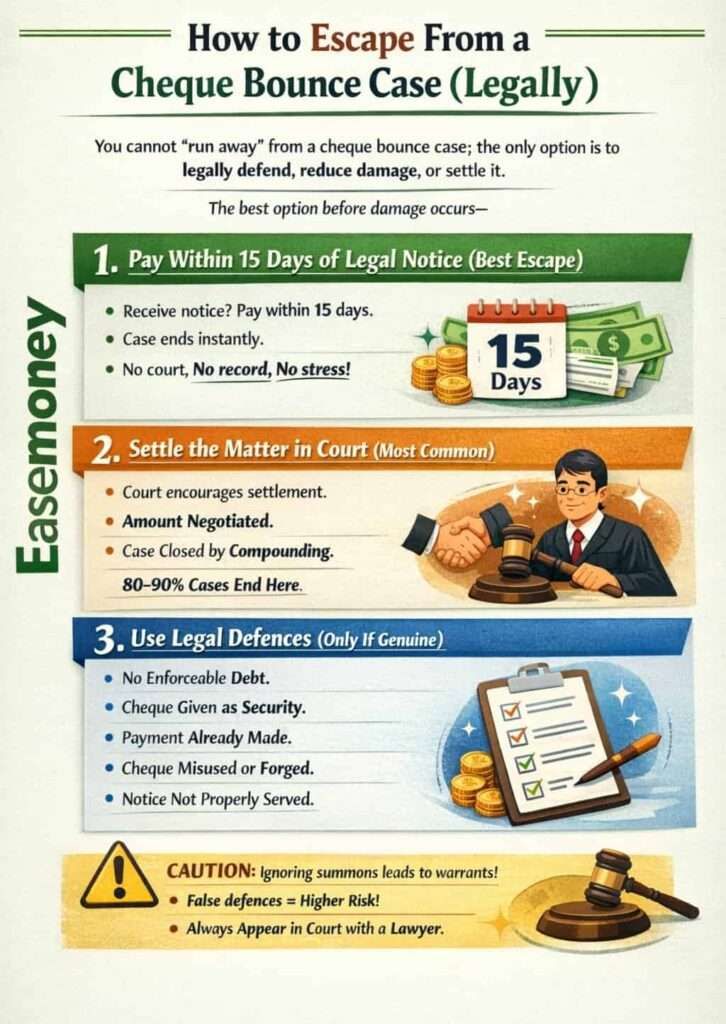
1. Pay Within 15 Days of Legal Notice (Best Escape)
- Once you receive a legal notice, you get 15 days, arrange the amount and pay it
- If you do it within 15 days, your case ends instantly and automatically
- This is the safest and cleanest exit. No court, no record, no stress.
2. Settle the Matter in Court (Most Common)
Even after the case is filed:
- The court encourages compromise, which is still the finest and least damaging state.
- You can ask for the Amount negotiated
- The case is closed through compounding
- In india, 80–90% cheque bounce cases end this way
3. Use Legal Defences (Only If Genuine)
You may escape conviction if you prove:
- No legally enforceable debt
- A cheque was given as security
- Payment already made
- Cheque misused or forged
- Legal notice not served properly
- Timeline not followed
Note: Accept any of the three, because ignoring summons leads to warrants, or False defence can be higher risk later. If you choose 2 option, appearing through a lawyer is enough. avoid non-Appearance.
If someone’s cheque bounced to you:
How to File a Cheque Bounce Case (Step-by-Step)
- 1 Step: Your bank will issue a return memo with the reason why it was dishonoured.
- 2 Step: You have 30 days. You can send a legal notice to him or the firm. It allows 15-day demand payment. You can talk to a professional lawyer for that.
- 3 Step: Now, wait for 15 days for the payment has been received or not. If not, it leads to offence.
- 4 Step: You have to file a case against the company via the Magistrate Court and prepare your documents, such as the original cheque, Bank return memo, proof of delivery and legal notice photocopy.
- 5 Step: The Court will issue a summons, and your accused needs to appear with a lawyer.
- 6 Step: Your court may ask for a Settlement encouraged and a Trial only if the settlement fails
Typical Court and Advocate Fees
cheque bounce case under Section 138 is a criminal complaint, so court fees are minimal.
| Item | Approx Cost |
|---|---|
| Complaint filing | ₹10 – ₹200 |
| Affidavit & stamps | ₹50 – ₹300 |
| Misc. charges | ₹100 – ₹500 |
Total court fees usually below ₹1,000 and your Cheque amount does NOT affect court fees
Advocate Fees
| Stage | Fees (₹) |
|---|---|
| Legal notice drafting | 1,500 – 5,000 |
| Reply to notice | 2,000 – 6,000 |
| Filing case (complainant) | 5,000 – 20,000 |
| Defending accused (trial) | 10,000 – 50,000 |
| Settlement drafting | 3,000 – 10,000 |
Most lawyers push for early settlement because it saves costs for both sides. The fee is subjective and depends mostly on the cities and all process.
What Changed in Cheque Bounce Law in 2025–2026 (And Why It Matters)
By 2025, Indian courts quietly accepted a hard truth: cheque bounce cases were no longer a legal problem. There was a system problem. There are millions of pending matters already, and delayed settlements have weakened the very purpose of Section 138.
Today, cheque bounce cases can attract up to two years’ jail and a fine of up to double the cheque amount. Repeat offenders may even face temporary account restrictions by banks. This is not to punish first-time mistakes, but to stop habitual misuse of cheques.
Procedures are now faster. Complaints can be filed online, notices can be sent by email or WhatsApp, and early hearings may happen virtually. Courts aim to finish most cases within 90 days, where possible.
Delaying a case is no longer free. Courts can ordera 20% interim payment, and late settlements now carry extra cost. Banks also send bounce alerts within 24 hours, so timing excuses rarely work.
What Most People Miss: Cheque Bounce vs Civil Recovery (Real Difference)
Unlike what many people think, a cheque bounce case is not just about getting money back — it is a criminal pressure mechanism, while civil recovery is different.
Let’s break it clearly:
| Factor | Cheque Bounce Case (Section 138) | Civil Recovery Case |
|---|---|---|
| Nature | Criminal case | Civil case |
| Goal | Force payment via legal pressure | Recover money through court decree |
| Time | Faster (if done correctly) | Slow (can take years) |
| Jail Risk | Yes (rare but possible) | No jail |
| Settlement | Very common (80–90%) | Less flexible |
Real Insight (Important for You)
Many smart businesses use both strategies together:
- First → File cheque bounce case (to create pressure)
- Then → Parallel civil suit (to secure recovery legally)
This dual approach increases chances of recovery significantly.
Practical example: If someone owes ₹2 lakh and cheque bounces, filing only civil case = slow recovery But cheque bounce + legal notice = faster settlement chances
Tip: If amount is large (₹5 lakh+), always consider both routes after talking to a lawyer.
FAQs
Can a cheque bounce case be decided in favour of the accused?
Yes, courts do dismiss cheque bounce cases when timelines are violated, notice is defective, the debt is not legally enforceable, or evidence rebuts statutory presumptions. Procedure matters more than sympathy in such cases.
How serious is a cheque bounce case in India, realistically?
Legally it’s a criminal offence, but practically courts focus on recovery and settlement. Jail is rare. Seriousness increases only when notices, summons, or court directions are repeatedly ignored.
Is there any minimum or maximum cheque amount for a cheque bounce case?
No. The law sets no minimum or maximum amount. Even a ₹500 cheque can lead to a case if legally enforceable, while a ₹1 crore cheque can fail if procedure is defective.
Can a cheque bounce case be cleared without going through full trial?
Yes, and most are. Payment within notice period, settlement during court proceedings, or compounding even after conviction can lawfully close the case without a prolonged trial.
How is a cheque bounce case in Dubai different from India?
Cheque bounce in Dubai involves local criminal and civil laws, not Indian law. Clearing it usually requires settlement, fines, or court compliance there—Indian courts cannot resolve UAE cheque disputes.
What happens if the accused lives in a different city or state?
Distance doesn’t stop proceedings. Appearance through a lawyer is usually sufficient. Courts now allow practical measures like dasti service and online payments to reduce unnecessary travel.
Can police directly arrest someone in a cheque bounce case?
No, police cannot directly arrest in cheque bounce cases because it is a complaint-based offence. Arrest happens only if court orders are ignored repeatedly, like non-appearance or warrant issuance.
What happens if cheque bounce case is filed after delay by mistake?
If timelines like 30-day notice or filing window are missed, the case can be dismissed technically. However, you can still recover money through civil recovery or fresh legal strategy depending on facts.
Hope you liked the content. Explore smart options below 👇
