

Goods and Services Tax (GST) registration becomes mandatory in India once a business crosses prescribed turnover limits or falls under specific categories like interstate sales and e-commerce selling.
After approval, businesses receive a unique 15-digit GSTIN that allows them to legally collect GST, issue tax invoices, and claim Input Tax Credit (ITC) on eligible expenses.
| Business Type | GST Registration Threshold |
|---|---|
| Goods Suppliers | ₹40 Lakhs (Most States) |
| Goods Suppliers (Special Category States) | ₹20 Lakhs |
| Service Providers | ₹20 Lakhs |
| Service Providers (Special Category States) | ₹10 Lakhs |
⚡ GST Registration Is Mandatory If:
- You sell products or services across different states
- You sell through Amazon, Flipkart, Meesho, or other marketplaces
- Your business falls under Reverse Charge Mechanism (RCM)
- You operate temporary, seasonal, or event-based taxable businesses
Businesses below the threshold can still apply voluntarily to improve business credibility, work with larger B2B clients, and access Input Tax Credit benefits.
Understanding the complete GST registration process also helps businesses avoid future compliance mistakes and penalties.
💡 Many startups register for GST early because several marketplaces, payment partners, and corporate clients prefer working only with GST-registered businesses.
📌 Quick Insight: Once registered, businesses must file GST returns regularly even if there is no sales activity during a particular month.
Read Below: Why GST Registration Matters for New Businesses • Types of GST Registration • Step-by-Step GST Registration Process • Understanding GSTIN
Types of GST Registration
India’s GST system offers different registration types based on business size, turnover, and operations. Choosing the correct GST category is important because return filing rules, tax rates, and Input Tax Credit (ITC) benefits differ for each type.
1. Regular GST Registration
This is the most common GST registration used by businesses operating normally in India. This category is commonly used by: Startups, Agencies, Shops, Manufacturers, and E-commerce sellers.
- Applicable Turnover Limits:
- Goods businesses: ₹40 Lakhs annual turnover
- Service businesses: ₹20 Lakhs annual turnover
- Special Category States: Lower limits may apply
- Under regular registration, businesses can:
- Collect GST from customers
- Claim Input Tax Credit (ITC)
- Issue GST invoices
- Sell across India
💡Insight: However, businesses must file regular GST returns such as GSTR-1 and GSTR-3B monthly or quarterly.
2. Composition Scheme Registration
The Composition Scheme is designed for small businesses that want easier GST compliance with lower tax rates. This scheme is mostly preferred by: Small traders, Local shops, Restaurants, and Small manufacturers.
- Eligibility Limit: Up to ₹1.5 Crores annual turnover And ₹75 Lakhs for some Special Category States.
- Key features: Lower GST rates (around 1% to 6%), Simplified quarterly filings, and Less paperwork
Important Restrictions 🚫: Businesses Cannot claim Input Tax Credit, Cannot collect GST separately from customers, and Interstate sales are generally not allowed.
3. Casual Taxable Person
- Rules: Valid for a maximum of 90 days (extendable upon request). Requires an advance tax deposit equal to the estimated GST liability for the active period.
- Target: Individuals or businesses setting up temporary stalls, exhibitions, or seasonal shops in a state where they do not have a permanent place of business.
4. Non-Resident Taxable Person (NRTP)
This category applies to foreign businesses or individuals supplying goods or services occasionally in India.
- Features include:
- No permanent office in India required
- Validity usually limited to 90 days
- Advance tax payment required before operations begin
- This is commonly used by:
- International event businesses
- Foreign exhibitors
- Overseas suppliers
5. Input Service Distributor (ISD)
ISD registration is mainly used by companies with multiple branches. Under this system:
- Head office collects Input Tax Credit on shared services
- ITC is distributed to branch offices under the same PAN
This helps businesses manage tax credits more efficiently across locations.
6. GST Registration for Service Providers
Service providers have to compulsorily register for GST once their turnover exceeds the prescribed threshold limit.
7. UIN Registration
- UIN (Unique Identification Number) registration is provided to special international organizations operating in India.
- Examples include: Foreign embassies, UN organizations, and Consulates.
- These entities do not pay GST like normal businesses. Instead, UIN helps them claim refunds on GST paid while purchasing goods or services in India.
Who is Eligible for GST Registration?
1. GST registration becomes mandatory when:
- Goods businesses cross ₹40 Lakhs annual turnover (₹20 Lakhs in special category states)
- Service businesses cross ₹20 Lakhs annual turnover (₹10 Lakhs in special category states)
2. Mandatory Criteria (Regardless of Turnover):
- Businesses making interstate supplies (selling across state lines).
- E-commerce sellers listing products on platforms like Amazon or Flipkart.
- Entities liable under the Reverse Charge Mechanism (RCM).
- Casual or non-resident taxable persons setting up temporary stalls.
Any business below these limits can also apply via voluntary registration.
Step-by-Step GST Registration Process
GST registration in India is completed entirely online through the official GST portal. Businesses must provide accurate details and upload valid documents to avoid delays during approval.
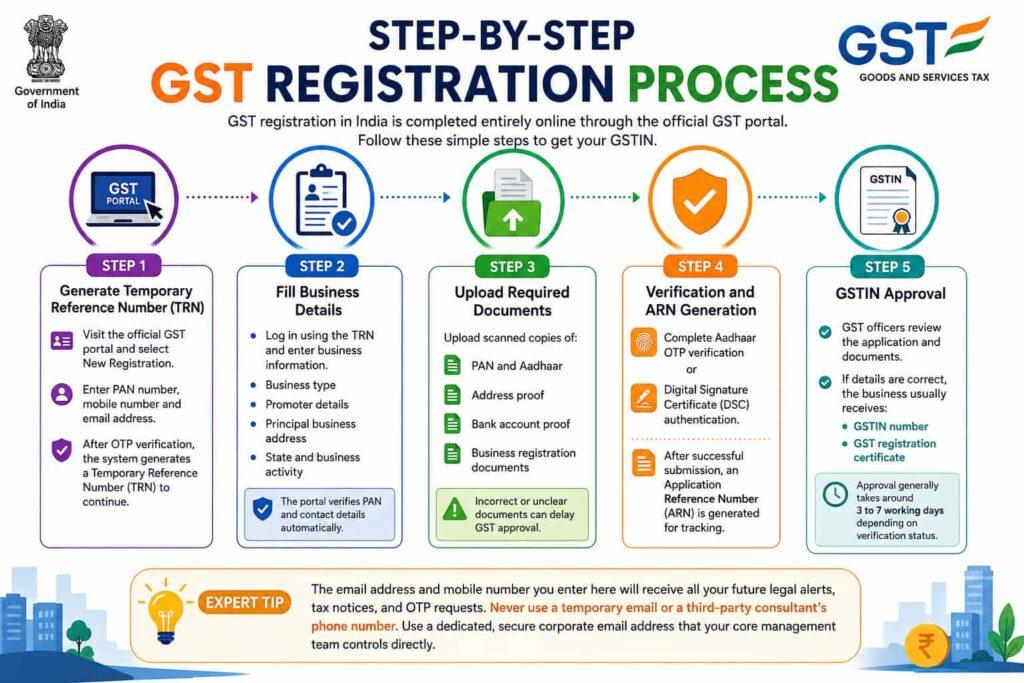
Step 1: Generate Temporary Reference Number (TRN)
Visit the official GST portal and select New Registration under the registration section. Enter:
- PAN number
- Mobile number
- Email address
After OTP verification, the system generates a Temporary Reference Number (TRN) to continue the application.
Step 2: Fill Business Details
Log in using the TRN and enter important business information such as:
- Business type
- Promoter details
- Principal business address
- State and business activity
The portal verifies PAN and contact details automatically.
Step 3: Upload Required Documents
Upload scanned copies of:
- PAN and Aadhaar
- Address proof
- Bank account proof
- Business registration documents
Incorrect or unclear documents can delay GST approval.
Step 4: Verification and ARN Generation
Complete Aadhaar OTP verification or Digital Signature Certificate (DSC) authentication. After successful submission, an Application Reference Number (ARN) is generated for tracking application status.
Step 5: GSTIN Approval
GST officers review the application and documents. If details are correct, the business usually receives:
- GSTIN number
- GST registration certificate
Approval generally takes around 3 to 7 working days depending on verification status.
💡 Expert Tip: The email address and mobile number you enter here will receive all your future legal alerts, tax notices, and OTP requests. Never use a temporary email or a third-party consultant’s phone number. Use a dedicated, secure corporate email address that your core management team controls directly.
Checklist of Required Documents
The GST registration process is fully online, so businesses must upload clear scanned copies of the following documents during application:
- Identity Proof – PAN card and Aadhaar card of the proprietor, partners, or directors
- Business Registration Proof – Partnership deed, LLP agreement, or Certificate of Incorporation
- Business Address Proof – Electricity bill, rent agreement, property tax receipt, or NOC from property owner
- Bank Account Proof – Cancelled cheque, bank statement, or passbook copy showing account details
- Authorised Signatory Proof – Board resolution or signed authorisation letter for the authorised person handling GST filings
- Photographs – Passport-size photographs of business owners, partners, or directors
💡 Quick idea: The legal name on your business profile must match your PAN database records exactly, down to every single space and full stop. If your PAN lists “John A. Smith” but your registration form says “John Smith,” the portal’s automated validation engine will instantly reject your entire application.
What are the charges and fees for Registration
The Government of India does not charge any fee (zero fee) for GST registration on the official portal gst.gov.in. The complete online registration process is free for all businesses.
However, some additional costs may still apply:
- Professional Fees: Hiring a Chartered Accountant (CA) or GST consultant usually costs around ₹1,000 to ₹3,000 for document handling and application support.
- Affidavits & Documentation: Preparing a rent agreement, stamp paper, or notarised No Objection Certificate (NOC) for office address proof may cost between ₹200 and ₹500.
- Late Filing Penalties: After GST registration, businesses must file GST returns regularly. Failure to file even zero-return filings can attract late fees starting from ₹20 per day and up to ₹50 per day for active businesses.
Understanding GSTIN
GSTIN (Goods and Services Tax Identification Number) is a unique 15-digit alphanumeric number issued to every GST-registered business in India. It acts as the official tax identity of a business and is required for GST return filing, tax invoices, Input Tax Credit (ITC), and compliance activities.
The GSTIN structure includes:
- First 2 digits: State code (e.g., 08 for Rajasthan).
- Next 10 characters: The business owner’s or company’s permanent account number (PAN).
- 13th digit: Registration number of the business entity under that specific PAN within the state.
- 14th character: The alphabet “Z” by default.
- 15th digit: A random check code to detect data errors.
Businesses must mention GSTIN on invoices, bills, and official GST documents. After registration, businesses are also required to file GST returns on time, maintain transaction records, and pay GST dues regularly to avoid penalties, interest charges, or compliance notices.
📌 Expert Insight: Many businesses register for GST using a home address initially, but later face compliance issues while opening current accounts, onboarding payment gateways, or applying for business loans because the GST address and bank/KYC records do not match properly.
Why GST Registration Matters for New Businesses
- National Scale: Allows businesses to sell products online across India and ship goods legally across state borders.
- Tax Savings (ITC): Businesses can claim GST paid on stock, software, office rent, laptops, and other business expenses.
- Big B2B Deals: Many corporate clients and wholesalers prefer working only with GST-registered businesses.
- Easy Bank Loans: GST returns provide verified revenue records that banks use during business loan approvals.
- Market Trust: GST registration improves credibility with suppliers, vendors, manufacturers, and customers.
- No Fine Risk: Helps businesses avoid GST penalties, notices, and legal compliance issues.
Head-to-Head: Registered vs. Unregistered Businesses
| Feature | 📜 GST Registered | ❌ Unregistered |
|---|---|---|
| Turnover Limit | No business restriction | Usually below ₹20L (services) or ₹40L (goods) |
| Input Tax Credit (ITC) Benefit | Claim GST on rent, stock, laptops, expenses | No Input Tax Credit |
| B2B Deals | Accepted by companies and wholesalers | Many businesses avoid non-GST vendors |
| Amazon/Flipkart Selling | Allowed across India | Restrictions may apply |
| Pricing Advantage | Buyers can claim GST credit | Full cost paid by buyer |
| Loan Approval | GST returns help prove income | Harder to verify revenue |
| Compliance | Monthly/quarterly GST filing required | Less compliance work |
| Penalty Risk | ₹20–₹50/day late filing fees | Up to 10% tax penalty or ₹10,000 fine |
Important GST Rules After Registration
Once your business receives a GSTIN, regular GST compliance becomes mandatory. Ignoring GST rules after registration can lead to penalties, notices, and return filing issues.
- Mandatory “Nil” Filing
- Businesses must file GST returns regularly, even during months with zero sales or no business activity
- Late filing can result in daily late fees, penalties, and interest charges
- The 45-Day Bank Rule
- You must update and link your active corporate or business bank account details on the GST portal within 45 days of getting your registration.
- GSTIN Must Be Displayed
- Businesses should display their 15-digit GSTIN at the main office or shop location
- GSTIN must also appear on tax invoices, bills, and other business documents
- Separate GST Registration for Different States
- GST registration is state-specific in India
- If a business opens a warehouse, branch, or office in another state, a separate GSTIN may be required there
- Maintain Proper Records
- Businesses should keep invoices, purchase records, and GST documents safely for future verification or audits
- Compliant B2B Invoicing
- Every invoice you issue to business clients must clearly show your GSTIN, their GSTIN, the correct HSN/SAC code, and the broken-down tax rates (CGST, SGST, or IGST).
Following these rules properly helps businesses avoid compliance problems and maintain smooth GST operations.
Frequently Asked Questions
What happens if I get a GST registration but make zero sales for a few months?
You are still legally required to file a “Nil Return” every single month via the portal. If you fail to log in and submit your zero-sales report, the system will automatically levy a penalty of ₹20 per day, locking your account until the dues are cleared.
How long does it take for the government to approve a new GST registration?
If your documents are clear and your address proofs match perfectly, approval usually takes 3 to 7 working days. However, if your file is flagged for physical biometric verification or if the tax officer issues a clarification notice, the process can take up to 15–20 days.
Can a single business owner have more than one GST registration?
Yes! GST is a state-centric tax system. If your business expands and opens a warehouse, office, or store in a different state, you must apply for a separate GST registration in that specific state using the same company PAN card.
Can I claim back the tax I pay on my startup’s computers, software, and office furniture?
Yes! This is called Input Tax Credit (ITC). If you hold a regular GST registration and buy business assets from registered vendors, you can use the GST paid on those bills to reduce the tax liability you owe on your own sales.
Does a GST registration expire if I do not use it?
A regular GST registration never expires and remains valid indefinitely unless cancelled voluntarily or suspended by tax authorities for compliance failures like missing GST return filings for over 6 consecutive months.
Can I change my regular GST registration to a Composition Scheme later?
Yes, but you can only switch to the Composition Scheme at the beginning of a new financial year (by filing Form CMP-02 before April 1st). However, you can opt out of the Composition Scheme and convert back into a regular taxpayer at any point during the year.
- Read –
Hope you liked the content. Explore smart options below 👇
🔥 Recommended