

Many HNIs are now moving beyond traditional investments like fixed deposits, bonds, and mutual funds to explore Alternative Investment Funds (AIFs) for better diversification and access to high-growth opportunities.
AIFs invest in assets such as private companies, startups, real estate, venture capital, and other non-traditional opportunities that are usually unavailable to regular retail investors.

Alternative Investment Funds (AIFs) overview infographic
📌 Why HNIs Prefer AIFs
💡 Simple Example: Some AIFs invest in startups, commercial real estate, or private businesses before they become publicly listed. If those projects succeed, returns can be much higher than traditional products.
⚠️ Important: AIFs usually involve higher risk, lower liquidity, and larger minimum investment requirements, so they are mainly suitable for experienced or high-net-worth investors.
📊 Industry Growth: India’s AIF sector has expanded rapidly. According to Business Today data, AIF commitments increased from around ₹27,484 crore in 2015 to more than ₹15 lakh crore by 2025.
Read Business Today Report
📖 Read below: Types of AIFs in India, minimum investment rules, taxation, risks, and how HNIs use AIFs for long-term portfolio diversification.
Why AIFs Are Gaining Attention Among HNIs
Let’s break down the main reasons behind this growing shift –
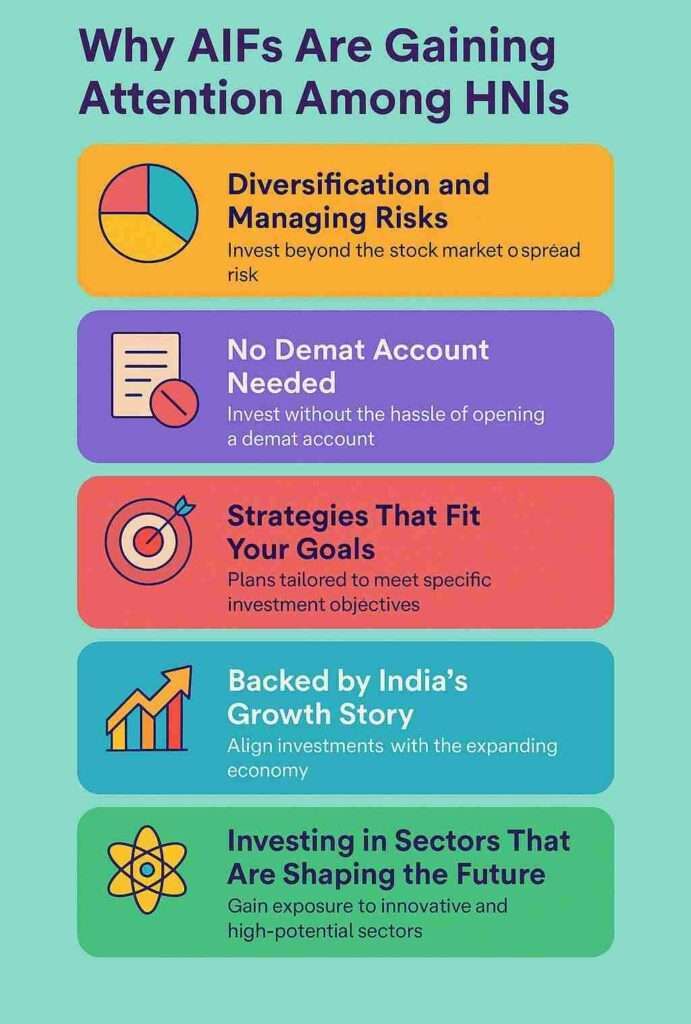
1. Diversification and Managing Risks
- AIFs open the door to investments beyond the usual stock market. We’re talking about areas like private equity, venture capital, and hedge funds.
- This kind of exposure helps spread the risk, so you’re not putting all your money in just one basket like traditional equities.
- For HNIs, this brings a sense of balance and gives room to explore different types of assets that might perform well even when the stock market doesn’t.
Example:
- Imagine the stock market is down, but the AIF you’ve invested in holds shares of a fast-growing private logistics company that isn’t listed.
- Even if listed stocks are falling, that private company may still grow — helping your overall portfolio stay stable.
2. No Demat Account Needed
For many people, the biggest hurdle is preparing and doing paperwork, opening a demat account, updating KYC, and handling formalities. AIFs make this much easier because you don’t need a demat account to invest in them.
This keeps the whole process smooth and quick, especially for investors who prefer keeping things simple. You still get access to high-quality, premium investment opportunities without the usual setup hassle.
Real Fact: According to SEBI’s AIF guidelines, Category II and III AIF units are issued and recorded directly by the fund, not through a demat system, which is why the onboarding is faster and more flexible.
3. Strategies That Fit Your Goals
- AIFs don’t follow a one-size-fits-all model. They are designed to match specific investment goals.
- This is why family offices and wealthy investors often go for them.
- Whether someone’s goal is to preserve wealth over the long term or grow it steadily, AIFs offer room to build a plan that fits.
4. Backed by India’s Growth Story
- The Indian economy has been growing steadily, and with that, the number of wealthy individuals is going up.
- Naturally, there’s more demand for investment options that offer better returns and can be shaped around personal financial goals.
- AIFs fit right into this space by offering personalised investment paths that grow alongside the country’s economy.
Recent IBEF data: India’s economy grew by 6.5% in FY25, making it one of the fastest-growing major economies.
5. Investing in Sectors That Are Shaping the Future
- Sectors like tech, AI and biotech are no longer just “new trends” — they’re turning into strong long-term opportunities.
- AIFs let you invest in these areas early, which can lead to good returns if these sectors continue to grow.
- India attracted over $20 billion in new AI investments in 2025. it directly shows how fast future-focused sectors are expanding.
6. More Room to Move With Investment Plans
Traditional mutual funds have to follow tight rules, so they can’t always react quickly when the market changes. AIFs work differently. Here, fund managers get more freedom to adjust the plan — they can shift money, change the mix of assets, or grab new opportunities without waiting for strict guidelines.
This extra flexibility helps the investment move with the market instead of getting stuck. For HNIs, that’s a big plus because their portfolio can respond faster when things start shifting.
Example: If the stock market suddenly becomes shaky, a mutual fund might not be able to change its allocation immediately.
But an AIF manager can quickly lower exposure to equities and shift part of the money into something steadier — like private debt or a stable real-estate deal.
That small, timely move can help protect returns during tough market phases.
What are the Risks in AIFs
Let’s take a look at some of the risks that come with investing in AIFs:

1. Your Money Stays Locked in for a Long Time
One of the first things you’ll notice with AIFs is that they are not liquid. You cannot withdraw your money anytime you want. Most AIFs come with long lock-in periods, which means once you invest, your money may stay locked for 5–7 years or more, depending on the fund’s strategy.
- Example: If you invest ₹50 lakh in a private-equity AIF that has a 7-year lock-in, you won’t be able to take out that money midway — even if the market changes or you need funds urgently.
- Fact: SEBI regulations require a minimum corpus of ₹20 crore for AIFs, and many private-equity AIFs operate with 6–10 year fund cycles, which is why investor money stays locked for long.
2. Less Regulation Compared to Mutual Funds
While AIFs are under SEBI’s watch, the level of regulation is still lower than what mutual funds go through. That gives fund managers more freedom, but it also means fewer protections for you as an investor. You need to be careful about where your money is going and who is managing it.
Mutual funds must follow strict SEBI rules on liquidity, diversification and daily NAV disclosure — but AIFs don’t have to publish daily NAVs, and their reporting is far less frequent. This is why due diligence becomes more important.
3. Fees Can be on the Higher Side
AIFs often follow something called the 2 and 20 fee structure. This means they charge two percent of your investment as a management fee. On top of that, they take twenty per cent of the profits earned. So even if the fund performs well, a big chunk of your return goes to the managers. It’s important to factor that in when you calculate potential earnings.
4. You Need Proper Research and Trusted Advice
AIFs are not something you invest in just by following a trend or a friend’s suggestion. These are complex products. You’ll need to dig deep, understand the strategy, check past performance, and more. Having a trusted financial advisor makes a big difference here. Someone experienced can help you see through the noise and guide you towards the right choices.
Quick Comparison: AIFs vs Traditional Investments
| Feature | AIFs | Traditional Investments (FDs / Mutual Funds) |
|---|---|---|
| Flexibility | High — fund managers can tweak strategy anytime | Limited — must follow strict rules |
| Investment Access | Private equity, startups, real estate, niche sectors | Mostly stocks, bonds, fixed income |
| Liquidity | Low — money stays locked in for years | High — easy to exit (except FDs with penalty) |
| Risk Level | Higher, but potential for stronger returns | Lower to moderate, more stable |
| Minimum Investment | Usually ₹1 crore | Starts as low as ₹500 (MFs) |
| Best For | HNIs wanting diversification & unique opportunities | Regular investors seeking simple, safe options |
Frequently Asked Questions
Why do HNIs prefer AIFs over adding more mutual funds?
Because adding more mutual funds often increases overlap. AIFs invest in unlisted equity, private debt, or real assets, giving exposure that traditional funds simply cannot offer.
Is the ₹1 crore minimum investment really worth it for AIFs?
For HNIs, yes. The high entry filters serious investors, allowing focused strategies. Even 5–10% portfolio allocation to AIFs can significantly improve long-term diversification quality.
Do AIF returns depend heavily on the stock market?
Not always. Many AIFs invest in private companies or structured debt, which are less correlated with listed markets, helping portfolios stay stable during equity volatility phases.
Why do family offices actively use AIFs in India?
Family offices prefer control and customisation. AIFs allow strategy alignment, sector focus, and flexible exits, unlike mutual funds that must strictly follow predefined mandates.
Why is fund manager quality more critical in AIFs than in mutual funds?
Because AIFs have fewer regulatory constraints. Returns depend heavily on manager skill, deal sourcing, and risk judgment, making due diligence far more important than brand name.
What role does regulation play in AIF confidence?
AIFs are regulated by the Securities and Exchange Board of India, which sets disclosure and eligibility rules. While lighter than mutual funds, this oversight still adds structure and investor confidence.
Hope you liked the content. Explore smart options below 👇
🔥 Recommended