
In 2026, NRE savings account interest in India usually falls between 2.50% and 8.00% per year, depending on your bank. Most large banks keep a base rate near 3%, but some private or small-finance banks give higher slab rates once your balance becomes larger.
Many NRIs leave money in foreign accounts simply because they are unsure which Indian bank actually gives a useful return on an NRE savings account. An NRE account is meant for foreign-earned income — interest is tax-free in India, and you can send the money back abroad – USA, UAE, Australia, OR Europe anytime.
This comparison goes beyond brand name in NRI Banking. Even a small gap like 2.70% vs 3.50% matters. On a ₹20 lakh balance, that difference alone becomes several thousand rupees a year. We checked official bank disclosures, NRI pages and minimum balance rules to see how these accounts work in real situations — salary remittance holding, parking funds before FD, or waiting for property payment.
One detail most NRIs miss: Savings interest is slab-based, not a single flat rate. The bank does not pay the highest rate on your full balance.
How the interest is actually calculated
| Balance portion | Typical rate | What it really means |
|---|---|---|
| Up to ₹10 lakh | ~3–4% | Basic savings return |
| ₹10 lakh – ₹2 crore | ~6–7.5% | Higher rate only on the extra portion |
| Above ₹2 crore | ~7–8% | Separate slab for large balances |
Example: If you keep ₹12 lakh, the first ₹10 lakh earns about 3–4%, and only the extra ₹2 lakh earns 7.5%. Many people assume the whole ₹12 lakh earns 7.5% — but the bank calculates each slab separately, which is why the credited interest often looks lower than expected.
Tier-1 Trusted “Big Four” Banks NRE Savings Account Rates For NRI
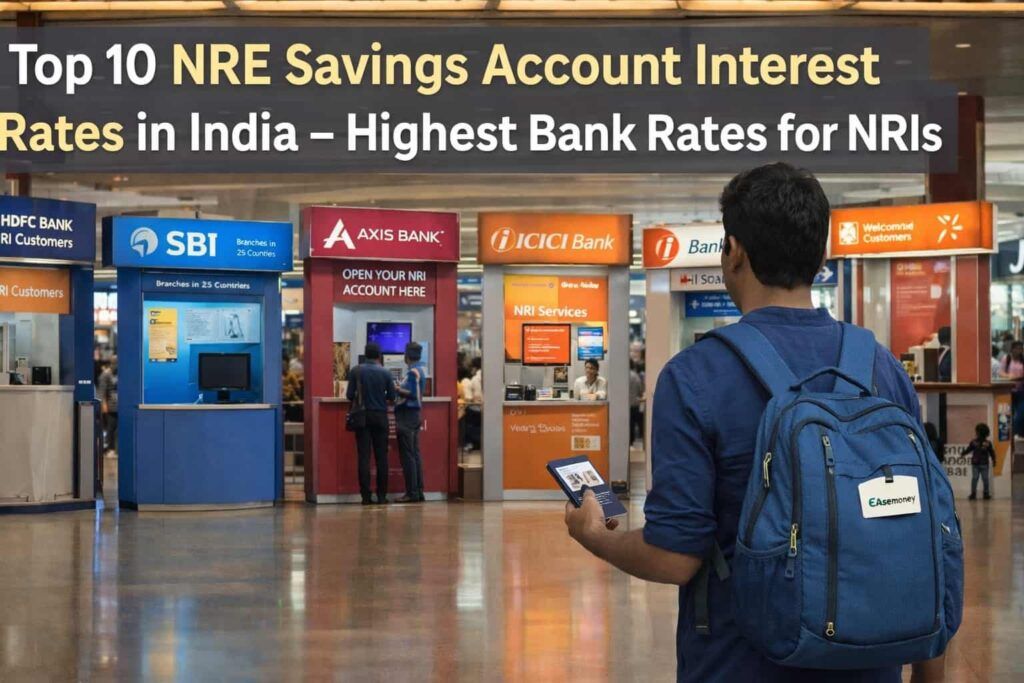
Start with the major banks — HDFC, ICICI, SBI and Axis. These are the Tier-1 institutions most NRIs first open accounts with. They usually focus more on stability, service network and digital access rather than giving the highest savings interest.
Because of that, their NRE savings rates stay fairly steady and generally lower than smaller private or small-finance banks. In simple terms, you trade a little interest income for easier remittance handling, better app support, and stronger long-term trust.
1. HDFC Bank
As per the HDFC Rates page, the bank currently gives a 2.50% yearly interest on NRE savings accounts (effective 24 June 2025 and continuing in 2026). This rate applies to every balance amount — no matter whether you add a balance of ₹1 lakh or ₹20 lakh, the percentage stays the same.
Key points you should know
- Interest rate: Fixed
- Minimum balance: about ₹10,000 (metro) / ₹5,000 (semi-urban)
- Tax in India: fully tax-free
- Transfer abroad: full amount and interest allowed anytime
- Calculation Method: Interest is calculated on the daily closing balance and credited every 3 months directly into your account.
So this account is mainly for holding remittance money safely, not for earning a high income.
Alternative for You HDFC NRE Fixed Deposits (Higher Yield) = Why do many NRIs shift to FD? At 2.50%, a ₹10 lakh balance earns only about ₹25,000 per year. But the same amount in an HDFC NRE Fixed Deposit (around mid-6% range in 2026) can generate more than double the yearly return.
In practice, many people keep the NRE savings account for receiving salary transfers and then move surplus funds into the NRE FD for better earnings while staying with the same bank.
2. ICICI Bank
This account is mainly for receiving your overseas transfer and holding money safely. Rate is flat, just like HDFC — you don’t get a higher interest even if the balance becomes bigger.
| Feature | What you actually get |
|---|---|
| Interest | 2.50% per year |
| How counted | On daily balance |
| Credit time | Every 3 months |
| Minimum balance | Around ₹15,000 |
| Tax | No tax in India |
What you should understand
- You get a debit card and a cheque facility in India
- If the balance falls below the minimum, a upto 500rs penalty applies
- You can send money abroad anytime
Real use = You normally keep only working money here (for EMI, family expenses). Once the balance grows, most people shift extra amount into ICICI NRE Fixed Deposit because savings interest stays very low.
3. SBI (State Bank of India)
SBI keeps it very simple. You earn about 2.70% per year on the NRE savings account. The rate does not change with balance — whether you keep ₹1 lakh or ₹1 crore, the percentage stays the same.
- Your Interest is calculated on the daily closing balance and credited every 3 months. It remains fully tax-free in India.
- If ₹10 lakh stays for a year, you earn roughly ₹27,000 — safe, but not a growth account.
Why are many NRIs still opening SBI
- You get government-bank comfort; many people feel money is safer
- Remittances become easier because SBI has global tie-ups
- The YONO app lets you manage NRE/NRO from abroad
Compared with HDFC and ICICI
- Like HDFC and ICICI, the savings return is low and meant only for parking funds
- But SBI gives a slightly higher rate (2.70% vs ~2.50%)
- Unlike chasing higher interest, SBI focuses more on stability and trust
- Same as HDFC OR ICICI, they give a value SBI NRE FD product to earn more interest than a savings account.
4. Axis Bank
Axis works a little differently from HDFC, ICICI and SBI. Instead of one flat rate, it uses balance slabs, so the interest depends on how much money you keep.
- Below ₹50 lakh → about 3.00% yearly
- ₹50 lakh and above → about 3.50% yearly
- Very large corporate-type balances → linked to market rate (MIBOR)
Interest is counted on your daily balance and credited every 3 months.
What this means for you: If you keep ₹5–10 lakh, you earn near 3%. But if you maintain bigger balances, you actually get slightly better savings income than other big banks.
Other important points:
- Interest is fully tax-free in India
- You can send the full money abroad anytime
- Minimum balance is usually around ₹12,000
- Good for temporarily holding remittance before FD
Real understanding: Unlike SBI/HDFC/ICICI, which stay near 2.5–2.7%, Axis gives a bit higher savings return. Still, it is a parking account — once the amount becomes large, many NRIs shift surplus into NRE fixed deposits for proper earnings.
Top Highest NRE Savings Account Interest Rates
After the big four banks, some private and small finance banks started giving much higher NRE savings returns in 2026. In certain balance slabs, the interest can touch 7%–8% yearly.
1. Suryoday Small Finance Bank — NRE Savings
This bank gives one of the highest NRE savings rates in India. Instead of one flat percentage, the interest increases as your balance grows, and it is calculated on your daily closing balance.
| Balance kept in account | Interest |
|---|---|
| Up to ₹1 lakh | 2.50% |
| ₹1–5 lakh | 3.00% |
| ₹5–10 lakh | 6.25% |
| ₹10 lakh – ₹2 crore | 7.50% |
| ₹2–5 crore | 7.50% |
| ₹5–25 crore | 7.75% (highest) |
Important features
- Interest credited every month (not quarterly like big banks)
- Fully tax-free in India
- Full repatriation allowed
- Two options:
- NRE Classic → MAB ₹10,000
- NRE Supreme → Minimum Balance required ₹1,00,000
Let’s understand it:
If you keep ₹12 lakh, the first ₹10 lakh does not earn 7.5%. Only the portion above the lower slabs gets the higher rate. Still, monthly compounding makes the earnings noticeably higher than those of large banks. Because of monthly credit and a higher percentage, some NRIs use this as a temporary FD alternative — park funds here while waiting before booking a fixed deposit or property payment.
2. IDFC FIRST Bank NRE Savings Account
As per IDFC Rates Updated on 9 January 2026, IDFC FIRST gives higher savings returns than most big banks. But the rate is progressive, meaning each part of your balance earns its own slab rate — not one rate on the full amount.
| Balance portion | Interest |
|---|---|
| Up to ₹1 lakh | 3.00% |
| ₹1–10 lakh | 5.00% |
| ₹10 lakh – ₹10 crore | 6.50% |
| ₹10–25 crore | 6.00% |
| ₹25–100 crore | 5.00% |
| Above ₹100 crore | 4.00% |
Interest is calculated daily and credited monthly, not quarterly.
Easy example
- If you keep ₹10 lakh: ₹1 lakh earns 3% but ₹9 lakh earns 5%
- If you keep ₹1 crore: ₹1 lakh → 3%, ₹9 lakh → 5%, and ₹90 lakh → 6.5%.
That’s why credited interest looks different from a simple calculation.
Other things you get
- Monthly interest payout (faster compounding)
- Tax-free in India (NRE rules)
- The bank offers zero fees on over 30 common savings account services, including IMPS, NEFT, and RTGS. (IMPS/NEFT/RTGS, etc.)
- Average monthly balance is about ₹25,000
Quick understanding: This type of account works well when you temporarily hold large funds (say, after selling property or before booking an FD). Because of monthly credit and higher slab rates, earnings can be much higher than a 2.5% big-bank savings account.
3. RBL Bank
RBL sits between big banks and small finance banks. It gives better savings interest than HDFC/ICICI/SBI, but still keeps a proper private-bank structure. Active from 11 February 2026, interest is calculated on the daily balance and credited monthly (last day of each month). The rate works on a progressive slab basis.
| Balance portion | Interest | Effective yield |
|---|---|---|
| Up to ₹1 lakh | 3.00% | ~3.04% |
| ₹1–5 lakh | 3.00% | ~3.04% |
| ₹5–10 lakh | 5.00% | ~5.12% |
| ₹10 lakh – ₹7.5 crore | 6.00% | ~6.17% |
| ₹7.5 crore – ₹100 crore | 5.50% | ~5.64% |
What you should know
- Interest credited every month (better compounding than quarterly banks)
- Fully tax-free in India (NRE rules)
- Premium variants available (Prime Edge / Insignia accounts)
- Works well for holding large balances temporarily
FD option: If you don’t want to keep money in savings, RBL NRE Fixed Deposits go up to about 7.20% for 18–36 months. Minimum tenure is 1 year — if you close earlier, interest is not paid.
Savings account here can earn meaningful return for a few months’ parking. But for long holding, people still move money into NRE FD to lock the rate.
4. Equitas Small Finance Bank — NRE Savings Account
Effective 26 February 2026, Equitas gives one of the highest savings returns among NRE accounts. Interest depends on the daily balance and follows slabs.
Interest slabs
| Balance portion | Interest rate |
|---|---|
| Up to ₹1 lakh | 2.50% |
| ₹1–5 lakh | 3.00% |
| ₹5–50 lakh | 6.00% |
| ₹50 lakh – ₹5 crore | 6.50% |
| ₹5–25 crore | 6.25% |
| Above ₹25 crore | 7.00% (highest) |
Interest is calculated daily and credited periodically (as per the account cycle), and remains tax-free in India.
Minimum balance
- Metro/Urban: about ₹10,000
- Semi-urban: about ₹5,000
- Rural: about ₹2,500
Special account options
- Explorer NRE → mainly for seafarers and marine workers needing international access
- Elite program → benefits like airport lounge access and locker discounts (shareable with family)
If you keep a large idle balance (for example, ₹50 lakh waiting for a property purchase), this account can earn meaningful income compared to 2.5% big-bank savings.
9. YES Bank
From 1 January 2026, YES Bank revised its NRI savings interest. The savings account now gives modest returns because the bank is pushing customers toward its higher-yield NRE fixed deposits (around 7% for 2–3 year tenure).
Interest slabs (rupee savings)
| Daily balance | Interest |
|---|---|
| Up to ₹1 lakh | 2.50% |
| ₹1–10 lakh | ~2.75% |
| ₹10–25 lakh | 3.00% |
| ₹25–50 lakh | 4.00% |
| Above ₹50 lakh | 4.00% |
Interest is calculated daily and credited periodically (bank cycle).
Account features
- Minimum opening amount is about ₹10,000
- Manage worldwide via YES Online / IRIS mobile app
- Joint holding allowed with another NRI or resident relative (former/survivor)
- You will get International debit card with ATM access and a reward program
- Full repatriation allowed for NRE balances
Real understanding
The savings account here is mainly for receiving remittance and holding money briefly. Because returns are limited, many customers shift larger balances into YES Bank NRE FD (near 7% range) once funds accumulate instead of leaving money idle in savings.
10. IndusInd Bank
From 1 March 2026, this account works on balance slabs. If you keep more money, you earn a bit more interest. Bank counts interest on the daily closing balance and it stays tax-free in India.
Interest idea
- Up to ₹1 lakh → 2.50%
- ₹1–25 lakh → 3.00%
- ₹25 lakh – ₹5 crore → 4.00%
- ₹5–100 crore → 5.00%
- Very large premium balances → up to about 7% (special tiers)
What you get
- You can send both principal and interest abroad anytime
- Minimum balance roughly ₹10,000 (urban) / ₹5,000 (rural)
- You can add an NRI or resident family member jointly
- International debit card and cheque facility available
- Video banking, WhatsApp banking and mobile access from overseas
For normal balances, you will usually see around 3–4% return, so people mostly use it to receive remittances and hold money safely. If a big amount sits temporarily, earnings look better than large banks, but for long-term holding, most people later move funds into a higher-return option.
FAQs
Which bank gives the highest interest on NRE savings account?
In 2026, small finance banks like Suryoday, Equitas and some private banks give near 6–7% on certain balance slabs. Big banks usually stay around 2.5–3%. Higher rate applies only on part balance.
Which bank is best for an NRE account?
Depends what you want. If you need easy remittance and trust, many people pick SBI, HDFC or ICICI. If you want higher savings return for temporary parking, smaller banks often earn more.
Do you get interest on an NRE savings account?
Yes, interest is paid and it is completely tax-free in India. Bank calculates daily balance and credits quarterly or monthly. For example ₹10 lakh at 3% earns roughly ₹30,000 yearly.
What is SBI or ICICI NRE savings interest rate now?
As of 2026, SBI gives around 2.7% and ICICI/HDFC near 2.5% yearly. These accounts are mainly for receiving remittance and payments, not for growing money long-term.
Can I calculate NRE savings interest myself?
Yes. Take yearly rate, multiply by balance and days kept, then divide by 365. Example ₹5 lakh at 3% for full year gives about ₹15,000 before compounding adjustment.
Is IndusInd or private bank NRE account safe?
They are regulated by RBI like other banks, but branch network and support differ. Many NRIs keep salary account in big bank and hold extra balance separately for better return.
What is Federal Bank NRE savings interest rate?
In 2026, Federal Bank NRE savings gives roughly 2.50% to about 5.50% depending on balance slabs. Interest is tax-free and credited quarterly. Higher returns appear only when balance becomes very large.
What is Canara Bank NRE savings interest rate?
Canara Bank NRE savings usually pays around 3.10% to about 4.00% yearly based on balance size. Interest calculated daily, credited quarterly, and remains tax-free in India for NRIs under current rules.
Are these government bank NRE accounts useful?
Yes, many people choose them for stability. You may earn slightly less interest, but branch support and documentation handling are easier, especially when family members operate the account in India.
Join 60,000 readers who get exclusive credit and banking deals, RBI updates, and investment insights from Easemoney.