

In 2025, cheque-related fraud reporting in India increased noticeably; however, the number of cases declined, but the amount still went up overall in Banking of india. As a result, the RBI pushed banks to strengthen checks, including making Positive Pay compulsory for cheques above ₹2 lakh. Consumer complaints also made it clear that banks would be held responsible if altered or forged cheques slipped through.
Because of this, even small mistakes when filling in a cheque now lead to faster rejection or delayed processing. So now, making correct cheque filling more important than it used to be.
What Is Cheque Filling And Why Is It Still Confusing in 2025
Cheque filling is a simple process of writing, normally hand-written via Blue or Black Ink, legally valid payment instructions on a cheque so that a bank can transfer money without ambiguity, dispute, or fraud risk. This transfer of money via cheque works on a designated person, business, Bank, or self.
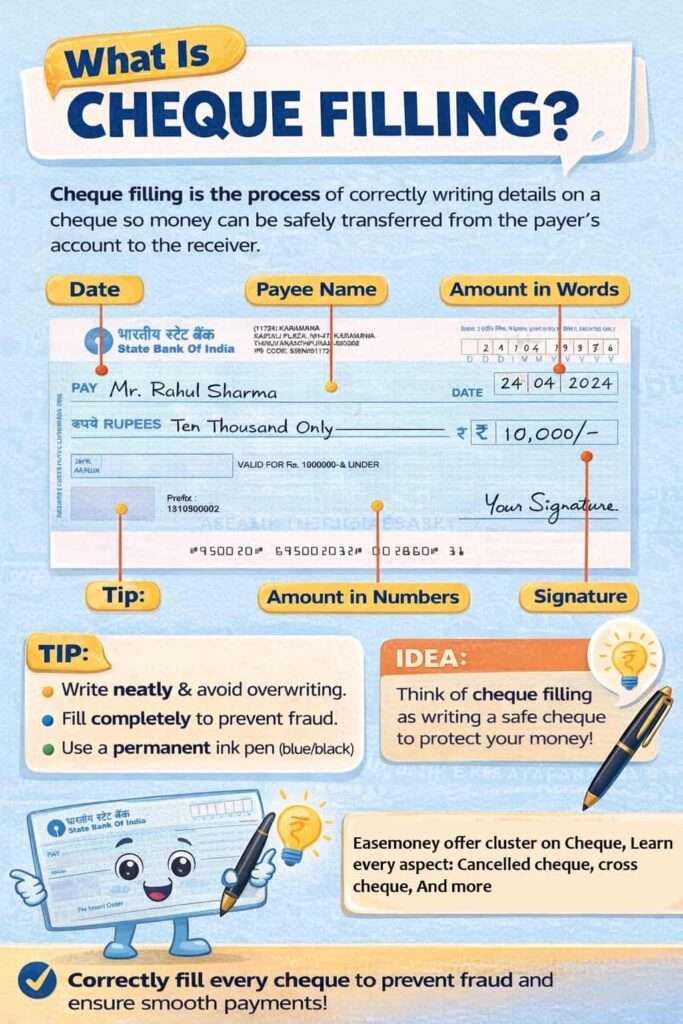
In this process, the leaf writing needs to accurately complete specific fields with permanent ink to ensure a secure and valid transaction. Not only that, but the cheque printed cheque number, MICR, IFSC, transactional codes, signatures, these Pre-Printed Security Features make this payment faster and way safer for you in the 2025 CTS system.
Even after digital payments, UPI, and Online RTGS, cheques are still heavily used in India. As per the PIB press release, India processed approximately 7.1 crores cheque transactions per month on average via the CTS system in fiscal year 2022-23. It means rent, security deposits, school fees, court matters, business payments, and RTGS settlements still need cheques in most PSU Banks and daily branch banking.
The confusion persists because cheque filling is not evaluated by humans first – it is directly judged by systems such as CTS.
Understanding What Banks Actually “Read” on a Cheque
Banks do not “understand” intent. They validate certainty. Your cheque passes multiple internal systems, such as
- CTS (Cheque Truncation System) scanning
- Automated field matching
- Risk-based manual review by Human (only if flagged)
Systems look for:
- consistency between words and numbers
- alignment inside boxes
- absence of overwriting
- signature pattern similarity
Even a small uncertainty (such as extra space, additional symbol, smudge, or correction). These can increase the rejection probability of your transactions.
Different Types of Cheques and How Filling Changes
Not all cheques are treated equally; however, if they look like the same.
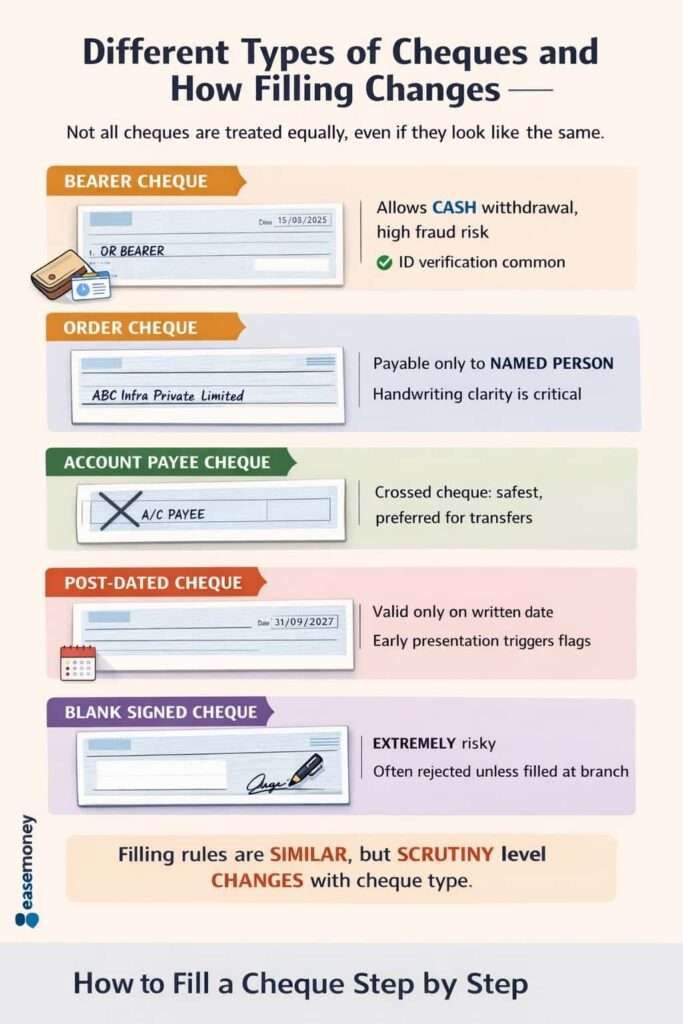
- Bearer cheque: It allows cash withdrawal, so it can be a high fraud risk. For this, your ID verification is common
- Order a cheque: payable only to the named person. Handwriting clarity is critical
- Account payee cheque: It is a type of a crossed cheque; It is one of the safest and preferred for transfers.
- Post-dated cheque: valid only on the written date; early presentation triggers flags, the only change you have to make here while filling, the date.
- Blank signed cheque: extremely risky; often rejected unless filled in at the branch. This is most popular due to the movie drama. but not do in real life.
In simple words, the filling rules remain similar and easy, same clear handwriting, but the bank scrutiny level changes with the cheque type.
How to Fill a Cheque Correctly in the Top 7 Official Steps
This is the official, bank-safe method used across Indian banks, no matter RRB, PSU, Private, and small finance Banks. The same method applies to whatever the cheque is for, self, another person, RTGS, or a deposit. But only the context changes. You need a cheque leaf, not random; cut a leaf from your book, accordingly, not one-by-one, not the last or in-between leaf. Importantly, you can choose English, Hindi, or your regional language. As per the RBI guidelines, It is a bilingual format supported; depending on your branch location, it works in multiple languages. you can confirm your branch first, if still confusion.
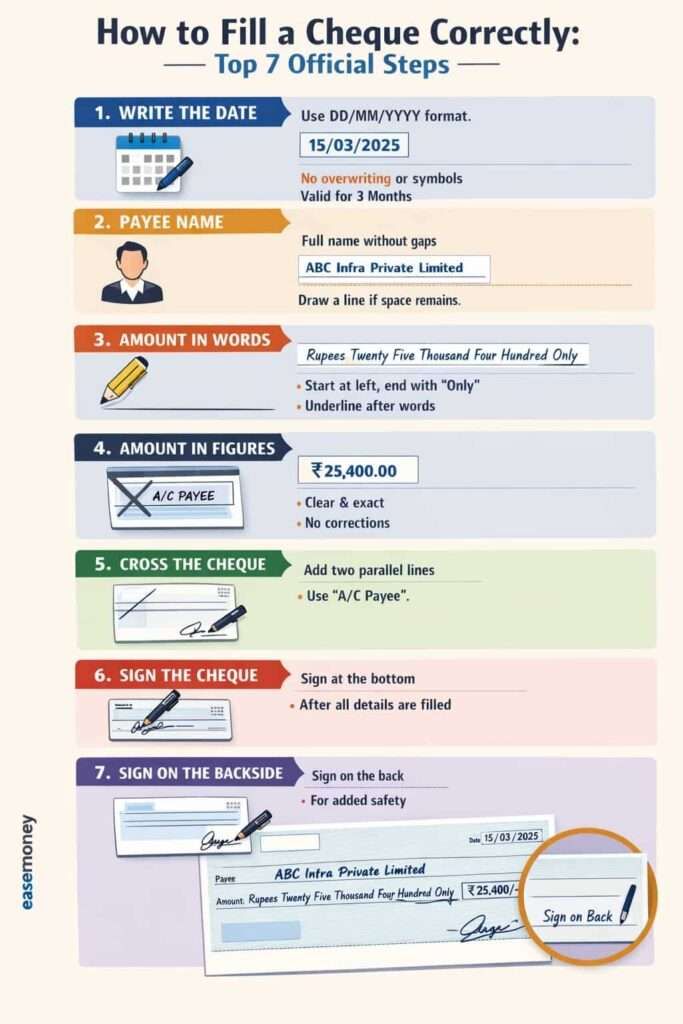
1 Step – Write the Date Clearly
First of all, like any banking form or slips, it also starts with the date. On the right side, top corner, you will simple Date format. Write down the date in the format 15/08/2026.
Also, avoid any overwriting; use symbols instead of slashes.
Remember: A cheque is valid for 3 months from the written date.
2 Step – Write the Payee Name Without Gaps
Now, in the Payee column, you have to write the full name of the person or organisation. The person who will receive this cheque and the amount will be credited on account.
Let me give you an example – ABC Infra Private Limited or SUNIL KUMAR
Tip: If space remains after the name, you can draw a straight line to block misuse.
3 Step – Write the Amount in Words
Now, the important part, here, you have to write the exact amount you want to give via cheque. such as Rupees Twenty Five Thousand Four Hundred and end with only. It required so, no one can rewrite it. You can use a different language as well. Banks treat this as the legal amount.
4 Step – Write the Amount in Figures
In the cheque leaf, there is a box with the ₹ symbol. Simply, put the amount and add /- at the end.
Simply, avoid:
- unclear zeros
- touching box borders
- handwritten corrections
Most silent rejections happen here.
5 Step – Cross the Cheque (When Required, Optional but good practice)
Two parallel lines on the top-left restrict cash withdrawal.
Use crossing when:
- paying someone else
- transferring funds
- issuing RTGS cheques
Writing “A/C Payee” increases safety. You can read this article to know better – Crossed Cheque Meaning, Types & How to Cross in India Laws
6 Step – Sign the Cheque (Always Last)
Now, the last part, you have to first check everything, the dates and amount, now put a sign. simple, as you always do in the same bank. Also, banks allow thumb presses for a few conditions or illnesses.
Important fact: Banks verify signature patterns, not artistic similarity.
You can choose Thumb Impression on Cheques as a sign.
| Who Can Use | How It Works | Simple Note |
|---|---|---|
| People who cannot sign | Thumb impression is taken on the cheque | Usually done in a bank branch, verified by bank staff |
This is allowed under Indian banking rules and explained in public references like Wikipedia.
7 Step – Sign on the Backside of the cheque
In India, most banks take security very seriously. Many PSU banks and a few commercial banks ask for –
- depositor signature on the back side twice. means, the account holder also needs to sign again, just like the face of the cheque.
This helps verify if the front signature is unclear.
What If You Are Writing the Cheque for Another Person
Changes are minimal, but you have to do a few things correctly if writing for someone:
- First of all, you have to always cross the cheque, so it is cash withdrawal will blocked.
- Avoid bearer mode
- Also, make sure the exact spelling of the payee name
Professional rule for you: Never issue bearer cheques to unknown recipients.
How to Ready a Cheque for Self – (Withdrawal or transfer)
Mostly people want a self-cheque only when they need to withdraw cash via a branch from their own bank account or to transfer funds between two accounts they hold. The filling of it is quite simple –
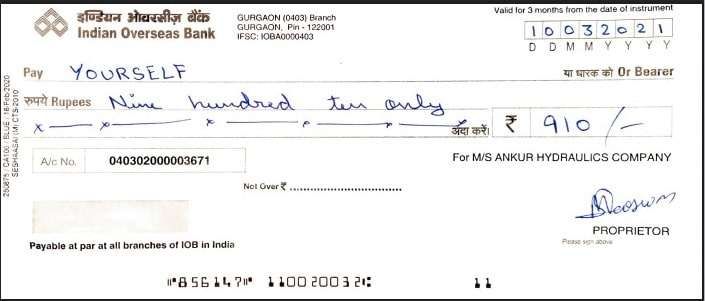
- Write “Self” or “Yourself” in the payee field
- No need to do the crossing
- Most of the time, your bank may ask for an ID proof or a Passbook. (not mandatory)
Most government banks in India and RRB Banks ask self-cheque for big cash withdrawals, but they offer a cash withdrawal slip for minimal cash only. Above that, you will need a self-cheque and a PAN.
RTGS or NEFT Cheque Filling — When Required and How
In Banks, when payment transfer is above 2 lakhs, they choose RTGS via cheque from a bank branch. This is common in most of the PSU Banks and commercial banks. The banking form is also strict on transfer via cheque only. Most NEFT Payments also need a self-cheque in many banks.
The process of filling is the same –
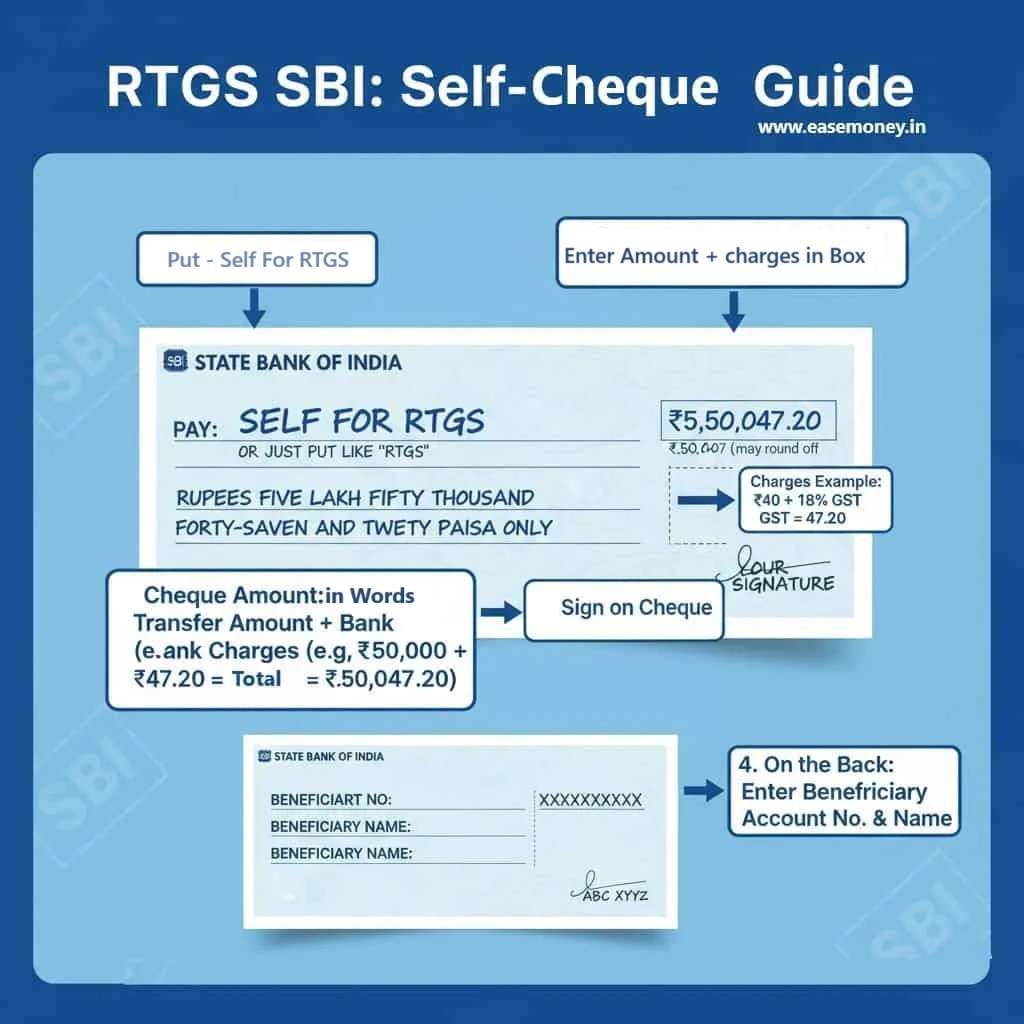
- Simply put the same amount on the RTGS form you enter.
- Put “Self RTGS or NEFT” for the beneficiary at the payee section in the cheque.
- Sign the same as you do, now attach the RTGS form and submit it to the counter.
Tip for you – Mismatch between payee and beneficiary name is a top rejection reason, so write slowly and use Capital words.
How to Fill a Cheque Deposit Slip at a Bank Branch (India)
Cheque deposit slips are not cosmetic forms — they are reconciliation tools. In India, most banks’ deposit forms support both:
- You can do a Cash Deposit.
- Also, you can choose Cheque Deposit.
We are ignoring cash entirely, so, better way to fill in for cheque deposit.
You usually need to fill up for cheque only:
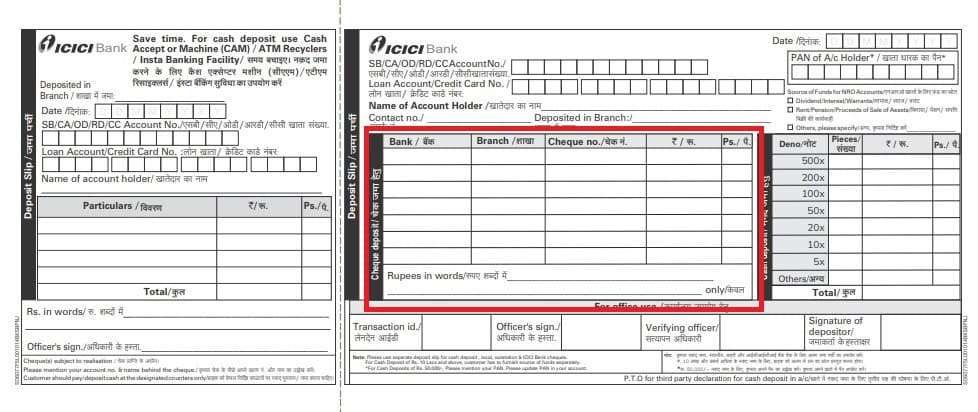
- Firstly, enter the dates and Account number at the top where you want to transfer the cheque amount.
- Account Holder Name
- Depositor’s Account Number
- Cheque Number (In the cheque box)
- Cheque Date
- Cheque Amount
- Bank Name of Cheque Issuer
- Branch (sometimes optional)
- Your signature (depositor)
- You can ignore the cash denomination table and the cash written section or symbols.
Important: The deposit slip does not override cheque errors. Even a perfectly filled slip cannot save a wrongly filled cheque.
Why Cheque Deposit Slip Accuracy Matters More After 2025
After CTS upgrades and RBI’s faster clearing push with NPCI:
- Cheques often clear within 24 hours, and soon, in 2026, you may find within 3 to 4 hours only.
- Errors are flagged earlier.
- Wrong cheque numbers cause misposting delays.
Under the Cheque Truncation System governed by the Reserve Bank of India, the slip and cheque are digitally paired. So, while writing, write correctly and submit it the same day. Make sure, not before the holiday and branch closing time. Sometimes, it can delay the payment.
Top 5 Special Cheque Filling Cases in India
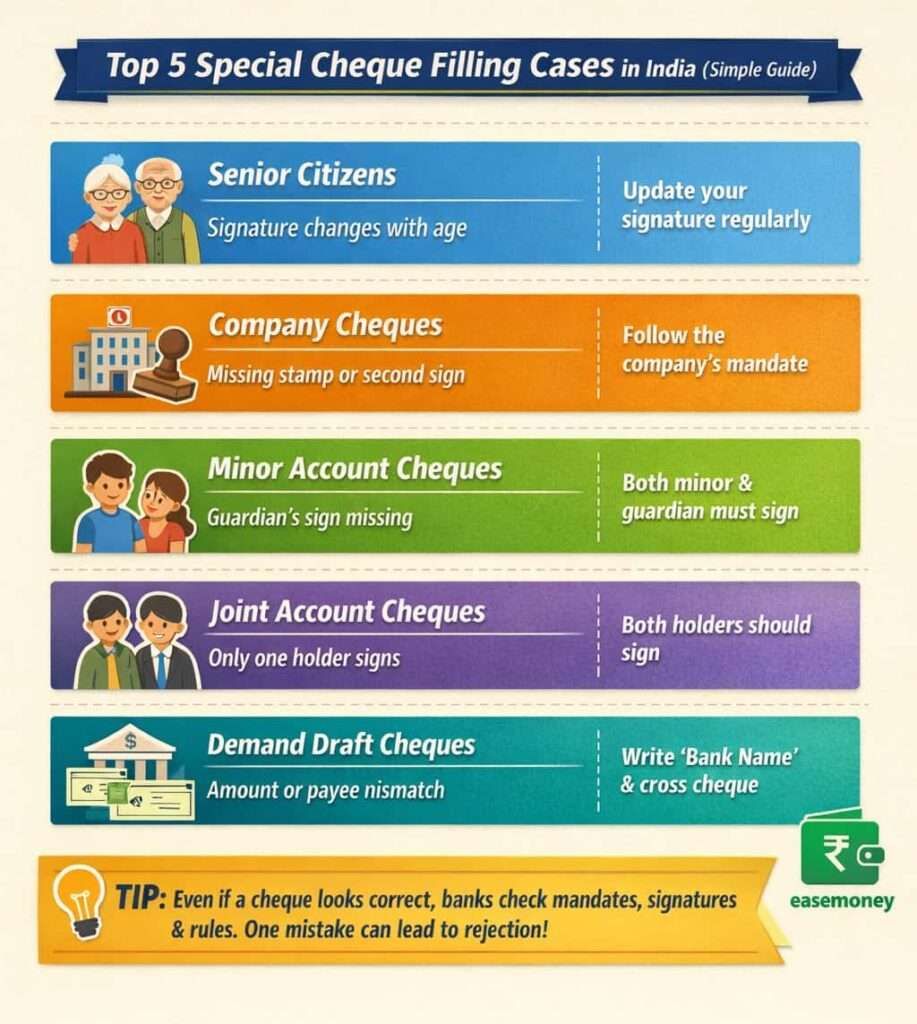
| Case | What People Commonly Face | What Actually Helps |
|---|---|---|
| Senior Citizens | Signature slowly changes with age and doesn’t match old bank records. | Visit your bank once in a while and update your signature. It prevents repeated cheque rejection. |
| Company or Corporate Cheques | Cheque looks correct but gets rejected due to missing stamp or second sign. | Always follow the company’s bank rules. Even one missing sign can stop the cheque. |
| Minor Account Cheques | Minor signs the cheque but bank expects guardian’s sign too. | Check how the account works. If guardian sign is required, both must sign. |
| Joint Account Cheques | Only one person signs when the bank expects two. | Confirm whether one or both signatures are needed before issuing the cheque. |
| Demand Draft Cheques | Cheque amount or payee doesn’t match the DD request. | Write the bank name clearly, cross the cheque, and match the amount exactly. |
FAQs
Is filling an HDFC Bank or State Bank of India cheque different from a normal cheque?
The filling steps are the same, but verification differs. SBI is stricter on overwriting and dates, while HDFC focuses more on signature clarity and amount alignment.
How do I fill a cheque to transfer money to someone’s bank account?
Write the exact beneficiary name, cross the cheque, and add “A/C Payee”. Never issue a bearer cheque for transfers, as banks may reject or delay it.
How do I fill a cheque book? Do I need to fill all pages?
You don’t fill a cheque book at once. Only fill one cheque leaf when making a payment. The remaining cheques stay blank until needed.
Why does my cheque get rejected even when amount and signature are correct?
Cheques are often rejected due to unclear dates, overwriting, extra spaces after the payee name, or amount touching box borders, even if signature and amount look correct.
Can I correct a mistake on a cheque by overwriting or cutting?
No. Most banks reject cheques with corrections. Even small overwriting raises fraud risk. The safest option is cancelling the cheque and issuing a fresh one.
How should I fill a cheque for RTGS or NEFT through a bank?
The cheque must be crossed, and the payee name must exactly match the beneficiary account name. Any mismatch between cheque and RTGS form leads to rejection.
Is signing on the back of the cheque compulsory in India?
It’s not mandatory everywhere, but many PSU banks prefer backside signatures, especially for self cheques or third-party deposits, to help with verification if doubts arise.
Can someone else fill or sign a cheque on my behalf?
No. Only the account holder should fill and sign the cheque. If someone else does it and a dispute occurs, the account holder remains fully responsible.
Hope you liked the content. Explore smart options below 👇
