What is a Credit Card Limit Increase
A credit card limit increase (also called limit enhancement) means your bank raises the maximum amount you are allowed to spend on your existing credit card. Your card number, rewards, and features stay the same — only the approved borrowing capacity becomes higher.
It basically gives you more headroom for purchases, bill payments, or emergencies without applying for a new card.
Example: Your Old limit was ₹40,000 → new limit approved like ₹1,00,000.
Key Benefits
- 1) Helps your credit score = If your limit increases but your spending stays the same, your utilisation automatically drops. Try to stay below 30% usage — banks see you as financially comfortable, and your CIBIL usually improves.
- 2) Emergency support = In real life this matters a lot. A higher limit gives instant backup for medical bills, urgent travel, or sudden repairs. You don’t need to take a quick personal loan.
- 3) Better loan approval chances = When lenders see you trusted with a higher limit and you manage it properly, they consider you lower-risk. This can help while applying for car loan or a home loan interest rates.
- 4) More rewards & perks = With higher limits, banks often move you to better offers — sometimes lounge access, higher cashback slabs, or festival offers. Not always automatic, but it starts opening those doors.
How Banks Decide Your Limit (Eligibility Rules)
Banks don’t just wake up and increase your limit. Every few months, they quietly review your profile and try to judge one thing: can you handle more credit safely or not? If your usage looks controlled, they feel comfortable. If it looks risky, they simply wait.
What the bank actually checks =
1) Income & job stability
Your income matters the most. In India, banks usually keep the limit around 2.5–3× your monthly salary, such as a 20,000 Salary Limit goes to 90,000 Max.
If your salary increased or you stayed in the same job for about 6–12 months, it helps a lot. Unlike frequent job changes, stable employment makes the bank trust you more.
2) Credit utilisation (how much you use)
This is where many people get confused. Using the card is good, but using too much is not.
Quick Example: Your ₹1,00,000 limit and You ₹25,000–₹30,000 spend → healthy. But ₹85,000–₹95,000 spend → bank becomes nervous
If you regularly stay below 30% usage, the bank feels you don’t depend on credit. Then they are more willing to increase it.
3) CIBIL score
A score around 750+ is usually the comfort zone. It shows you repay properly. If your score drops, even slightly, the system may pause the increase.
4) Repayment history
This matters more than people think. Paying the full bill on time for 6–12 months continuously builds strong trust. But even one late payment can delay the offer for months.
5) Card tenure
Most banks want to see some history first. You usually need to hold the card for at least 6 months (and closer to 12 months is even better) before they seriously consider a limit increase request.
6) Festival Offer
During the festive season (roughly September to January in India), most banks relax approval rules to encourage big purchases like electronics, travel, and jewellery. If you use about 60–80% of your limit before Diwali/Christmas and clear the bill fully, the system may automatically offer a temporary or even permanent limit increase.
Different Types of Credit Card Limit Increase (India)
Banks don’t increase the limit in only one fixed way. Usually, it happens in three practical paths. Sometimes the offer is already waiting for you — you just don’t notice it in the app.
1. Pre-approved offer (the easy one)
This is the smoothest method. The bank watches how you use and repay the card and, if things look comfortable, it quietly places an offer inside your app.
You don’t submit documents; you just accept. Where you can check:
- HDFC: Credit Cards section or Eva chatbot
- ICICI: iMobile Pay → Cards → Manage Credit Limit
- Axis: Mobile App → Credit Cards / Offers tab
- SBI Card: App/website → Manage Card
If you see it and accept, the limit usually updates the same day.
2. Manual request (you ask the bank)
If no offer appears, you can still request it yourself.
- Log in to net banking or card app
- Open Manage Card OR Services
- Tap Credit Limit Increase
- Upload documents if asked
Here, the bank basically says: Okay, show us your current income. They may ask:
- Your Last 3 salary slips
- or ITR if self-employed
This helps especially if your salary increased but the bank still thinks your old income.
3. Income review (proper evaluation)
Sometimes the system alone is not enough. Then a manual review happens.
You submit income proof and the bank checks whether you can safely handle a bigger limit. This method often gives the biggest jump, but takes a few days.
Small habits that actually matter
- Try to use only about 20–30% of your limit
- Pay the full bill every month
- Update salary after increment
- Don’t apply repeatedly — wait about 6 months
If you keep hitting the limit but always repay, the bank slowly understands you need more space.
One extra trick
If your bank still refuses, you can apply for a card from another bank. Many times, the new bank matches your highest existing limit, so your total available credit increases anyway.
Steps to Increase Credit Card Limit (All Banks – 2026)
Now limit increase is mostly online. Bank system already studies your behaviour, but the final step you must approve — RBI rules don’t allow banks to increase the limit without your permission. Follow this practical order:
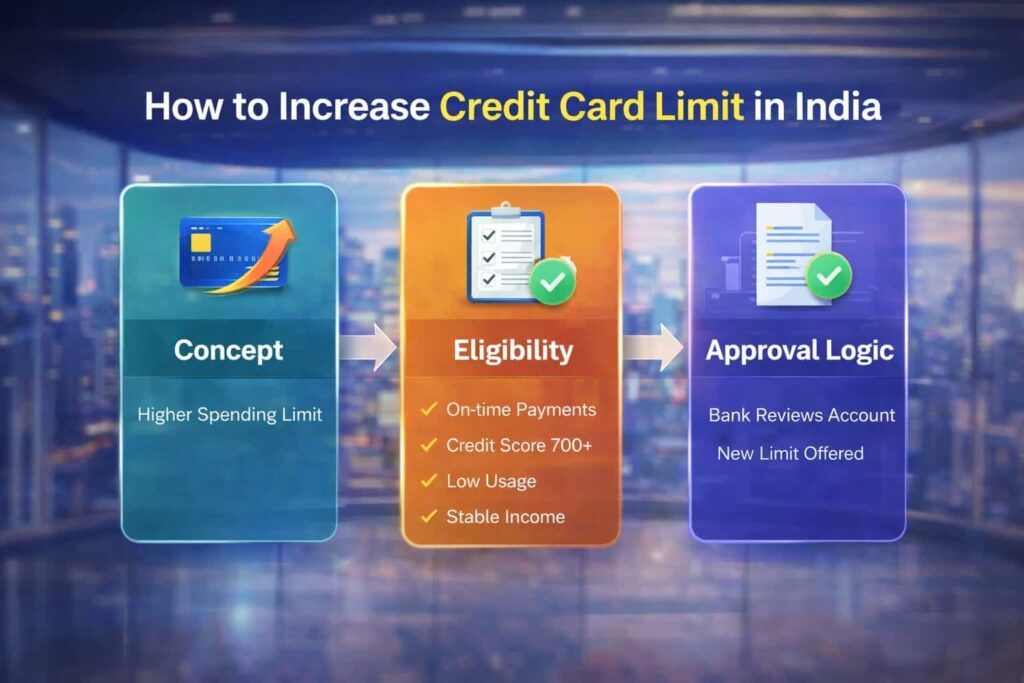
Step 1 — First check your profile (very important)
Before you press request, quickly verify your basic info, such as:
- Your CIBIL is around 750+
- No late payment in the last few months
- Income details updated in the bank
- Check your outstanding total limit. You can check any credit checking app. such as easemoney or paisabazaar
Because the moment you tap request, the bank system instantly checks your credit report. If the profile looks weak, the request quietly gets rejected.
Step 2 — Always check the pre-approved offer first
This saves effort and avoids extra verification. Where to see it:
- HDFC: NetBanking → Cards → Credit Limit Enhancement
- ICICI: iMobile Pay → Cards → Manage Limit
- SBI Card: App → Menu → Benefits → Limit Increase
If you see “No Documents Required”, accept that only. This is the safest approval.
Step 3 — Keep documents ready (if the offer is not visible)
If nothing shows, you go with manual action. This is a tricky one, even if your credit is good and your salary is upgraded and better still bank holds the rights. Just keep PDFs ready:
- Last 3 salary slips
- Latest ITR (self-employed)
- 6 months bank statement (salary account)
Without income proof, most manual requests stop here.
Step 4 — Raise the request
Open your card app → In menu, open Service Request OR Contact Us → Credit Limit Enhancement.
The system may ask for your desired limit. The SBI card app offers to limit increase, they allow more than 200%, but you have to choose not too much. just 10 to 30% only.
Practical tip: don’t ask twice. Ask about 25–30% higher than the current limit — banks approve more easily.
Step 5 — Upload & verify
Upload documents in the portal. Sometimes you will get:
- OTP verification
- Aadhaar authentication
- or Video KYC
This is normal in 2026 for higher limits.
Step 6 — Give final approval
Even after approval, the limit does not increase automatically. Bank sends:
- SMS link or
- email confirmation
You must accept within ~48 hours. Without acceptance, the offer expires.
Step 7 — Check the update
After confirming, the new limit usually appears within 24–48 hours in the app. Before doing a big purchase, open the card screen and check Available Credit — then swipe.
Bank-wise Credit Card Limit Increase (2026)
Now, almost every bank has shifted the limit increase to the mobile banking app. You normally get two ways — instant pre-approved (a few taps) or manual review (documents) in the same app. If the offer is ready, it takes 30 seconds. If not, then income proof comes, and you need to upload statement and provide basic information.
| # | Bank | If Offer Already Ready (Fast Way) | If No Offer Shows (Manual Way) |
|---|---|---|---|
| 1 | HDFC Bank | NetBanking → Cards → Request → Credit Limit Enhancement | Upload 3 salary slips or ITR through service request or simply email |
| 2 | SBI Card | SBI Card App → Menu → Benefits → Limit Increase | SMS INCR last-4-digits to 5676791 or send income proof |
| 3 | ICICI Bank | iMobile Pay → Cards → Manage Card → Manage Credit Limit | SMS CRLIM last-4-digits to 5676766 or call support |
| 4 | Axis Bank | Axis Mobile → Credit Cards → Select Card → Limit Enhancement banner | Call support or submit salary proof for review |
| 5 | Kotak Bank | Kotak App → Cards → Credit Card Home → Limit Enhancement | Visit branch or upload Form-16 / salary slips |
| 6 | IDFC FIRST Bank | IDFC FIRST App → Credit Cards → Limit Increase | Email bank statement or latest ITR for verification |
| 7 | IndusInd Bank | IndusNet/App → Credit Card → Request Limit Increase | Customer care raises request after income re-check |
| 8 | RBL Bank | RBL MyCard App → Profile → Manage Limit | Email salary slips/ITR to card support |
| 9 | YES Bank | YES Mobile → Cards → Credit Card Services → Request Increase | Written/email request with updated income details |
| 10 | Bank of Baroda | bob World App → Credit Cards → Limit Enhancement | Net banking request or branch submission with ITR |
What actually happens in real life
- If you see the offer → accept → limit changes same day or next day
- If you don’t see the offer → bank first checks your income again
- Usually cards older than 6 months start getting reviewed
Small tip: if your salary increased and you never updated the bank, the system still thinks your old income. Updating income many times triggers the offer automatically after a few weeks.
RBI Rules for Credit Card Limit Increase (India – 2026)
As per RBI guidelines (updated framework continuing in force as of 2026), credit card limits are now completely customer-consent-based. The bank can offer an increase, but it cannot activate the higher limit unless you approve it.
Main RBI rules you should know =
1. Your permission is compulsory
According to the Reserve Bank of India’s customer-protection directions, banks cannot automatically raise your credit limit anymore. They must send you:
- OTP confirmation
- mobile-app approval
- or secure acceptance link
If you ignore it, the limit will not change.
2. Over-limit spending protection
As per RBI guidelines effective after the revised credit card rules (2025 onward, applicable in 2026), banks cannot allow spending above the sanctioned limit unless you manually enable the over-limit facility. if it is OFF → transaction declines. No penalty should be applied.
3. Income matching requirement
According to the RBI’s fair-lending framework, banks must keep your limit reasonable compared with your declared income.
Practically, many banks keep the limit around roughly 2× monthly income for newer customers. If your salary increased but your bank records are old, the system won’t offer a higher limit.
4. Faster credit bureau reporting
RBI reporting norms followed by lenders in 2026 tell your card usage and payments now get reported to credit bureaus frequently.
So:
- good repayment improves the score faster
- Missed payment hurts faster
That is why some users suddenly receive limit increase offers after only a few clean billing cycles.
5. New safety features
- Tokenisation security = Online transactions now use secure tokens instead of your actual 16-digit card number. This reduces fraud risk on higher limits.
- In-app controls = Banks must provide switches where you can:
- enable/disable international usage
- contactless payments
- over-limit facility
You now control the card behaviour directly.
How Long Does Approval Take & Does Limit Increase Affect CIBIL (India 2026)
1. Approval Time — what actually happens
It mainly depends on the offer vs the manual request. If the bank already trusts you, it’s fast, almost 1 minute. If they must re-check income, it takes time. in email manual method, it goes 15 days long.
| Bank | Pre-approved Offer | Manual Request |
|---|---|---|
| HDFC Bank | Instant / few minutes | 2–5 working days |
| SBI Card | Same day to ~5 days | 2–7 working days |
| ICICI Bank | Mostly instant | 3–5 working days |
| Axis Bank | Instant | 3–4 working days |
| Standard Chartered | Up to 5 days | 3–5 working days |
Simple rule: You accept in app → limit changes quickly. You submit documents → bank reviews → a few working days.
2 . Does a Credit Limit Increase Affect CIBIL Score?
Yes — but both ways.
A. Small temporary drop (sometimes)
If you manually request, the bank checks your credit report (hard inquiry). Because of that, your CIBIL may drop about 5–10 points for a short time. Pre-approved offers usually don’t cause this. However, requesting a credit limit increase does not affect your CIBIL in the long term, but if you choose to do so multiple times in a week, it can hurt.
B. Long-term improvement (main effect)
This is the real benefit. When the limit increases but spending stays the same, your Credit Utilisation Ratio (CUR) drops. For Example:
- ₹30,000 spend on ₹1,00,000 limit → 30% usage
- ₹30,000 spend on ₹2,00,000 limit → 15% usage
Lower usage makes lenders comfortable. Within about 2–3 months, your score usually improves.
If you see a pre-approved offer, accept that first. You avoid the inquiry and still get the score improvement — best situation.
Common Mistakes That Delay Credit Limit Increase (even after years)
Many people get confused — “I pay every bill, even EMI, also on time, still my bank is not increasing the limit.” I have 99% timely payment in last 4 years. In 2026, the problem is usually not payment behaviour. The system checks risk capacity, not only honesty. Bank software studies your income vs total liabilities.
Here are the real reasons limits stay frozen for years:
1. Too many EMIs (the silent blocker)
You may never miss EMI, but your bank calculates the FOIR and DTI ratio. You can use our Easemoney DTI Calculator to check it out.
If your total monthly EMIs cross about 40–50% of your salary, the system thinks you are already financially stretched. Example: your Salary ₹50,000 and your monthly EMI – ₹22,000 → system becomes uncomfortable → no limit increase.
2. Buy Now Pay Later (BNPL) accounts
Small apps — Amazon Pay Later, Simpl, LazyPay — look harmless, but on a credit report, they appear as personal loans.
Keeping 3–4 active lines makes you look credit-dependent. Even ₹2,000 limits can hurt approval. Closing unused BNPL accounts often improves offers within a few months.
3. “99% payment” is still a problem
Banks see the full history. Even one missed ₹100 payment 10 month ago stays, or a status like Settled OR Written-off, can block limit increase for 3–5 years. For premium approvals, banks expect a clean 100%, not almost clean.
4. Too much total credit across banks
If your combined limits are already very high compared to income, banks stop. Example: your Income ₹12 lakh yearly and your Total card limits ₹18–20 lakh
Bank worries you could use all cards together, so they freeze increases. Sometimes closing an unused card actually helps another card grow.
5. Employer or address mismatch
Your bank record, credit report and KYC must match. Different employer name, old address, or outdated job details cause automatic verification failure. The system then silently rejects offers without telling you.
6. Too many requests or applications
Every rejected request creates a hard inquiry. If 3–4 checks appear within 6 months, the bank assumes you urgently need money → risk flag → no increase.
Best practice: stop applying for about 6 months, then try again.
7. New or recently upgraded card
If you just upgraded to a higher card, the bank restarts evaluation. Usually, they want about 12 months of stable usage on that specific card before raising the limit.
8. Salary account in another bank
This matters more than people think.
If your salary goes to Bank A but your credit card is from Bank B, Bank B cannot see your real income growth. When salary and card are in the same bank, pre-approved offers come much faster.
Expert tip
If you feel the system is stuck, send a manual mail to the bank’s nodal/credit card team with your latest salary slips or ITR and ask for a limit review. Sometimes a human review succeeds where the automated system keeps saying no.
FAQs
Is limit increase free or bank charges fee?
In India 2026, limit enhancement is normally free. Bank earns when you spend, not when limit increases. If anyone asks processing fee, it’s usually a card upgrade offer, not a simple limit increase.
How to move CIBIL from 750 to 800?
Maintain 100% on-time payments for 6–9 months, avoid new loans, and keep utilisation near 10–20%. Also stop unnecessary hard inquiries; even two rejected card applications can delay improvement.
What credit limit improves CIBIL score?
Score improves not by limit amount but by usage ratio. Keep spending below 30%. Example: ₹20,000 usage on ₹1 lakh limit boosts score faster than ₹20,000 usage on ₹40,000 limit.
How can I increase limit in SBI / ICICI / Axis practically?
Use your mobile app first. Accept pre-approved increase; that is fastest. Manual requests require salary slips or ITR. Tip: update employer details — many rejections happen only due to outdated job records.
Why bank not increasing limit even after years?
Usually EMIs or Buy-Now-Pay-Later loans blocking you. If monthly obligations cross about 40% income, system marks risk. Close unused loans, keep usage below 30%, and offers often appear within 3–6 months.
What credit limit can I get on ₹50,000 salary?
Most Indian banks keep starting limit around 2×–3× monthly income. So ₹50,000 salary typically gets ₹1.0–₹1.5 lakh limit initially, but after one year disciplined usage it often rises near ₹2–₹3 lakh.
How do I increase my credit card limit?
First check inside your bank app for a pre-approved offer. If not visible, update income and request manually. After 6–12 clean billing cycles and 750+ CIBIL, banks usually approve within 2–5 working days.