

What Is a Cheque Deposit and What Does the Data Really Say?
A cheque deposit is the process of submitting a physical cheque leaf to a bank so that the amount written on it can be credited to a bank account after checking by the drawee (paying) bank. such as your bank is SBI and the drawee bank is HDFC.
Unlike instant digital payments, UPI or NEFT, a cheque deposit still goes through verification, confirmation, and settlement. Today, this process is handled electronically under the CTS framework. after October 2025, a new continuous cheque-clearing framework. This is monitored by the Reserve Bank of India and supported by clearing systems run by NPCI.
At the global level, cheque usage is going down, not up. In countries like the US, UK, Europe, and many parts of Asia, cheque volumes have been falling for many years. including India with UPI, doing billions of payments per month.
Still, the NPCI data clearly shows that, in India, cheques continue to move very large amounts of money. The percentage is around 1 or 2% percent but is worth nearly ₹8.4 lakh crore. This happens because of structural reasons:
- Businesses and corporates still use cheques for audits, vendor payments, and old working systems
- Banks, courts, government offices, and trusts issue cheques because they are legally strong and accepted everywhere
- High-value payments often prefer cheques instead of consumer payment apps
- So even though the number of cheques is reducing compared to total digital payments, the importance of cheques in specific sectors remains high.
Back to the topic, in India, cheque filling, depositing, and clearing – NPCI and RBI are working continuously to improve the timing and make it easier for anyone. For a deposit, firstly, you need to check where to deposit it, what really working options are available in india as per real-life, not by documentation.
What Are the Real Options in India for Cheque Deposit
In India, cheque deposits are still branch-centric, not ATM-centric, or any other machine. Fun fact is that cheque deposit machines are also an option, but they are only found in branches. This is a key difference from some Western markets. Mobile cheque deposit slip facility is also common in the US and the UK, not in india.
1. Branch Counter (Cash counter)
The most reliable option. Every bank branch must accept cheques at the counter and provide an acknowledgement. Best suited for:
- High-value cheques
- First-time deposits
- Cases where confirmation or guidance is needed
You can visit here and ask for a deposit or instant cash withdrawal if you have a self-cheque or bearer cheque. Make sure, bearer cheques only work on the same drawee bank and mostly in the home branch for an easy process.
2. Branch Cheque Drop Box
A convenience option inside the branch. In most PSU and commercial bank ATMs, they also add a cheque drop box. Works only for deposits, never for cash withdrawal. Best suited for:
- Routine account-credit cheques
- Non-urgent
- You don’t need immediate acknowledgement
A drop box is collected by branch staff, not scanned instantly.
- Cheques deposited early in the day may be scanned the same day.
- Cheques deposited after the staff cut-off move to the next working day.
3. Cheque Deposit Machines or Kiosks
Common in large PSU branches (especially SBI). These machines scan cheques immediately and reduce manual delays. Not category-wise, but this machine is available at almost all banks, private or commercial, Kotak Bank or BOB. You can find near the branch ATM or inside the branch. The benefit of using it is:
- Faster CTS upload
- Customers who want proof without waiting at counters
- It works like an ATM, so feel easy and simple. not too many buttons.
4. ATM or Mobile Deposit
Not common in India. Most cash-withdrawal ATMs do not accept cheques, and mobile cheque deposit exists only in limited pilots. Any article suggesting “deposit cheques at any ATM in India” is misleading. however, few old class ATM Machines gave this option before 2020. so, in 2026, it is outdated and not practical.
What You Need to Deposit a Cheque (Documents and Details)
Depositing a cheque in India is simple, but small mistakes cause most rejections. In all of these 4 options, these documents and details, you need to carry to complete the process.
Mandatory Items
- Original cheque (undamaged, legible, not out-dated)
- Endorsement (signature on the back, most PSU banks and commercial banks in india ask for twice signature backside of the cheque)
- Deposit slip (for counter or drop box)
Strongly Recommended
- Account number written on the back
- Mobile number on the deposit slip
Practical Insight
Banks do not reject cheques because of “style”; they reject them because of verification risk. Signature mismatch, overwriting, or unclear amounts trigger manual checks and delays. In simple terms, most people write amounts in hindi, but sometimes, they mismatch the digits. Cheques are bilingual, but depending on the location of the branch, you can confirm via the branch before writing.
How to Deposit a Cheque in a Bank
Depositing is easy; the process is the same in different banks. If you get a cheque and try to transfer it to your bank account or encash it, follow these steps –
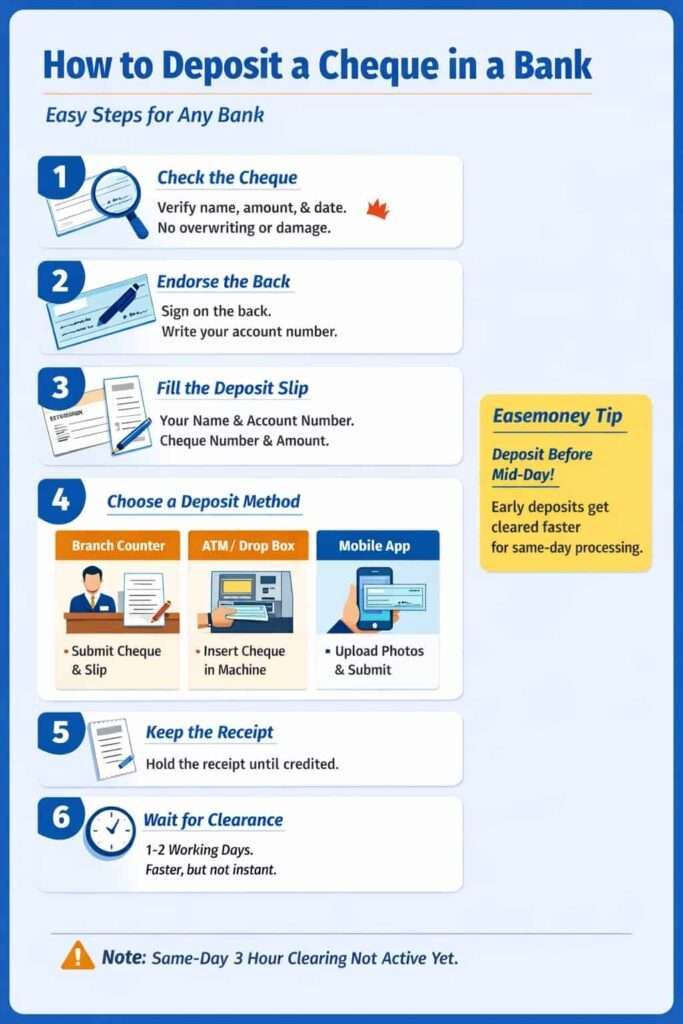
1. Check the Cheque
- This is good idea, you have to verify name, amount, date, and signature
- Make sure there is no overwriting or damage
2. Endorse the Back
- Sign on the back of the cheque
- Write your account number (if required by the bank)
3. Fill the Deposit Slip (Branch / Drop Box)
- Your name
- Account number
- Cheque number
- Cheque amount
4. Choose a Deposit Method
- Branch Counter
Submit the cheque with the deposit slip and collect the stamped receipt - ATM / Cheque Drop Box / Kiosk
Insert the cheque as per the machine or slip instructions - Mobile Banking App
Upload clear photos of the front and back of the cheque and submit digitally
5. Keep the Receipt
- Keep it safe until the amount is credited to your account
6. Wait for Clearance (Updated)
- Due to the Phase-2 postponement, cheque clearing is not instant yet
- Most cheques are credited within 1 working day
- In some cases, it may take up to 2 working days, depending on the bank and the cut-off time
⚠️ The old “1–3 working days” rule is mostly outdated, but same-day (3-hour) clearing has not started fully yet.
Tip: Depositing before mid-day increases the chance of same-day scanning under the continuous clearing system.
How to Fill a Deposit Slip (and What to Ignore)
The bank deposit slips are almost common and simple in all banks. It works for cheque, DD, and Cash. You have to ignore the cash section. It has two side – the customer copy and the bank copy. Simply, firstly, write the same full information as written on the cheque. Then copy and paste it customer copy.
Fill carefully
- Account number (no shortcuts)
- Use the cheque box section, enter the 6-digit cheque number (printed on the cheque bottom), date, the branch or city name of the cheque issued, and the Bank name.
- Amount in figures
- Do your signature
Ignore or leave blank
- Branch internal codes
- Ignore the cash denomination table
- Unfamiliar columns not explained by the staff
- In the cheque box, you can add multiple cheques, so, use it correctly. and do total amount at last.
Do not
- Use correction fluid
- Write over printed fields
How to Use the Cheque Deposit Machine or Kiosk
Cheque deposit machines are not ATMs, but they look similar and work similarly. They are CTS-enabled scanners and accept cheques instantly. Let me give you the steps, how to deposit a cheque via the Machine by using the example of the SBI Cheque Kiosk –
- Select Transaction Type
- The screen will show two options:
Reference Number or Account Number - Tap on Account Number
- The screen will show two options:
- Insert the Cheque
- The machine will ask you to place the cheque
- Insert the cheque with the front side facing up, top side first
- Enter Your SBI Account Number
- Enter your full SBI account number
- Tap on Continue
- Cheque Scanning
- The machine will scan your cheque automatically
- Enter Cheque Amount
- Enter the exact amount written on the cheque
- Tap on Continue
- Enter Cheque Date
- Enter the same date written on the cheque
- Do not enter today’s date unless it is printed on the cheque
- Tap on Confirm
- Review Details
- Carefully check and re-check:
- Account number
- Cheque amount
- Cheque date
- Carefully check and re-check:
- Confirm Deposit
- Tap on Deposit to complete the process
- The machine will give you an acknowledgement slip with UTR.
Real-world advantage – Machines scan cheques immediately, reducing dependency on manual batch collection. This often results in faster CTS presentation compared to drop boxes.
Cheque Types and Where to Deposit Them
| Cheque Type | Where It Can Be Deposited | Cash Allowed | Practical Tip |
|---|---|---|---|
| Account Payee (Crossed) | Counter, Drop Box, Machine | No | Safest for transfers |
| Crossed Cheque | Counter, Drop Box | No | Cannot be encashed |
| Self Cheque | Counter only (Best Home Branch) | Yes | Carry ID |
| Bearer Cheque | Counter only (Best Home Branch) | Yes (limited) | High fraud risk |
| Cancelled Cheque | Not for deposit | No | Used only for KYC |
| Post-dated Cheque | On or after date | No | Depositing early fails |
Final words
By the end of 2025, India was still clearing around 44.86 crore cheques in just one month through the Cheque Truncation System. As per the BFSI News, At the same time, NPCI records data shows that more than 1.49 crore cheques. If we talk about the worth, it goes around ₹8.4 lakh crore. These were processed after the new, faster cheque-clearing system started in October 2025.
These numbers are important because many people think cheques are “finished” after UPI and digital payments. That is not fully true. Cheques are no longer the main payment method for daily use, but they are still heavily used by businesses, banks, companies, courts, and for large transactions. In short, cheques may look old, but they are still very much active in India.
As observed by Easemoney, most Indians are not rejecting cheques — they are only expecting them to be faster and more reliable. That is exactly why RBI and NPCI are upgrading cheque systems and introducing better cheque deposit options, instead of removing cheques completely.
FAQs
How do I deposit a cheque in my bank given by someone else?
If someone gives you a cheque, endorse it by signing on the back, write your account number, fill a deposit slip, and submit it at your bank branch or cheque deposit machine.
How can I deposit my cheque into my bank account?
To deposit your cheque, verify details, sign on the back, fill a cheque deposit slip, and submit it at the branch counter, drop box, or cheque deposit kiosk. Amount credits after clearance.
Can I deposit my cheque in an ATM in India?
Most ATMs in India do not accept cheques. Cheque deposits are allowed only at bank branches using counters, drop boxes, or cheque deposit machines. Claims about ATM cheque deposits are outdated.
How to deposit a cheque in bank online?
Online cheque deposit through mobile apps is not widely available in India. Most banks still require physical cheque submission at branches. Limited pilot features exist, but they are not reliable nationwide.
Can I withdraw cash immediately after depositing a cheque?
No, cash withdrawal is allowed only for self or bearer cheques at the counter. Account-payee cheques must be cleared first before funds are credited and available for withdrawal.
Why do banks reject cheque deposits even when balance is sufficient?
Banks reject cheques due to signature mismatch, overwriting, unclear amounts, stale dates, or CTS image issues. Rejection is usually about verification risk, not insufficient funds in the account.