

Cash withdrawal slips work almost the same across most Indian banks — whether it is SBI, PNB, Bank of Baroda, UCO Bank, or regional rural banks. Small layout differences exist, but the writing process remains nearly identical in most branches.
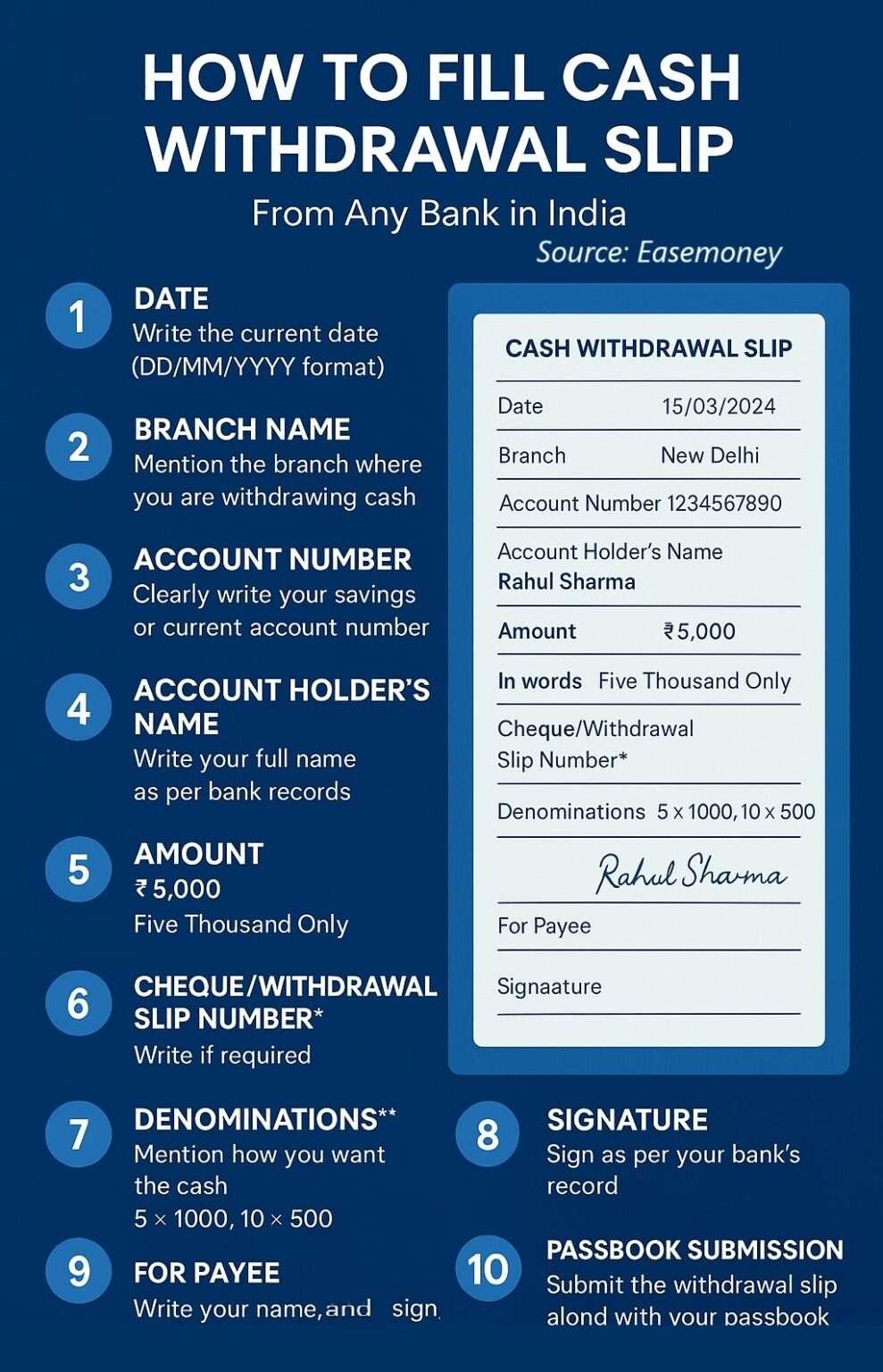
✅ Step-by-Step: How to Fill Bank Withdrawal Slip Correctly
💡 Real Branch Banking Tip: Cash counters commonly reject slips because of signature mismatch, incomplete amount fields, or overwriting near account number.
Many experienced branch customers first fill the slip slowly near the writing desk instead of directly standing in the cashier queue.
Next: Check below how to download sample withdrawal slips of major Indian banks with real filled examples.
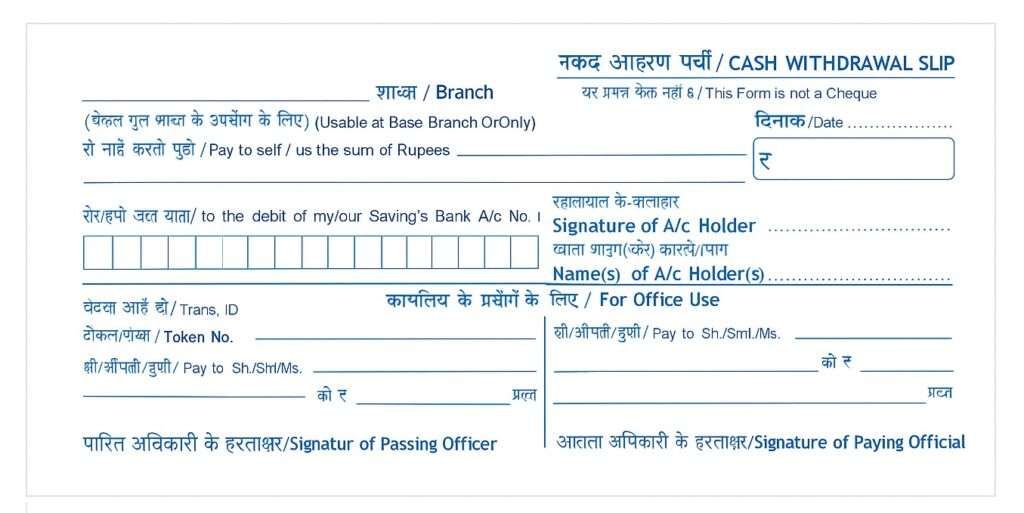
Download All Bank Cash Withdrawal Slip PDF List
Below are some popular banks and institutions where customers commonly use cash withdrawal slips at branch counters:
- Punjab National Bank (PNB)
- Post Office Savings Scheme
- Canara Bank
- State Bank of India (SBI)
- Bank of Baroda (BOB)
- Indian Bank
What Changes in Cash Withdrawal Slips Across Banks?
- SBI: Mobile number field is compulsory.
- BOB: No denomination section; may require double signatures.
- PNB: Very simple slip with basic details only.
- Post Office: Same slip works for savings and investment withdrawal.
- Canara Bank: Similar to SBI; passbook usually compulsory.
- HDFC Bank: No withdrawal slip system; use self-cheque or debit card.
- ICICI Bank: Provides printable withdrawal forms online and at branches.
What is the validity period of the withdrawal slip?
There is no validity period if you just get a fresh slip from the branch, but the validity period starts when you mention a date. If you write today’s date but don’t submit it, it cannot be reused tomorrow. Always fill it fresh at the bank counter.]
What Are the Withdrawal Limits Through Slips?
- SBI: Usually up to ₹50,000 per day with passbook and self cheque.
- BOB: Around ₹50,000, but depends on branch cash availability.
- Canara Bank: Mostly ₹25,000 to ₹50,000 based on account type.
- Indian Bank: Basic savings accounts usually get ₹10,000 to ₹50,000 limit.
- HDFC Bank: Limits vary branch-wise; larger withdrawals may need extra verification.
For withdrawals above ₹50,000, banks generally ask for a cheque instead of a slip.
Note: Limits can change depending on branch rules, account type, cash availability, RBI guidelines, and whether it is a home or non-home branch transaction.
What If Your Bank Doesn’t Use Withdrawal Slips?
If you bank with HDFC, HSBC, or Urban co-operatives banks, you won’t get withdrawal slips. Rather, you can:
- Use a cheque – Write a self-cheque and present it at the counter.
- Use a debit card at a teller – Many private banks have teller-assisted debit card machines for withdrawal.
- ATM/UPI – For smaller amounts, use ATM or digital transfers instead of visiting the branch.
Expert tips to avoid a few common mistakes
- You can use a regular ball pen; the blue and black inks are widely accepted.
- Leaving out the date or writing an old date.
- Writing only figures without words.
- Overwriting without countersigning.
- Wrong account number or incomplete name.
- Forgetting the depositor’s signature when withdrawing on behalf.
- Submit a slip without a passbook or debit card.
- Don’t touch the “For Office use” section; sometimes, people mark a line in that section. Simply ignore that; it’s for bank staff only.
Frequently Asked Questions
Can a family member withdraw cash using my slip?
Yes, but you have to first sign in as an account holder on both sides of the slip, and your family member also has to sign as a depositor and attach a passbook.
What is the maximum cash allowed through a withdrawal slip?
There are no maximum limits set by banks; however, most banks in india cap at Rs. ₹25,000 to Rs. 50,000 cash only. If you want a higher amount, the bank may ask for a cheque withdrawal.
Can I pre-fill a withdrawal slip at home and submit it later?
Technically, yes, but risky. Slips are date-sensitive. If branch rules change or cash isn’t available, staff may reject it. Smart move: fill and submit on the same visit.
Why do banks prefer slips for small withdrawals instead of cheques?
Because slips are instant, low-risk, and don’t need clearing. For amounts below ₹25,000–₹50,000, counters process slips faster than cheques, especially in government banks during peak hours.
Does handwriting really matter while filling out a withdrawal slip?
Yes, a lot. Unreadable numbers cause delays. Counters often reject slips with confusing 1, 7, or 9. Tip: write slowly in capital letters and double-check digits before submission.
Can I use the same withdrawal slip format in another branch?
Usually no. Slips are branch-specific. Even within the same bank, formats vary. Always pick a fresh slip from the same branch counter you’re withdrawing from.
Why do banks ask for a passbook even when the slip is correct?
Passbooks act as manual verification. In non-CBS or crowded branches, staff cross-checks the balance and signature. Around 70% public banks still insist on passbooks for counter withdrawals.
Is the denomination choice guaranteed if I write it on the slip?
Not guaranteed. It depends on the cash stock. If you ask for ₹500 notes and the branch has mostly ₹100s, the cashier decides. Tip: Request denominations before submitting the slip.
What happens if I write the correct amount but forget my signature?
Instant rejection. No signature = no authorisation. Even for ₹500, banks won’t process it. Always sign after filling amount, not before, to avoid disputes.
Are withdrawal slips safer than ATM withdrawals for seniors?
Yes. Branch slips allow human verification, thumb impression, and assistance. Many seniors prefer slips for amounts above ₹10,000, especially when ATM limits or PIN issues arise.
Hope you liked the content. Explore smart options below 👇
🔥 Recommended