

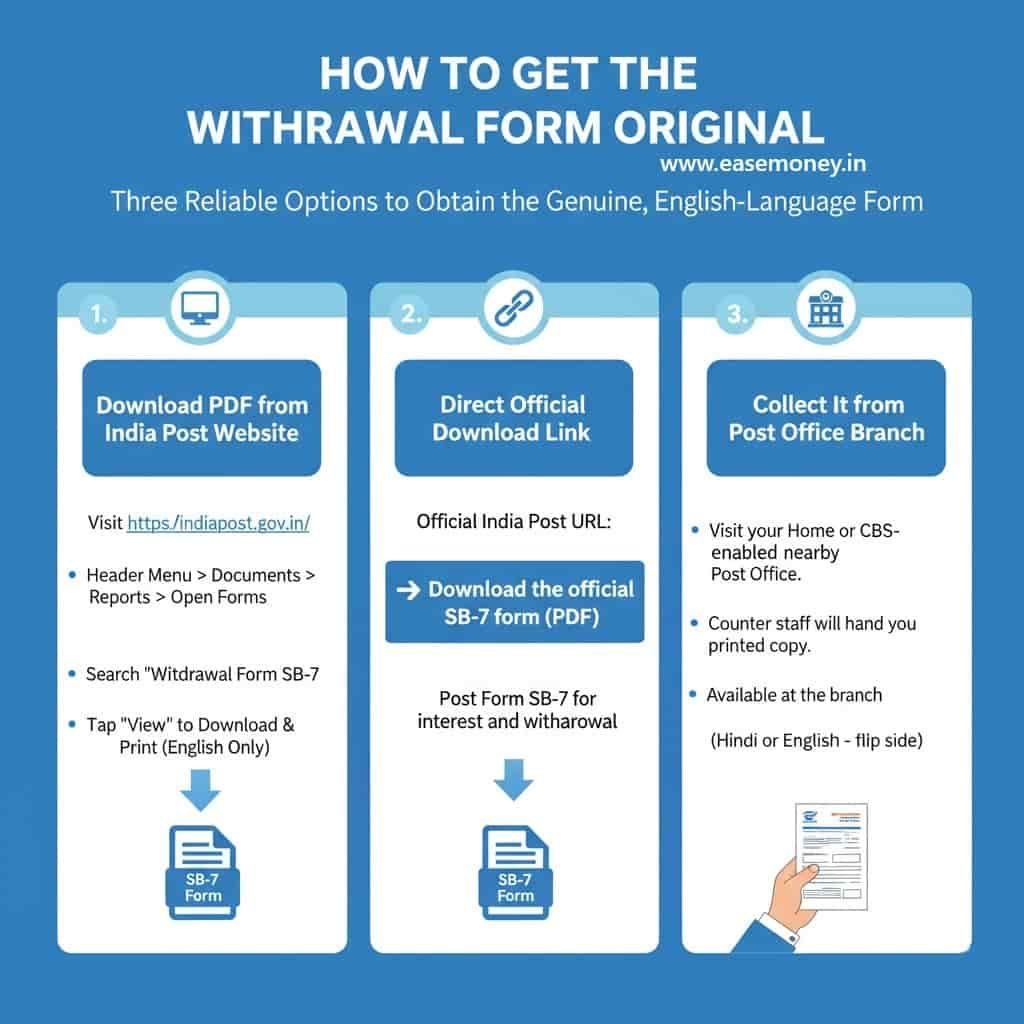
India Post now allows customers to download the official SB-7 withdrawal form online from the official website, or you can download it below.
| Feature | Details |
|---|---|
| Use | Savings account, RD, TD, MIS, and maturity withdrawals |
| Before Visiting | Fill account number, amount, and signature carefully |
| Passbook Required | Original physical passbook is normally mandatory |
| Language | Form is available in English and Hindi |
💡 2026 Post Office Rule: PAN card is now commonly required for post office withdrawals and account verification. Customers without PAN may be asked to submit alternative declaration forms.
For withdrawals above ₹50,000, branches usually verify PAN details carefully and may ask for additional approval before processing cash.
📥 If the PDF link does not open:
- Visit the official India Post website
- Open Documents → Reports → Forms section
- Search “Withdrawal Form SB-7” and download PDF
- Or collect printed form from nearby CBS-enabled post office branch
Next: Check below how to correctly fill the India Post SB-7 withdrawal form step-by-step.
Fill up Process – Post Office Withdrawal Form
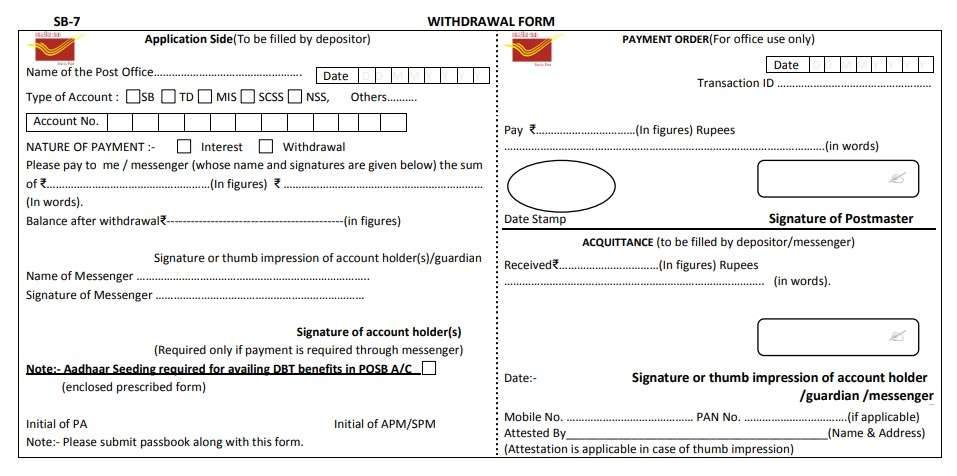
- The form has three sections, but you only need to fill the first and last parts. The middle section is completed by postal staff.
- Use a blue or black pen and write clearly in capital letters. Let’s understand each section step by step.
1. Application Side — To Be Filled by the Depositor
This is the front part of the form where you state your request.
| Field | What to Write | Example / Notes |
|---|---|---|
| Name of Post Office | Your branch name | India Post – Delhi GPO |
| Type of Account | Tick or underline one: SB, TD, MIS, SCSS, NSS, Others | Tick SB if it’s a Savings Account |
| Nature of Payment | Choose “Withdrawal” or “Interest” | Most people select “Withdrawal” and interest for other investment schemes only |
| Amount (in figures) | The amount you want to withdraw | Such as – 5000 put “/-“ |
| Amount (in words) | Write clearly in words | Rupees Five Thousand Only |
| Balance after withdrawal | DO NOT FILL | Postal staff will fill it |
| Signature or Thumb Impression | Sign exactly as in the passbook | Required for all withdrawals |
| Name & Signature of Messenger | Only if someone else collects | DO NOT FILL for self-withdrawal |
| Date | Current date in simple format | 08/10/2026 |
| Account Number | Your complete account number | your 10 to 12 digit number – such as 805872265412 |
2. Payment Order — For Office Use Only
This middle section is usually filled by your post-office staff or teller after verifying your account and signature. They add information:
- Transaction ID
- Authorised withdrawal amount (in figures and words)
- Date and official stamp
- Signature of the Postmaster only, not yours.
You should not write anything here, but if your branch asks to fill it out, you can simply repeat the withdrawal amount in words, digits and put the date.
3. Acquittance — To Be Filled by Depositor/Messenger
After the cash is handed over, you must sign here to confirm receipt.
| Field | What to Write |
|---|---|
| Amount Received (in figures & words) | Same as the amount withdrawn |
| Date | Date you received the cash |
| Signature or Thumb Impression | Sign again to acknowledge |
| Mobile No. | Optional but recommended |
| PAN | If the amount is higher |
| Attestation (if thumb impression) | Signature & address of a witness |
Types of Accounts Covered by the Withdrawal Form
This SB-07 withdrawal slip is not only for work on a single product. It’s valid for almost every small-savings scheme offered by India Post. let check the list –
| Variants | Full Form | Description |
|---|---|---|
| SB | Savings Bank | Regular savings account for day-to-day deposits and withdrawals |
| TD | Time Deposit | Fixed-term deposit (1–5 years) with higher interest |
| MIS | Monthly Income Scheme | An investment option that pays monthly interest for five years |
| SCSS | Senior-Citizens Savings Scheme | High-return scheme for people aged 60 years or above |
| NSS / Others | National Savings Scheme | Includes NSC, RD, PPF, KVP, and Mahila Samman Savings Certificate |
Withdrawal Important Rules
- PAN card: For withdrawals above ₹50,000, you must show your PAN card or mention the PAN number in the slip.
- Passbook compulsory: Carry your passbook along with the withdrawal form at the counter.
- Self-cheque option: If withdrawing through cheque, passbook is usually not required.
- Minimum balance: Do not withdraw the full balance if it leaves less than ₹500 in the account, otherwise charges up to ₹50 may apply.
- Whole rupees only: Enter the amount only in full rupees, not paise.
- Messenger withdrawal: If another person collects the cash, both signatures and valid ID proof are required.
- Aadhaar linking: Aadhaar seeding is necessary to receive DBT government subsidy benefits.
Post Office Savings Bank (POSB) Withdrawal Limits
home branch withdrawals for basic savings accounts usually have no fixed upper limit, while other branches and digital services have set limits. Here is the list –
| Mode | Daily Limit | Important Note |
|---|---|---|
| Home Branch | No fixed limit | Large withdrawals depend on branch cash availability |
| Other CBS Post Offices | ₹50,000 | Available at CBS-enabled branches |
| GDS Branch Post Office | ₹50,000 | Per account daily limit |
| Aadhaar Withdrawal | ₹20,000 | Without withdrawal slip/voucher |
| ATM Withdrawal | ₹25,000 | Daily ATM limit |
| ATM Per Transaction | ₹10,000 | Single swipe limit |
| IPPB Online Transfer | ₹2 lakh | IMPS daily limit |
| Minimum Withdrawal | ₹50 | For branch withdrawal slips |
Note: Most Post Offices are now CBS-enabled, so you can use this withdrawal form at any branch, not only your home branch, usually up to ₹25,000.
Frequently Asked Questions
Can I fill out the post office withdrawal form in regional languages?
Yes, most branches accept forms in English and Hindi, as long as the details are clearly written and readable. Also, other local regional language depending on your post office location.
Can a family member submit the India Post withdrawal form on my behalf?
Yes, you can authorise a messenger to collect cash for you by writing their name and signature in the form. You may need to provide ID proof. However, most branches only allowed for senior citizens or incapacitated individuals.
How do I correct a mistake made while filling out the Post Office withdrawal form?
Never use a whitener or overwrite. Simply ask for a new slip from the counter, use neat and clean Capital words, and you can use a passbook while entering the information, such as Account number, type, and more.
Can I use one SB-7 withdrawal slip for multiple accounts together?
No. One SB-7 slip works for only one account number. Even if two accounts are in the same branch, the staff will reject combined slips. Always take separate forms per account.
What is the most common reason a post office rejects a withdrawal slip?
Around 6 out of 10 rejections happen due to a signature mismatch. Tip: carry your latest passbook, and sign slowly, matching the original signature stored during account opening.
Is it faster to withdraw cash in the morning or the afternoon at post offices?
Morning withdrawals (10:00–12:00 PM) are faster. After 2:00 PM, cash counters often slow down due to settlement work. For amounts above ₹20,000, visit before noon.
Can I withdraw interest and principal together using one SB-7 form?
Yes, but only for schemes like MIS, TD, or SCSS. Tick both clearly and mention the total combined amount. Staff usually reconfirms verbally before processing—listen carefully.
What happens if I forget to write “Only” in the amount in words?
Usually accepted, but risky. Some branches return slips without “Only” for safety. Smart tip: always end with “Only” to prevent manual alteration and avoid second visits.
Do rural and small post offices verify withdrawals more strictly?
Yes. Branch Post Offices (BPOs) often double-verify ID and passbook, especially above ₹10,000. Carry Aadhaar and avoid sending messengers unless genuinely required.
How much advance notice should I give for large cash withdrawals?
For amounts above ₹50,000, inform the branch 1 working day earlier. Many post offices don’t hold excess cash daily, especially non-GPO branches—advance notice saves rejection.
Is it safer to withdraw via SB-7 or a cheque at the post office?
SB-7 is safer for walk-in cash withdrawals. Cheques may take 1–2 days for clearing. For urgent cash needs below ₹25,000, SB-7 is always faster.
Hope you liked the content. Explore smart options below 👇
🔥 Recommended