

The easiest way to request a new cheque book is through your bank’s Net Banking. The process usually takes less than 2 minutes with more control, and most banks deliver the cheque book to your registered address within 3 to 7 working days.
📌 Quick Steps to Apply
💡 Pro Tip: Most banks let you track your cheque book delivery status directly from the Service Requests history section inside Net Banking or the Mobile Banking app.
📖 Read below: Bank-wise cheque book apply process + other methods like SMS banking, ATM request, branch visit, and customer care support.
Other General Methods (SMS, ATM, Branch)
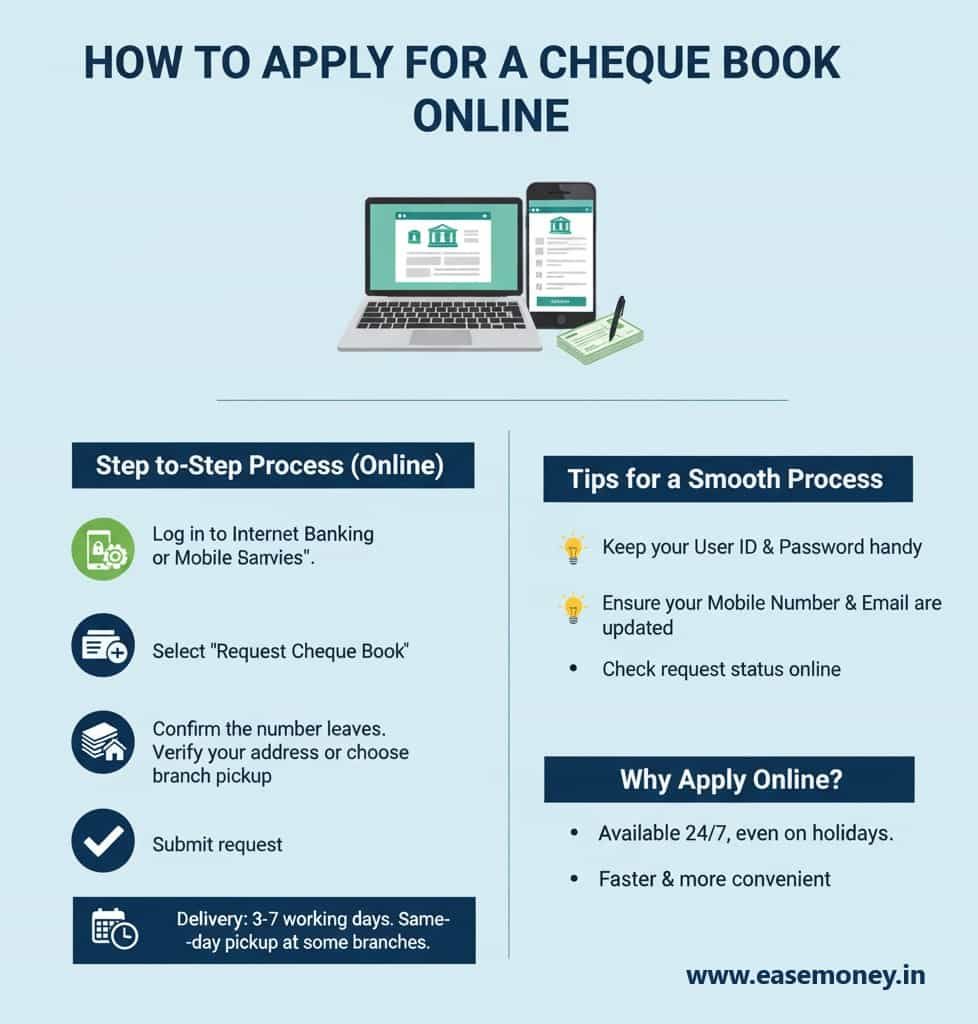
Here are the common ways to apply for a cheque book in India:
- Bank Website AI Chatbot – This is one of the simplest, most private banks, such as Axis. Go to the site, chat with the bot, say I want a chequebook, it asks your mobile number and OTP to order it for you instantly.
- Mobile Banking App – Most apps like iMobile (ICICI), YONO (SBI), or Axis Mobile let you apply in just 2–3 taps.
- ATM – Some banks allow cheque book requests through their ATMs under “Other Services.”
- SMS Banking – Most banks allow SMS banking. Just check the exact code for the request on the official site, and send an SMS.
- Branch Visit – Collect from the branch counter or Download First. Fill out a customer request form or application letter at your home branch. This is useful if you want an urgent issue or same-day collection.
- Phone Banking/IVR – A few private banks let you raise a cheque book request by calling customer care.
If you are an ICICI Bank, SBI, or Axis Bank customer, the request flow might vary slightly, but the idea remains the same—you’re simply telling the bank, “I need a new cheque book, please issue one linked to my account.”
Bank-Wise Application Process (SBI, HDFC, ICICI, etc. Pages)
| Bank | Best Method | Key Detail |
|---|---|---|
| ICICI Bank (Apply Process) | WhatsApp / SMS | Free for Savings A/c |
| SBI (State Bank of India) | YONO App / SMS | 7–10 days delivery |
| Axis Bank | Insta Services | Home delivery available |
| HDFC Bank | NetBanking (2025) | Check for new charges |
| Bank of Baroda (BOB) | Chatbot / App | 2 Free per year |
| Kotak Mahindra Bank | Mobile App | Not free for 811 A/c |
| Union Bank of India | ₹5.90 + GST per leaf | |
| Canara Bank | Canara AI1 App | Starts ₹4 + GST/leaf |
Emergency: How to Get a Cheque Book Immediately
In urgent situations, many government and private banks provide an emergency cheque book facility through the branch. Follow these steps:
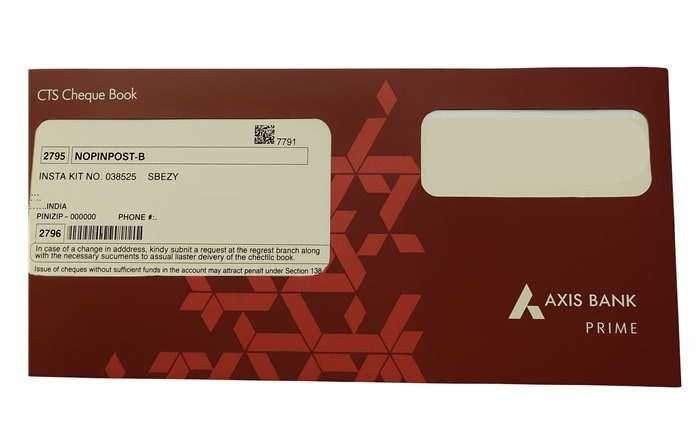
- Visit your home branch or nearest bank branch.
- Inform the bank staff that you need an emergency cheque book urgently.
- Carry your passbook, debit card, or valid ID proof for verification.
- The branch may issue a few instant cheque leaves on the same day.
- In most cases, the bank staff manually writes or stamps your account number and account holder name on the cheque leaves.
- Emergency cheque books usually have higher charges compared to regular cheque books.
- You can confirm the charges and availability directly with your branch before requesting it.
How to Track Your Delivery Status
You can easily track your cheque book delivery status through your bank’s mobile app, Net Banking, customer care, or courier tracking number sent to your registered mobile number.
1. Track Through Bank Services
Most banks provide cheque book tracking facilities inside their banking app or website.
- SBI: Call customer care at 1800 1234 or 1800 2100. Select your language, then choose ATM and cheque book services for tracking updates.
- ICICI Bank: Open iMobile app or Net Banking and go to Services > Check Status > Track Deliverables.
- HDFC Bank: Log in to Net Banking and open Accounts > Cheque & DD Services > View Cheque Status.
- Axis Bank: Use the Axis Deliverable Tracker using your registered mobile number.
- Kotak Mahindra Bank: Courier tracking details are usually sent through SMS after dispatch.
2. Track Through India Post or Courier
Many banks send cheque books through Speed Post or private courier services.
- You will receive a tracking number on your registered mobile number after dispatch.
- If sent through India Post, the tracking ID usually contains 13 characters like EB123456789IN.
- Visit the India Post tracking page and enter your consignment number to check delivery updates.
3. Understand Delivery Status Messages
Here are some common cheque book tracking status meanings:
- Dispatched: The bank has handed over the cheque book to the courier.
- In Transit: The parcel is moving between courier hubs.
- Out for Delivery: The delivery agent is coming to your address.
- Undelivered / Returned to Origin (RTO): Delivery failed because of wrong address, unavailable receiver, or other issues. In such cases, contact your home branch for re-dispatch.
Delivery timing – Banks usually deliver the cheque book within 3–7 working days, either by courier (Bluedart, Delhivery) or speed post (India Post). Some premium branches allow same-day collection.
Free Limit of Cheque Book (Leaves)
As per the RBI policy, you are entitled to a minimum of 25 cheque leaves per year, free of charge, upon request in savings bank accounts.
Beyond that, the cost depends on bank policy:
- Public Banks (SBI, PNB, Union Bank): Generally free up to 10 or 20 leaves per year, then ₹2–5 per additional leaf.
- Private Banks (ICICI, HDFC, Axis): Free for premium accounts, but chargeable for regular accounts after a limit.
- Current Accounts: Usually get higher free limits since they’re used for business.
- Instant Cheque leaves: It goes from ₹100 to ₹150 per 5 leaves.
You can check the latest service charge on your bank issued circular. It’s available on your mobile banking app and the bank’s official website.
How Many Leaves Does a Cheque Book Usually Have?
The number of cheque leaves in a cheque book depends on your account type and bank policy:
- Savings Account Holders: Typically receive 10 or 25 leaves in one cheque book.
- Current Account Holders: Often get 50 or 100 leaves, since businesses use them more frequently.
- Premium Customers: Some banks issue personalised cheque books with even larger sets, depending on account privileges.
For example, if you request a cheque book via YONO – SBI allow upto 100-leaf cheque books for savings accounts.
Who is Eligible for a Cheque Book?
Almost every bank customer is eligible for a cheque book.
- Savings account holders get a personal cheque book.
- Current account holders receive a business cheque book with more leaves.
- Salary accounts often come with a standard 25-leaf cheque book.
- Minor accounts and basic savings accounts may have restrictions.
- Most zero-balance digital accounts do not have a facility.
If your account is active and KYC is complete, you can request one anytime.
Safety Tips for Your New Cheque Book
- Verify cheque leaves, account number, and name after receiving the cheque book.
- Never sign blank cheques. Fill all details before signing.
- Write “A/C Payee” with two parallel lines for safer transactions.
- Avoid empty spaces while writing amount and payee name.
- Update the cheque record slip for tracking cheque usage.
- Keep the cheque book in a safe and secure place.
- Do not leave it openly in office desks, bags, or vehicles.
- If lost, immediately contact the bank and stop payment/block the cheque series.
Frequently Asked Questions
Can I track my cheque book delivery online?
Yes, you can, when you apply for a chequebook by any method, SMS, online or branch, they provide you a SR number, you can use it to track. Also, after 48 hours of applying, most banks share courier tracking details via SMS.
How can I cancel a cheque book request?
If requested online, you can cancel through mobile or net banking, go to services, tap on the cheque stop facility. For branch requests, contact the manager to stop processing.
What happens if the cheque book is lost?
You have to immediately report the loss to your bank via customer care or the Mobile app, block the unused leaves, and request a new cheque book to prevent misuse.
What is the MICR Code in a Cheque Book?
The line of numbers at the bottom of each cheque is your MICR code. If your MICR is 400229001, the digits point to a Mumbai-based branch of a particular bank.
What’s the Difference Between a Check and a Cheque?
The difference is only spelling; typically, “cheque” is used in British English for India or the UK, but check is an American English word; however, both refer to a banking booklet.
Do banks still issue cheque books automatically in 2026?
Mostly no. Branch experience shows banks now issue cheque books only on request, especially for digital accounts. Welcome kits rarely include them unless it’s a salary or premium account.
What is the fastest way to get a cheque book urgently?
Visit your home branch early morning. Many branches issue an instant emergency cheque book (5 leaves) on the same day, but charges are higher, usually ₹100–₹150.
Why do banks prefer customers not to use cheques anymore?
Cheques involve manual clearing, fraud risk, and delays. Data point: digital transfers settle within minutes, while cheques take 1–3 days and increase operational cost for banks.
Why do cheque books arrive faster in tier-2 or tier-3 cities?
Courier load is lower. Branch data shows metros face delivery delays due to volume, while smaller cities often receive cheque books within 3–4 working days.
Is the RBI rule of free 25 cheque leaves applicable everywhere?
It applies broadly to savings accounts, but banks set conditions. Many now give 25 free leaves per year only on request, not automatically.
Hope you liked the content. Explore smart options below 👇
🔥 Recommended